
A Literary Journey through The Trial and The Metamorphosis
ABS believes in
Literature should make us think, question, laugh, and occasionally wonder whether the author has been secretly observing our lives through a hole in the wall.
1. Franz Kafka: The Man Who Discovered That Life Had a Department for Everything
Franz Kafka was born in Prague in 1883, into a German-speaking Jewish family, and grew up in a world of complicated identities, social expectations, and paternal authority. He worked in an insurance office, a profession that gave him an intimate acquaintance with paperwork, regulations, official language, and the peculiar species of human being who can make a simple matter appear to require seventeen signatures. Kafka knew the modern bureaucratic world from the inside. He understood how an individual could become a small, insignificant figure before institutions that seemed to possess unlimited power and very little interest in explaining themselves. His relationship with his domineering father, Hermann Kafka, also contributed to his lifelong feelings of inadequacy, guilt, and anxiety. Yet it would be a mistake to reduce his fiction to a collection of personal grievances.
Kafka transformed private suffering into an imaginative universe in which the personal becomes universal. His characters are not merely unfortunate individuals; they are representatives of humanity caught in systems they cannot understand. What makes Kafka particularly interesting is that he does not always present his characters as innocent victims. They can be confused, compliant, evasive, and even faintly ridiculous. His humour emerges from this uncomfortable recognition: we may be trapped in an absurd world, but we are often remarkably cooperative with the people holding the keys. Kafka’s life was troubled, but his literary imagination was astonishingly clear-eyed. He could see the comedy inside despair, and the despair inside ordinary comedy. That combination made him one of the most distinctive writers of the twentieth century.

2. The Trial: Guilty Until Someone Explains What You Have Done
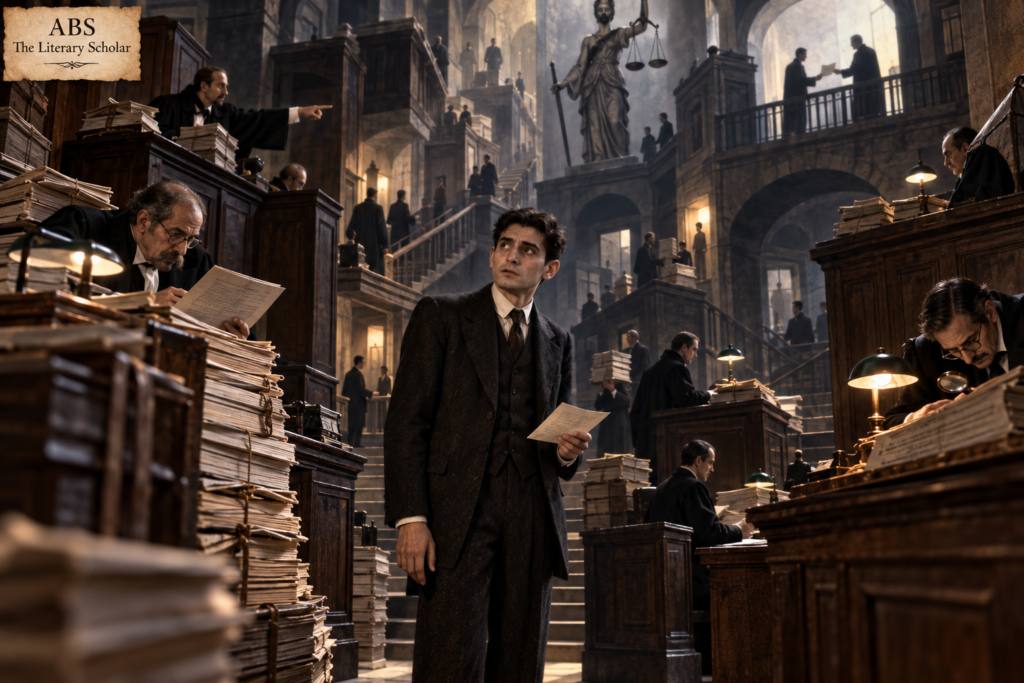
In The Trial, Josef K. wakes up one morning to discover that he has been arrested. The situation is immediately peculiar, because nobody tells him what crime he has committed. He is allowed to continue living his ordinary life, but he is now entangled in a legal process whose rules, authorities, and purpose remain maddeningly obscure. Kafka’s opening situation is a masterpiece of dark comedy. Imagine being arrested without being informed of the charge, then being expected to attend meetings, consult officials, and demonstrate a respectful attitude towards a court that refuses to explain itself. It is rather like receiving a notice that you have failed an examination for which the syllabus has not been published. Josef K. attempts to defend himself, but every effort to understand the system draws him deeper into its labyrinth. The court seems to exist everywhere and nowhere, operating through obscure rooms, inaccessible officials, and endless procedures.
Kafka exposes the terrifying power of institutions that do not need to prove their authority because their victims have already begun to believe in it. The most disturbing feature of The Trial is not simply that Josef K. may be innocent; it is that he gradually becomes absorbed in the logic of his own prosecution. He begins to organise his life around a charge he cannot identify. ABS finds here a painfully familiar human tendency: when confronted with an incomprehensible authority, we often spend more time trying to appear respectable before it than asking whether it has any right to judge us. Kafka’s court is therefore not merely a legal institution. It is a portrait of guilt, fear, and the human desire to obtain approval from powers that may never have deserved our obedience.
3. The Metamorphosis: When the Breadwinner Becomes the Family Problem
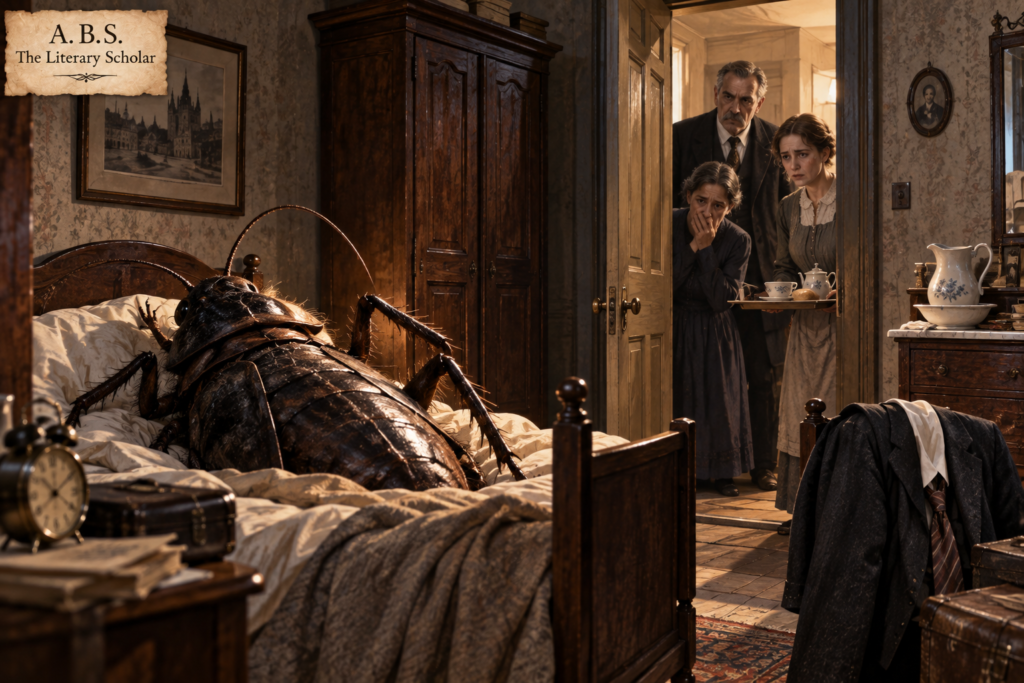
If The Trial begins with a man arrested for an unknown offence, The Metamorphosis begins with a travelling salesman waking up to discover that he has become an enormous insect. Gregor Samsa’s transformation is one of the most famous openings in literature, and Kafka presents it with a composure that is almost offensively practical. Gregor does not immediately ask the great philosophical questions. He worries about missing his train, displeasing his employer, and explaining his absence from work. Apparently, even becoming a monstrous insect does not automatically qualify one for a day off without questions from management. This is where Kafka’s humour becomes extraordinary. Gregor’s body has undergone a complete transformation, but his mind remains trapped in the routines and responsibilities of his former life. He is still concerned about earning money, supporting his parents, and protecting his family’s financial security.
His family, meanwhile, must confront the practical difficulties of having an insect in the household. The horror is not simply that Gregor has changed physically. It is that his value within the family appears increasingly connected to his ability to work and provide. Once he can no longer perform that function, affection becomes strained, embarrassment grows, and dependence turns into resentment. Kafka’s own difficult relationship with his father and his feelings of inadequacy provide an important background to this story, but Gregor is not merely a disguised version of the author. He embodies a much wider human predicament: the fear that love may be conditional upon usefulness. ABS believes that this is the true sting of The Metamorphosis. Gregor becomes an insect, but the people around him reveal something distinctly human, and not necessarily flattering, about themselves.
4. Why Did Kafka Write Such Strange and Disturbing Stories?
Why would a writer choose to place an ordinary man inside a nightmare and then refuse to provide an explanation? Why transform a dutiful son into an insect, or allow a respectable employee to be prosecuted by an invisible legal machinery? Kafka was not simply interested in frightening readers. He was exploring the anxieties of a world in which traditional sources of certainty were becoming increasingly unreliable. Modern life promised order, progress, professional success, and rational administration. Yet individuals often experienced these promises as new forms of pressure. The office demanded obedience, the family demanded sacrifice, society demanded respectability, and authority demanded compliance without necessarily offering understanding. Kafka recognised that modern power could be most frightening when it appeared perfectly ordinary. His characters are not usually confronted by spectacular villains. They encounter clerks, supervisors, relatives, messengers, and officials who may themselves be insignificant parts of a system nobody fully controls. This is precisely why the stories remain so unsettling. We cannot dismiss the danger as something belonging to a distant fantasy kingdom.
Kafka’s nightmares are constructed from familiar materials: a bedroom, a workplace, a family dinner, a court hearing. His fiction also reflects his complicated emotional life, including his troubled relationship with his father, his persistent self-doubt, and his sense of being an outsider. But Kafka’s achievement was to transform these personal tensions into stories that speak to readers far beyond his own circumstances. ABS would argue that Kafka wrote about the fear of being judged, the fear of becoming useless, and the fear that the rules governing our lives may be impossible to understand. His strange worlds are not escapes from reality. They are reality with the polite explanations removed.
5. The Kafkaesque World: Where the Joke Is on Us
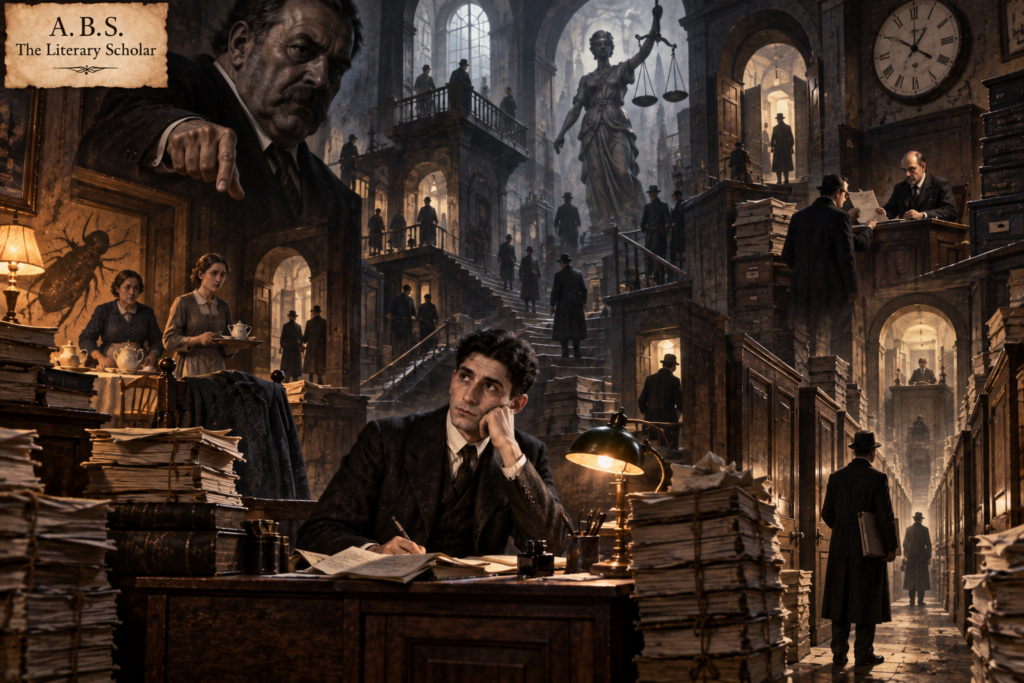
The word Kafkaesque has entered everyday language to describe situations that are absurd, oppressive, confusing, and governed by an authority that refuses to explain itself. Its popularity is understandable, although Kafka might have found it amusing that a writer who struggled with the world should eventually become an adjective used by the world to describe its own behaviour. In The Trial, Josef K. cannot discover the nature of his offence. In The Metamorphosis, Gregor Samsa cannot persuade his family to recognise the person who remains inside his altered body. Both characters experience a terrifying separation between their inner identities and the way others perceive them. Josef K. is reduced to an accused man; Gregor becomes an inconvenient creature. Their suffering reveals how easily human beings can be defined by labels, functions, and judgments imposed from outside.
Yet Kafka does not offer a comforting solution. He does not provide a heroic escape, a benevolent official, or a magical explanation that makes everything sensible again. His characters inhabit uncertainty, and readers must learn to endure it. This is where Kafka becomes especially valuable for students and literature enthusiasts. He teaches us to read beneath the surface of events, to question apparently reasonable systems, and to notice the emotional consequences of power. He also reminds us that humour can be a form of intellectual resistance. A laugh at an absurd authority does not necessarily defeat it, but it may prevent us from worshipping it. ABS believes that Kafka’s greatest achievement is not that he made the world appear strange. It is that he made us recognise how strange it had been all along. After reading him, even an ordinary form asking for three copies of a document may begin to look like the opening chapter of a very serious novel.
ABS Folds the Scroll
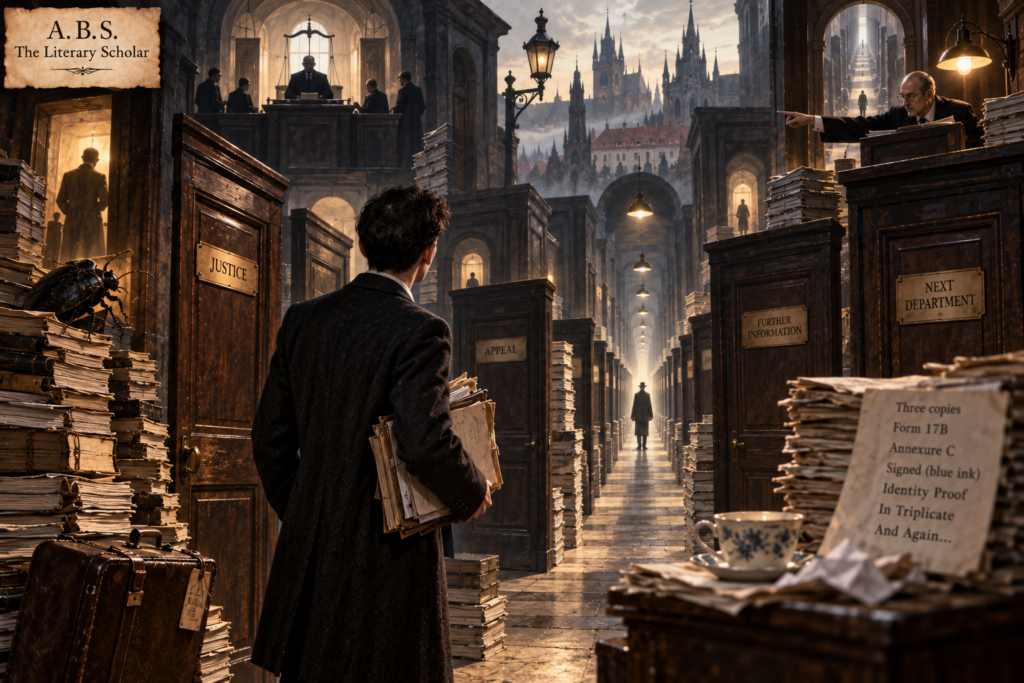
Franz Kafka gives us two unforgettable figures: Josef K., who cannot discover why he is guilty, and Gregor Samsa, who discovers that being useful may matter more to others than being human. One is trapped in a court; the other is trapped in his own home. Both are surrounded by people who seem to know the rules, although nobody can quite explain them.
Kafka’s genius lies in making the absurd familiar and the familiar absurd. He invites us to laugh, but never comfortably. His humour opens the door to questions about authority, family, identity, guilt, and the price of belonging.
Perhaps the most Kafkaesque moment of all is this: we finish reading his stories, close the book, and return to our ordinary lives, only to discover that the world has been behaving suspiciously like a Kafka novel.
And somewhere, an official is preparing another form.


Abha Bhardwaj Sharma is a Professor of English Literature with over 30 years of teaching experience. She is the founder of Miracle English Language and Literature Institute and the author of more than 50 books on literature, language, and self-development. Through The Literary Scholar, she shares insightful, witty, and deeply reflective explorations of world literature.
Share this post / Spread the witty word / Let the echo wander / Bookmark the brilliance