
Reflections on the Inner Light That Guides Us Through a Complicated World

The Moral Compass: Guiding Principles of Life
Life, as we know it, rarely comes with a manual. There’s no single rulebook, no flashing signboards to tell us when we are straying away from our values. And yet, somehow, we all carry within us a silent navigator, a set of beliefs, values, and principles that helps us steer through the stormy seas and sunlit shores of existence. We call it the moral compass.
Today, let us take a journey through that inner compass. Let us ask ourselves: What is morality? Why were we taught it so young? Why does it often clash with the world we grow into? And most importantly, does it still matter?
1. We All Begin in Stories
Remember those bedtime tales of rabbits and turtles, honest woodcutters and greedy kings, of fairies that reward kindness and demons that fall to their own vices?
These tales told in schoolrooms, at bedtime, around dinner tables were not just entertainment. They were ethical blueprints.
Morality was baked into our earliest understanding of life. We were taught that goodness is rewarded, hard work pays off, sharing brings joy, and truth always wins.
We believed that if we worked hard, told the truth, helped our friends, respected elders, and shared our chocolates, we were not just good children but destined for a good life.
Morality then was simple, clear lines, straight roads. Right was right. Wrong was wrong.
2. But Then, Life Grew Up
Life has a funny habit of handing us a different script.
As we stepped into adolescence and adulthood, the world slowly removed its fairy tale mask.
We saw classmates cheat and still top the charts. We watched the arrogant get applauded while the humble were overlooked. We heard lies win elections, manipulations win rewards, and shortcuts win races.
The world, we realized, is not always a rewarder of virtue.
The corrupt sometimes rise. The liars get applause. The ruthless become leaders. And suddenly, the black and white world of childhood seems like a quaint painting hung in a museum of forgotten ideals.
And so began the internal struggle, a pendulum swing between what we were taught and what we observed.
We asked ourselves:
Is morality practical?
Is goodness a luxury?
Have we been set up to fail in a world that does not play fair?
And worst of all: Is being moral even relevant anymore?
We wonder, are morals outdated? Are they relics of the past? Do they still belong in a world run by profit, power, and pretension?
This is the moral dissonance of modern life — the feeling that we are walking through two contradictory worlds, one of idealism and the other of survival.
But perhaps this confusion is not a problem. Perhaps it is the beginning of understanding what morality really is.
3. Morality is About Orientation, Not Control
Morality is not about perfection. It is not about martyrdom. And it is certainly not about living like saints in a world of sinners.
Morality, at its core, is about orientation — not control. It is about the direction we choose even when the world spins around us. It is about what kind of human we become, not what results we get. Because results come and go, positions rise and fall, but character stays.
And here is a secret: morality evolves.
Yes, morals are not commandments etched in stone. They are living, breathing ideas.
What was moral in one age may be questionable in another. In ancient times, conquest was valor. Today, it is oppression. At one time, silence was dignity. Now, it can be complicity.
So yes, morality adjusts with time — but it does not vanish.
Its core remains: the desire to do no harm, the ability to feel another’s pain, the urge to act with integrity even when no one is watching.
In fact, morality is not rigidity. It is kindness in action. It is empathy that breathes. It is the stillness that says, “Let me not be the reason for someone else’s sorrow.” That, dear friends, is timeless.
4. Morals are Not Fixed Stars
There was a time when speaking against elders was considered immoral. Today, it is called critical thinking. Once, following your heart was rebellion — now, it is called authenticity.
The core of morality remains, but its forms evolve.
Now, you might ask — how does this abstract idea help in daily life?
Let us bring this to the everyday.
You are in a shop. The cashier gives you extra change. Do you return it?
Your colleague is being gossiped about. Do you defend them or stay silent?
A street dog is limping in the rain. Do you walk past or help?
These are not grand decisions. But they are character decisions. Every act we take is a vote for the person we are becoming.
Morality is not about huge heroics. It is about tiny, invisible victories.
Every time you choose what is right over what is easy, you grow.
And when you go to bed at night, your conscience asks just one thing:
Did you stay aligned with your compass today?
5. The Everyday Heroism of Goodness
Every day, we are faced with a hundred decisions: do we return the extra change, do we gossip about a colleague, do we help a stranger even when we are running late, do we take credit for someone else’s work?
These decisions seem small, but they form the architecture of our soul.
People often say, “But being good does not get you far.” True, perhaps.
But being good gets you peace. And peace is no small prize.
When your head rests on the pillow at night, your soul knows what you did. The world may clap or criticize, but the soul — it whispers only the truth.
And when your actions align with that inner voice, that is when you are truly moral.
Morality does not mean weakness. It takes strength to stay silent when provoked. It takes courage to be honest in a dishonest room. It takes inner power to stay kind in a cruel world.
That is the heroism of the everyday — and it matters.
Morality should not be about rigid obedience to the past. It should be about living consciously in the present.
A moral compass is not about clinging to the rules of 500 years ago. It is about holding onto the spirit of humanity and applying it with wisdom.
Empathy, kindness, respect — these are not old-fashioned. They are ever-fashionable. Because they heal wounds, prevent harm, and strengthen human connection.
Because morality, at its heart, is about doing the right thing — and the right thing is often the kind thing.
Whether it is about standing up for the marginalized, respecting the environment, or treating animals with compassion — modern morality is no longer about rigid codes. It is about conscious living.
We now understand that empathy is moral, not a soft trait.
That honesty is a responsibility, not a burden.
That forgiveness is strength, not submission.
That love, the most misused word in the world, is actually the deepest moral of all — because love, in its purest form, can never harm.
And yet, it is not always easy.
Sometimes, doing the right thing comes at a cost. Saying no to dishonesty might mean saying goodbye to certain opportunities. Taking a stand might mean standing alone.
But every time you choose your values over convenience, your compass gets stronger, like a muscle.
That muscle — quiet, resilient, unshakeable — is what will carry you through every crisis the world throws at you.
6. The True North
Let me offer a metaphor.
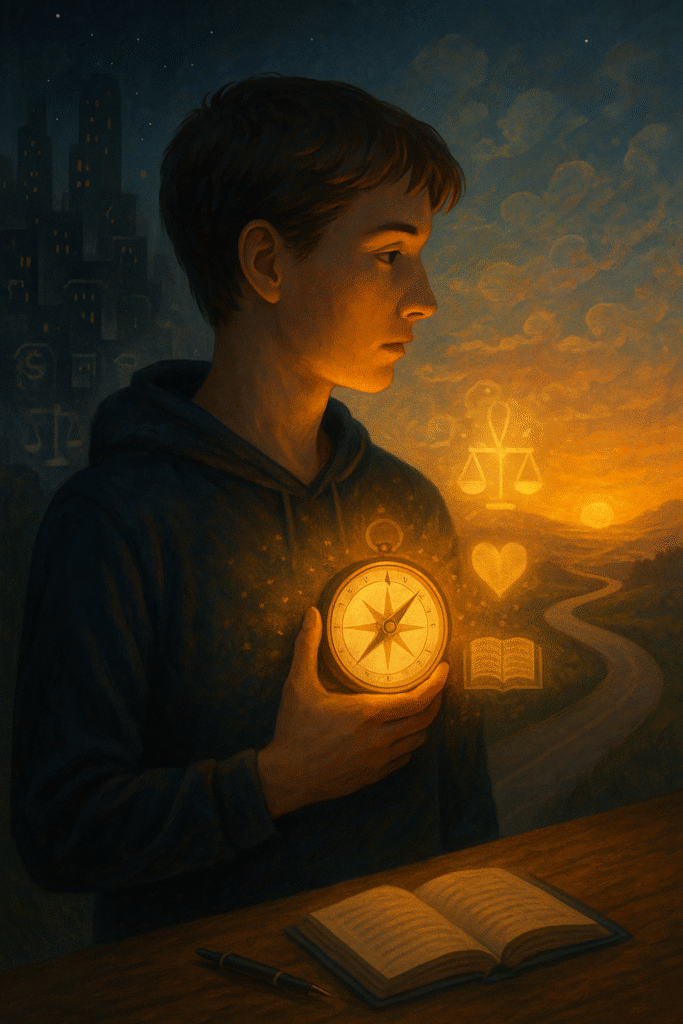
Morality is not the map. It is the compass.
Life does not give us a mapped-out plan. But a compass — that is ours to hold.
It will not tell you every turn, but it will keep pointing to your true north.
And what is this true north?
It is your conscience, that tiny, unshakable voice that says:
You are better than this,
You can be kinder,
You should not lie to yourself,
You must not harm another soul.
This moral compass connects us not just to society but to the soul itself.
You may escape the law, you may fool the world, but you cannot fool the soul.
Because at the end of the day, morality is not about society. It is about you and your soul sitting face to face.
And when you meet your own eyes in the mirror — can you hold your gaze?
That is the test of a moral life.
7. The Return
Let us be honest — none of us are saints.
We all slip. We all falter. We lie, we lash out, we regret.
But the point of a moral compass is not to be perfect — it is to return.
To return when you stray. To apologize when you err. To repair what you broke. To forgive yourself and grow.
That is the essence of being human.
We are not meant to be flawless. We are meant to feel, to learn, to evolve.
And morality — it is the gentle reminder that no matter how far you drift, you can always come back home.
Even on the most broken days, when you feel farthest from your ideals, just a single act of kindness, one honest word, one selfless gesture can bring you back into alignment.
That is the beauty of being human.
We may drift. But the compass is always there, quietly waiting.
8. The Light Within
So dear listeners, what then is the moral compass?
It is not a burden we carry — it is a light we kindle.
Sometimes dim, sometimes flickering, but always present.
It is built in us from childhood, questioned in youth, challenged in adulthood, and ultimately embraced in wisdom.
Yes, the world is unfair. Yes, it often rewards the wrong. But let us not let the world’s brokenness break our own center.
Morality is not about judging others. It is about being answerable to yourself.
It is not about shouting your goodness. It is about living quietly with honor.
And here is the quiet truth: The world may not always reward you for being good. But it will need you.
Because when everyone else is lost, they look for the ones with a compass.
So, hold on to yours.
Not because it is easy.
Not because it guarantees success.
But because it is right.
Because it makes you you.
And because, in the end, when the applause fades, when the noise settles, when the masks fall — the only thing left will be the integrity with which you lived.
Let that be enough.
Let that be everything.
Thank you for being part of this reflection with me.
May your compass stay strong.
May your journey be meaningful.
And may you always return to what is true.


Abha Bhardwaj Sharma is a Professor of English Literature with over 30 years of teaching experience. She is the founder of Miracle English Language and Literature Institute and the author of more than 50 books on literature, language, and self-development. Through The Literary Scholar, she shares insightful, witty, and deeply reflective explorations of world literature.
Share this post / Spread the witty word / Let the echo wander / Bookmark the brilliance