
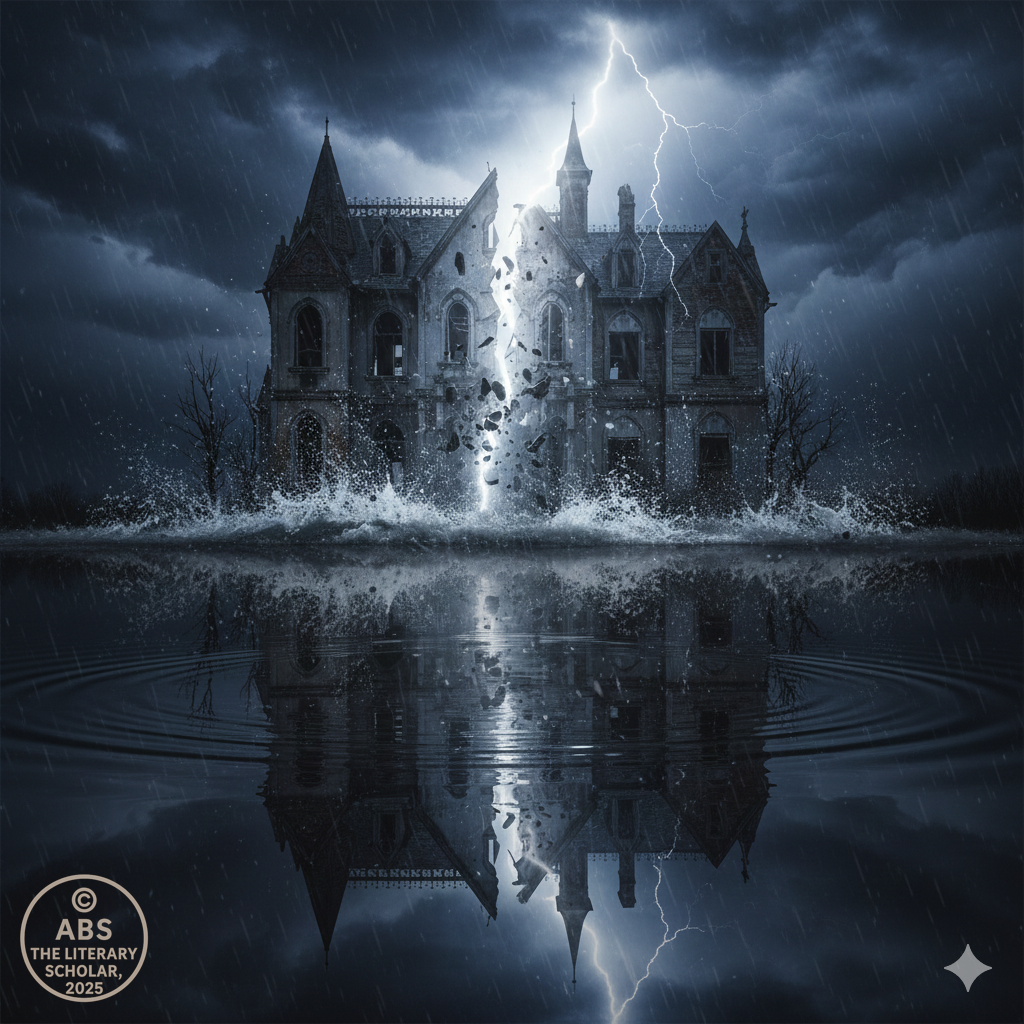
There are Gothic stories, and then there is The Fall of the House of Usher—a tale that doesn’t so much “begin” as it crawls up your spine and asks if you’ve paid your mental health bill this month. Before we dive into Roderick Usher’s personalized horror palace, let’s set the mood for this scroll. Think of this as your literary flashlight: it won’t save you from the darkness, but at least you’ll see what’s about to trip you.
Edgar Allan Poe remains the patron saint of beautiful dysfunction, and this story is his temple.
If you came here for comforting fireplaces and cheerful endings, I’m afraid you’ve walked into the wrong mansion. Here, cracks in the architecture are a metaphor, the weather is always in a mood, and every character looks as if they haven’t slept since the invention of the alphabet.
“Some houses shelter you. The House of Usher studies you, diagnoses you, and then waits for you to break first.”
This scroll is going to take you from Poe’s deeply complicated life to his masterpiece of collapse—both physical and psychological. We’ll stroll through the author’s ghosts (he had plenty), then wander into the history of the story itself: where it came from, when it was published, and how it ended up becoming the Gothic blueprint for “my house is trying to kill me.”
Once the ground is laid, we’ll walk through a full, detailed summary—not the school-textbook one that reads like someone chewing dry chalk, but a vivid retelling where Usher’s neuroses and Madeline’s eerie silence feel disturbingly alive. You’ll see the narrator arrive, the mansion brood, the siblings deteriorate, and finally the house do what any self-respecting Gothic mansion would do in a crisis: implode dramatically.
But this scroll isn’t stopping at storytelling. Oh no—Poe would be disappointed if we didn’t poke the corpse intellectually.
We’ll pull the story apart with thematic analysis (madness, decay, fear, duality), stylistic appreciation (Poe’s lush sentences, rhythmic dread, symbolic overkill but in a good way), and critical interpretations ranging from psychological to architectural to “Poe really needed therapy.”
“Poe writes terror the way surgeons handle scalpels—calm hands, cold precision, and no apology.”
Expect rich paragraphs, blunt truths, clever punches, and the occasional sarcastic slap against Gothic melodrama.
And yes, as promised, picture prompts will appear throughout the scroll—carefully timed, not thrown in like confetti. They’ll visualize the decaying mansion, the pale Usher twins, the symbolic gloom, and that famous final collapse into the tarn.
By the end, you should understand not only what the story says, but what it means, why it has survived nearly two centuries, and why readers keep returning to this crumbling nightmare like it’s a toxic relationship they can’t quit.
“The House of Usher doesn’t fall. It waits, it whispers, and then it sinks with the satisfaction of a building that finally had the last word.”
If Gothic fiction is a banquet of shadows, then this story is its main course—served cold, unsettling, and subtly philosophical. So unfold the scroll, steady your nerves, and walk with me through Poe’s collapsing corridors.
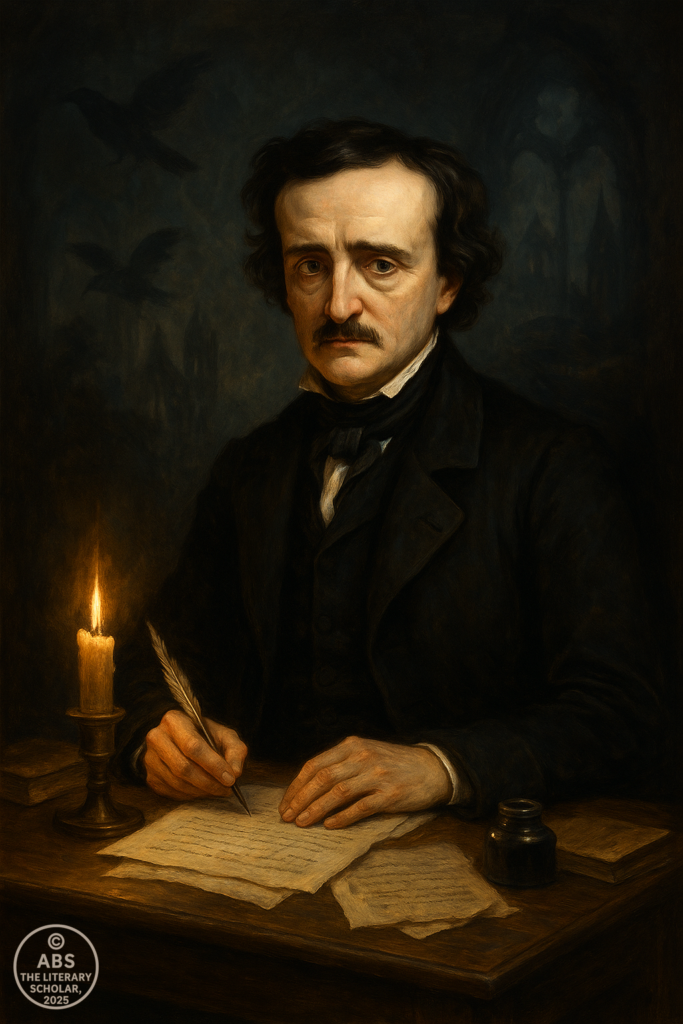
Before we unpack the Usher family’s emotional demolition, let’s meet the man who practically industrialized psychological misery into literature: Edgar Allan Poe. If life were a school project, Poe is the kid who was handed a broken chart paper, a leaking glue bottle, and half a crayon, and still delivered something the entire class whispered about for years.
Born in 1809, Poe lost his parents before he could even pronounce the word “trauma.” The foster parents who took him in loved him but argued with him constantly, especially about money—because Poe was a champion at not having enough of it. He studied briefly, dropped out spectacularly, fought with father figures like it was an Olympic sport, and then decided the best way to earn a living was… writing. Naturally, fate laughed hard.
Yet here’s the joke: out of this chaos came one of the most distinctive literary minds in American history. Poe didn’t just write dark tales; he engineered them. His theory of the “unity of effect” insisted that every word should push the story toward one emotional destination. No filler. No lazy wandering. Pure, intentional unease.
“Poe didn’t find darkness. Darkness found Poe, pulled up a chair, and the two began collaborating.”
Let’s talk range.
This is the man who wrote “The Raven,” turning a bird into the world’s most inconvenient therapist.
He created the modern detective story with “The Murders in the Rue Morgue,” making Sherlock Holmes possible before Sherlock existed.
He produced horror classics like “The Tell-Tale Heart,” “The Black Cat,” “The Masque of the Red Death,” and several short stories that make you wonder if he had a subscription to weekly nightmares.
His poems drip with mourning. His prose burns with anxiety. His narrators are always one nervous breakdown away from a cautionary tale.
And then there’s his personal life, which reads like the prequel to a Gothic novel. He married his 13-year-old cousin Virginia, loved her fiercely, and watched her die slowly of tuberculosis. That grief carved him open, and literature is where he bled. His career was a series of spectacular highs and even more spectacular lows. If professional stability were a building, Poe was constantly standing outside it, drenched in rain, writing about the weather.
“If suffering built character, Poe had enough to construct an entire Gothic mansion.”
So how does The Fall of the House of Usher fit into Poe’s creative universe?
It is Poe at his sharpest, his coldest, his most exquisitely controlled. It’s not just a Gothic story; it’s the X-ray of a breaking mind. Poe treats the house as a character, the siblings as psychological metaphors, and the narrator as an observer who slowly realizes he signed up for more than a friendly visit.
This story is an intersection of everything Poe did best:
atmosphere,
symbolism,
psychological disintegration,
and that slow, delicious dread he ladles out like a chef who knows his customers enjoy suffering.
Poe’s genius lies in how he merges the external landscape with the internal mind. When a house collapses in his fiction, it’s not property damage. It’s a personality diagram.
“Every Poe story is a confession disguised as architecture.”
And in case you’re wondering whether he lived long enough to enjoy his fame—he absolutely did not. Poe died mysteriously in 1849, found delirious in Baltimore, wearing someone else’s clothes. His obituary was written by a professional enemy. His finances were a disaster. His reputation was shredded.
And yet, here we are—still reading him, still teaching him, still creeping ourselves out with the psychological fossils he left behind.
If that isn’t literary immortality, nothing is.
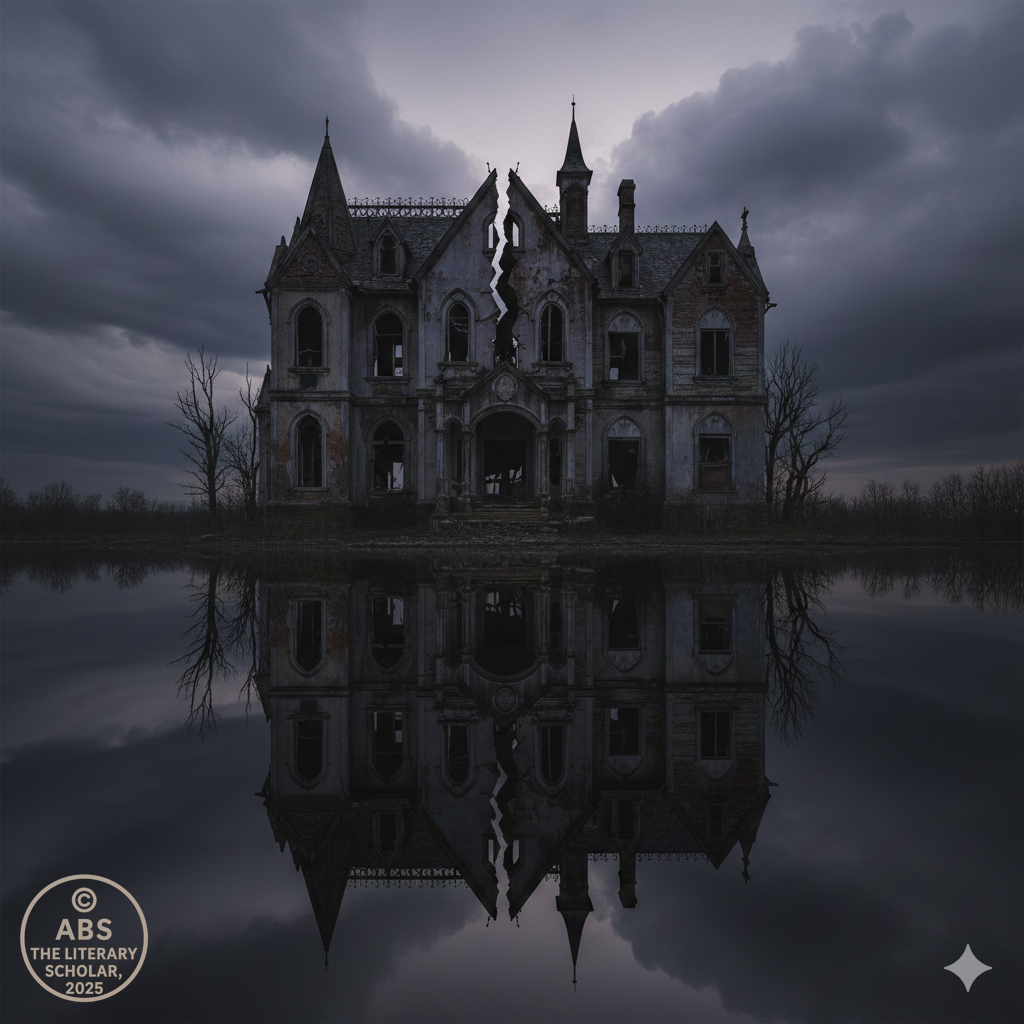
THE FALL OF THE HOUSE OF USHER
Before we wander into the mansion that looks like it failed every architectural and psychological inspection, let’s look at how The Fall of the House of Usher came into the world. Spoiler: it didn’t stroll in gracefully. It slithered.
The story was first published in 1839 in Burton’s Gentleman’s Magazine, a periodical with a title so polite it almost hides the fact that Poe was slipping nightmares between its pages. A revised, sharper version appeared in 1845, because Poe was the kind of perfectionist who edited even his horrors until they gleamed.
So what was happening around Poe when this story erupted?
The nineteenth century was experiencing a collective identity crisis. America was pretending not to copy Europe, Europe was busy reinventing Gothic gloom, and everyone was secretly fascinated with death, illness, mesmerism, and the possibility that the mind could betray itself. Poe, being Poe, didn’t just follow the trend. He built the psychological basement where the trend now lives.
“Gothic fiction gave the world ruins. Poe gave the ruins a nervous system.”
The Gothic tradition had already introduced readers to gloomy castles, cursed families, and moody landscapes that behave like disgruntled relatives. But Poe pushed Gothicism inward. Instead of giving us a ghost floating down a hallway, he gave us a mind that thinks the hallway is haunted. Instead of supernatural monsters, he gave us fear itself as the villain.
When Poe sat down to craft The Fall of the House of Usher, he wasn’t telling a simple ghost story. He was constructing an atmosphere where the house mirrors the human mind, the weather mirrors the emotions, and every sigh, shadow, and structural crack whispers politely, “Run.”
The story belongs to what scholars lovingly call his “tales of the grotesque and arabesque,” a label Poe accepted because he knew it made him sound like an artistic acrobat of darkness. This collection focused on subtler terrors—the kind that don’t jump out at you but slowly make you question your breathing.
Here, Poe uses the Gothic mansion not as scenery but as a psychological portrait.
The Usher family isn’t simply cursed; they’re decaying. Their home isn’t merely old; it’s sentient in the quietly judgmental way only Gothic homes can be. Every stone, window, and fungus patch seems threaded to Roderick Usher’s collapsing sanity.
Why this story matters—and why it still cuts deep after nearly two centuries—is because it captures something universal:
that creeping fear that the environment around you is reflecting the instability within you.
“Most Gothic stories show you the monster. Poe makes you wonder if the monster is just you on a bad day.”
Historically, this tale stands as one of the most polished Gothic expressions in American literature. No melodrama, no cheap thrills, no unnecessary ghosts. Just atmosphere so thick you could bottle it and sell it as perfume for depressed castles.
And then there’s the twin dynamic of Roderick and Madeline, which critics have read as everything from split personality to doomed lineage to the physical and mental halves of one diseased whole. Poe wasn’t about to explain any of this directly, of course. He drops clues like breadcrumbs in a haunted forest and leaves readers to decide whether they want to escape or understand.
By the time the story ends—house sinking into the tarn like a dramatic diva exiting the stage—you realize Poe has not just narrated a family tragedy. He has illustrated the complete collapse of identity, sanity, and structure itself.
This is why teachers still teach it. This is why critics still analyze it. And this is why readers, even today, sit there thinking, “This mansion needs therapy.”
Poe didn’t invent Gothic terror. He upgraded it.
And Usher is his most sophisticated upgrade.
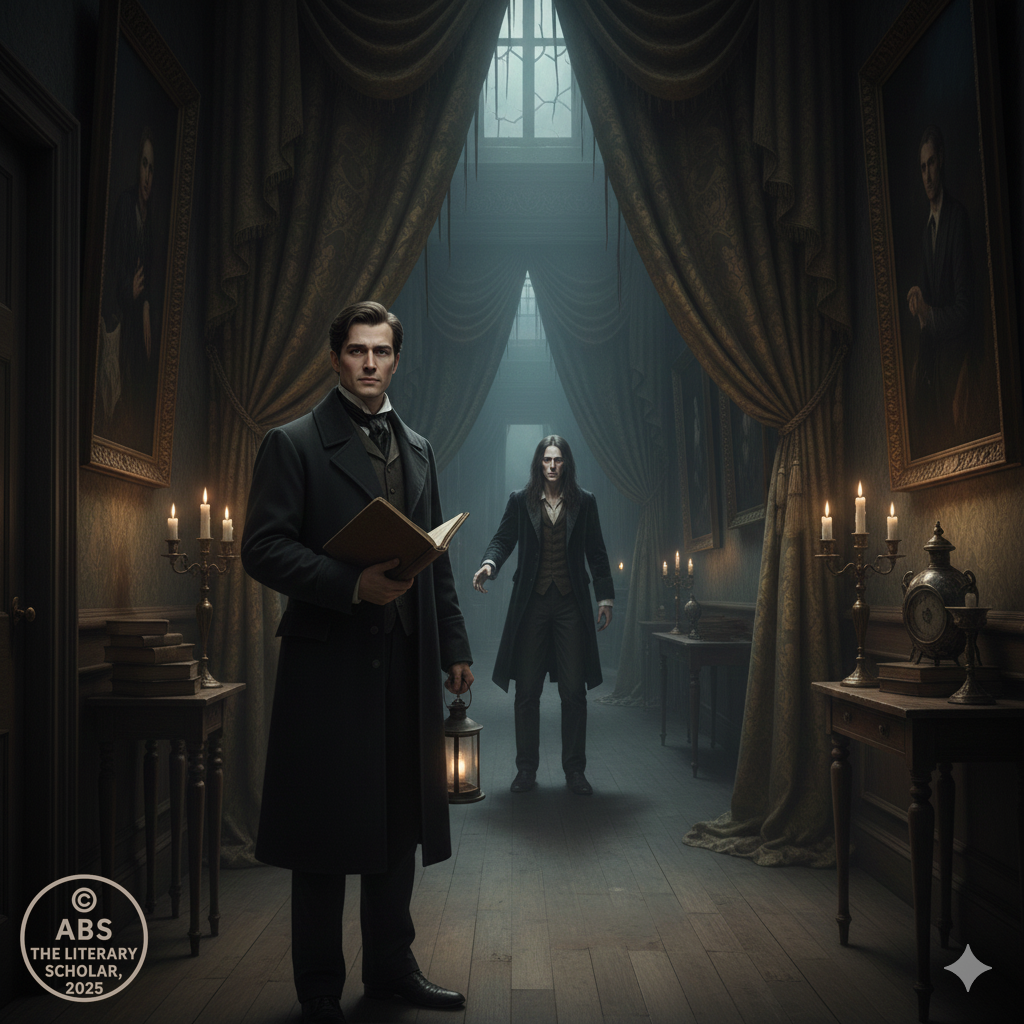
DETAILED SUMMARY — THE FALL OF THE HOUSE OF USHER
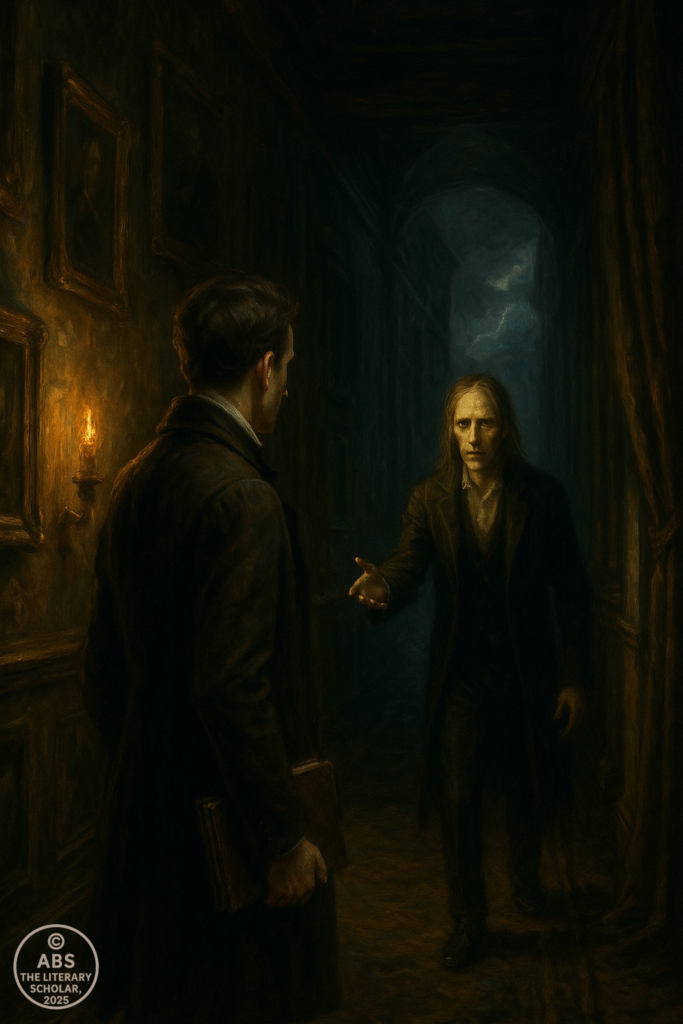
If a therapist ever needed a case study in architectural depression, Poe’s story would save them years of research. The plot begins when our unnamed narrator receives a letter from his childhood friend Roderick Usher, a man so mentally frayed he might qualify as a full-time Gothic landmark. The narrator, being either loyal or catastrophically naïve, decides to travel to the Usher estate. This is his first mistake.
As he approaches the mansion, he doesn’t see a home. He sees a moody stone corpse pretending to be real estate. The place is draped in gloom, dripping with decay, and sporting a thin crack running down its façade—subtle, like a headache that threatens to become a life crisis.
“The House of Usher doesn’t welcome visitors. It evaluates them as potential co-sufferers.”
Arrival: Where Hope Goes to Die Politely
Inside, the narrator finds Roderick looking like he’s been living off candlelight and existential dread. His skin is ghostly, his senses are painfully acute, his nerves laugh at the idea of stability, and his emotional equilibrium is one sneeze away from collapse. He explains that he suffers from a hereditary nervous disease, which in modern terms translates to: my mental health is doing backflips.
Also present—though barely—is Madeline Usher, Roderick’s twin sister. She appears once, drifting through the room like a silent omen, and then retreats into her elaborate catalogue of mysterious symptoms. Modern readers would diagnose her within minutes; Poe prefers to keep her illness floating in that Gothic zone where medicine and myth shake hands awkwardly.
Roderick’s Meltdown Begins (and Never Stops)
The narrator tries his best to cheer Roderick up. He reads to him. He listens to him play strange, haunting music. He nods supportively as Roderick rambles about sentient houses and sympathetic stones, which is when you know the friendship has reached an uncomfortable point.
The house itself feels alive—or at least, alive enough to judge everyone inside it. The air is thick, the rooms suffocating, the corridors endless. Even the furniture looks like it’s carrying emotional baggage.
“In the Usher mansion, even the wallpaper needs therapy.”
Madeline Dies… Probably… Maybe… Okay, Not Really
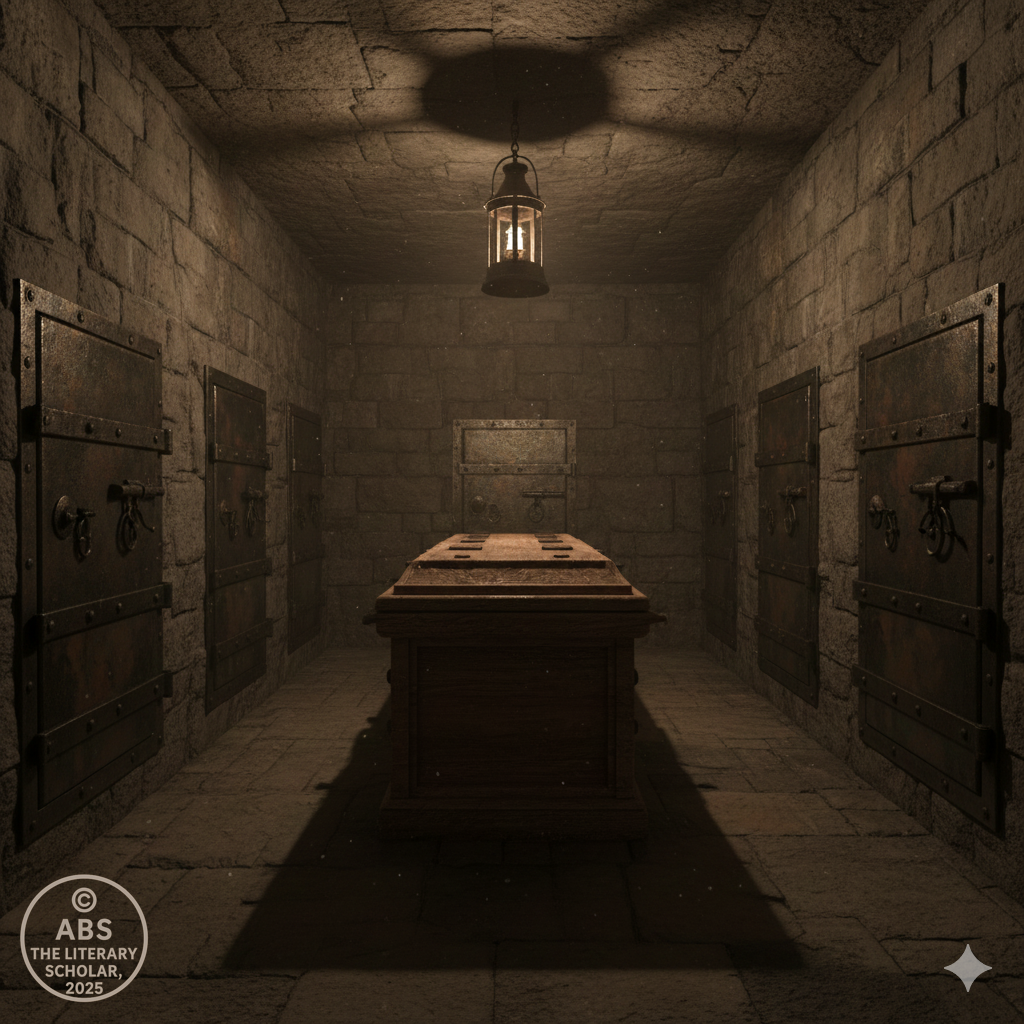
Eventually, Madeline “dies.” I put that in quotation marks because Poe practically screams, This woman is not fully dead, but the characters don’t seem to hear him. Roderick insists she should be placed in a coffin and sealed in a vault inside the house because he fears doctors might dig her up or, worse, gossip.
The narrator helps carry her body down. During this intimate Gothic workout session, he notices an alarming detail: Madeline’s cheeks are rosy, her body warm, her muscles rigid—not exactly textbook death. But he keeps quiet. As one does in haunted houses.
The vault is sealed. Hope is not.
The House Starts Making Noises (Because What Else?)
As days pass, Roderick deteriorates even further. He stops sleeping. He hears sounds. He jumps at shadows. He looks like a prophecy of his own funeral. The narrator tries reasoning with him, but rationality is allergic to Usher property lines.
A storm arrives—the overly dramatic Gothic kind that makes you wonder if nature also read the script. The narrator decides to distract Roderick with a reading from The Mad Trist, a fictional romantic adventure tale. Unfortunately, everything the narrator reads seems to occur simultaneously in the house.
He reads about a knight breaking down a door. A loud cracking noise echoes in the mansion.
He reads about a dragon’s shriek. There’s a horrifying moan from the vault below.
He reads about metallic clanging. The house says “Let me contribute.”
Roderick finally confesses what he’s known all along:
Madeline was buried alive.
And now she’s coming.
“Nothing brings siblings together like a premature burial followed by revenge.”
The Climax: Madeline Enters the Chat
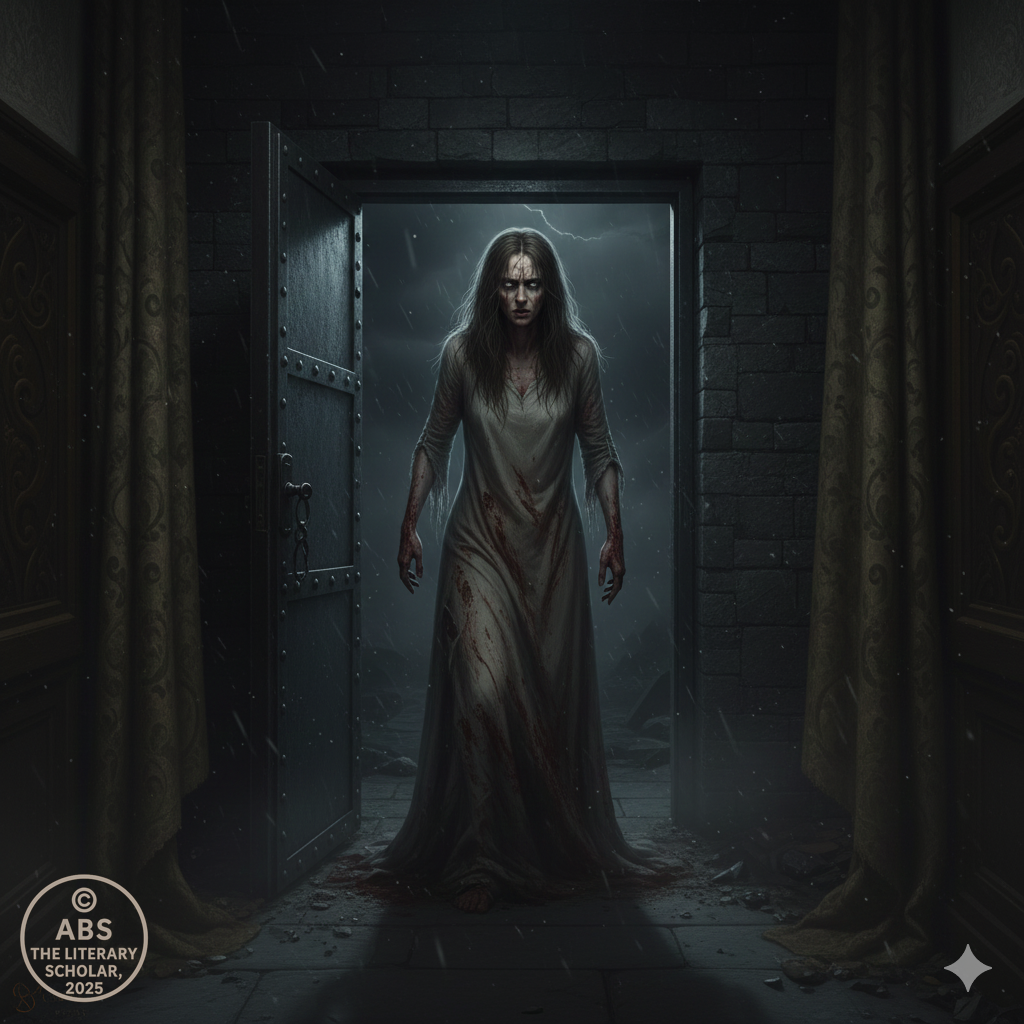
As if summoned by dramatic timing itself, Madeline appears. She collapses onto Roderick, drenched in blood, her body bearing the marks of struggle. The twins fall to the floor—he from terror, she from exhaustion—and die together, fulfilling their strange, unhealthy bond.
At this point, the narrator finally does something sensible: he runs.
The Final Fall
Outside, he turns back just in time to witness what generations of Gothic architecture students call the best dramatic exit in literature.
The fissure in the house widens, the entire mansion cracks open, and the structure collapses into the tarn below. Water closes over it like nature saying, “Enough.”
“The bloodline ended. The house followed. Symmetry achieved.”
And that, in essence, is the story.
A nervous narrator visits a mentally collapsing friend, watches a woman accidentally buried alive, witnesses the worst sibling reunion in history, and escapes just before the mansion performs its grand finale.
The plot works because Poe doesn’t rely on jump scares. He relies on atmosphere, psychological tension, and the haunting suspicion that the real monster isn’t the house or the illness—it’s the mind that interprets both.

CHARACTER STUDY & CHARACTERISATION — THE FALL OF THE HOUSE OF USHER
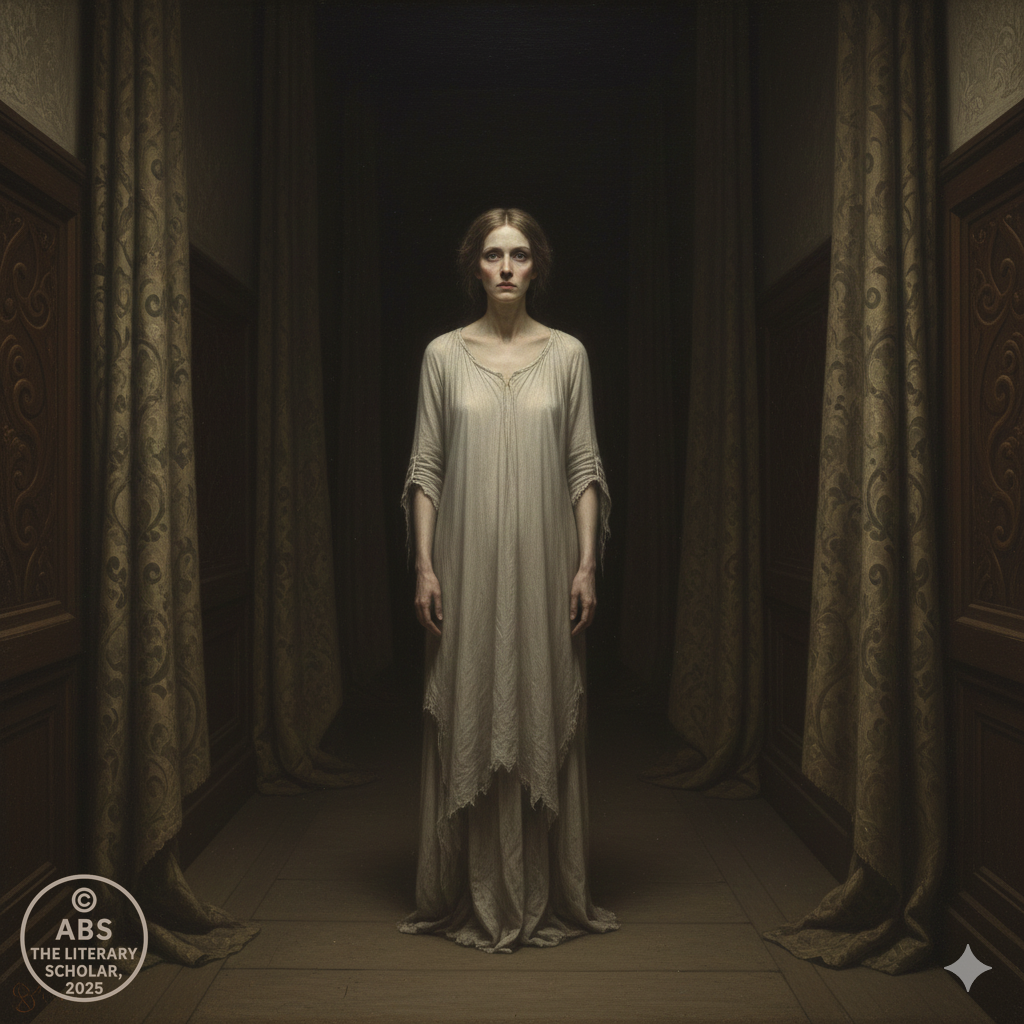
Character lists often read like census documents. Poe’s characters refuse to behave that politely. In this story, everyone—yes, all three of them—arrives with enough psychological luggage to sink a ship. Let’s break them down before they collapse on their own.
1. Roderick Usher — The Human Representation of a Nervous Breakdown
Roderick Usher is what happens when hypersensitivity, family trauma, artistic genius, and chronic isolation rent a flat together inside a single human brain. He is pale, trembling, poetic, and perpetually convinced the world is on the verge of ending—which, ironically, turns out to be accurate.
He suffers from:
Hyperacute senses (light hurts him, sound tortures him, textures offend him)
Extreme anxiety
Degenerative mental instability
Hereditary doom (the Usher family’s unofficial surname)
He is a painter, musician, and poet, but instead of expressing creativity, his art expresses collapse. His songs are dirges. His paintings are nightmares. His speech sounds like a TED talk delivered during an emotional crisis.
“Roderick Usher doesn’t think the house is alive. He knows it is alive, and that’s worse.”
His defining flaw is paralysis. He overthinks, overworries, overwaits—and finally gets overwhelmed. Even when he senses he has buried his sister alive, he does nothing.
He is not evil. He is simply a man consumed by his own mind.
The house doesn’t kill Roderick.
His fear does.
2. Madeline Usher — The Silent, Terrifying Heartbeat of the Story
Madeline appears only a handful of times, but she dominates the narrative like a ghost supervising her own funeral.
Her characteristics:
Silent
Mysteriously ill
Cataleptic (prone to deathlike trances)
Symbolic of the physical self—suppressed, controlled, then violently resurrecting
Her silence is not weakness; it is menace. Her stillness is not passivity; it is tension. Poe uses her like a loaded gun lying quietly on the table, waiting for the final scene.
Her premature burial is not just a plot twist—it’s the central metaphor.
Everything the Usher family suppresses—emotion, mortality, the feminine, the body—gets shoved into that vault with her.
And naturally, it bursts out.
“Madeline speaks once. She speaks through action. And her message is: ‘Surprise, you can’t bury consequences.’”
Her final appearance is both tragic and triumphant. She collapses onto Roderick in a grotesque embrace—death reconciling with the living, the body reclaiming the mind. Her death completes the symbolic cycle.
3. The Narrator — The Calm Friend Who Should Have Booked a Hotel
Our narrator is the story’s most entertaining liar. He insists he is rational, balanced, and unafraid. Meanwhile, he’s having hallucinations, panic attacks, and psychological disintegration at the exact same pace as the Ushers.
His characteristics:
Educated, polite, emotionally repressed
Claims objectivity he absolutely does not have
Attempts to “help” Roderick with reading, logic, and gentle denial
Gradually succumbs to the atmosphere
He begins as a visitor.
He ends as a survivor.
Poe gives him no name because:
He represents the outside world entering the closed Usher system.
He becomes the reader’s consciousness inside the nightmare.
His anonymity keeps him psychologically flexible—someone who can break without the plot needing to justify it.
His greatest character moment is recognizing danger about twelve seconds before the mansion collapses. Congratulations to him for finally choosing self-preservation.
“The narrator isn’t brave; he’s slow at understanding when to run.”
4. The House — Yes, a Character. Deal With It.
If you think the mansion is just scenery, you haven’t been paying attention. The house has more personality than either twin at the beginning of the story.
Traits of the House:
Alive-ish
Responsive
Decaying beautifully
Emotionally manipulative (architecture shouldn’t influence mood this aggressively)
Linked to the Usher bloodline
The house mirrors its owners:
Cracks in the family
Cracks in the walls
Rot in the bloodline
Rot in the timber
Emotional collapse
Structural collapse
When the Ushers die, the house doesn’t wait politely. It performs a dramatic finale worthy of a Gothic opera, sinking into the tarn with an attitude that says, “My work here is done.”
“Name me one other mansion that times its death perfectly with its owners’. Exactly.”
Characterisation Bottom Line
Poe’s characters are not individuals—they are psychological states wearing human shapes.
Roderick is the mind collapsing inward.
Madeline is the body rising outward.
The narrator is reason losing stamina.
The house is identity cracking under pressure.
Together, they form one of literature’s most elegant Gothic breakdowns.
THEMATIC ANALYSIS — THE FALL OF THE HOUSE OF USHER
If Poe had one talent besides tormenting his narrators, it was crafting themes that behave like invisible traps. The Fall of the House of Usher isn’t just a story about a creepy mansion and two emotionally unstable siblings. It is a fully equipped psychological laboratory disguised as real estate. Every theme slips in quietly, then wraps itself around you like fog that refuses to mind its own business.
Let’s break down the major obsessions Poe plants in the tale.
1. Madness: The House Always Wins
Roderick Usher is not merely unwell; he’s practically auditioning for the role of “Human Symbol of Anxiety.” His heightened senses, trembling nerves, and catastrophic imagination reveal a mind in free fall. His madness isn’t sudden. It’s curated. Polished. Almost artistic.
“Poe doesn’t write madness as chaos. He writes it as architecture.”
The real genius here is the narrator. He insists he’s sane—because nothing says mental stability like volunteering to stay in a house that feels like a mood disorder. His denial becomes the second thread of madness. Poe loves unreliable narrators because they let the reader experience the horror without ever identifying a clean culprit. Is Roderick mad? Yes. Is Madeline a ghost? Maybe. Is the narrator losing it? Probably.
Is the house alive? Don’t worry, we’ll get there.
2. Decay: Physical, Psychological, Familial
From the moment the narrator sees the Usher mansion, it radiates perfectly coordinated rot. The walls crumble. The tarn is stagnant. The air is stale. Even the windows look like they’re judging you.
This is not background decoration. Poe weaponizes decay.
The Ushers themselves are a dying bloodline. Their physiology is failing. Their minds are thinning. Their family tree is a single branch desperately pretending it’s still a tree.
“When Poe writes decay, he doesn’t mean old age. He means the slow, elegant collapse of everything that once mattered.”
The house decays with them, not in parallel but in synchrony. Their deaths trigger its fall. Their lives sustained it. This connection is deliberate and unnerving.
3. Duality and the Twin Motif
Roderick and Madeline aren’t just siblings. They’re two halves of one diseased identity. He represents intellect—hypersensitive, anxious, spiraling. She represents the body—silent, suffering, suppressed.
Her premature burial reflects how Roderick buries his physical fears. Her return is the violent rebellion of everything he tried to silence.
The fact that they die together is not poetic justice. It’s symbolic reunion.
The crack in the house? Same deal. A visual metaphor for the split self.
“In Usher world, a fissure is never just a fissure. It’s therapy notes written on stone.”
4. Fear: The Self-Fulfilling Prophecy
Roderick doesn’t fear death. He fears fear itself. He anticipates disaster with such intensity that he essentially summons it. Every sound becomes a threat. Every movement feels like a conspiracy.
Poe demonstrates how fear distorts perception. The narrator begins to hear what Roderick hears. He sees what Roderick sees. By the final night, both men are captives of anticipatory terror—fear before the event, fear summoning the event, fear magnifying the event.
Madeline’s arrival becomes inevitable because the story has been preparing for her from the start.
5. The House as the Psyche
If you take this story literally, the mansion is haunted.
If you take it symbolically, the mansion is Roderick.
Its structure mirrors his mind.
Its decay mirrors his illness.
Its final collapse mirrors his death.
Even the infamous fissure represents a crack in his sanity—growing, widening, threatening to split everything apart.
“The House of Usher doesn’t fall. It breaks the moment the mind that sustains it finally gives up.”
Poe’s brilliance lies in making the house feel animate without proving anything supernatural. He’s not interested in ghosts. He’s interested in the possibility that the environment absorbs emotional energy like a deranged sponge.
6. Isolation: The Silent Killer
The Ushers live alone. They have no friends. No society. No new bloodlines. No grounding force. Their isolation exaggerates every weakness and turns every thought into an echo chamber.
Even the narrator, the only outsider, begins to lose his sense of proportion within days.
Isolation doesn’t just kill the Ushers; it distorts them into the perfect Gothic tragedy.
Thematic Bottom Line
Poe isn’t writing a horror story for jump-scare tourists. He’s writing a meditation on what happens when the mind collapses under the weight of itself. The Gothic is merely the stage; the psychology is the plot.
This is why The Fall of the House of Usher refuses to age. Every generation recognizes its own fears inside this mansion—its own cracks, its own suppressed halves, its own dread of collapse.
“Usher isn’t about ghosts. It’s about the fear that the real ghost is the self.”
CRITICAL APPRECIATION — THE FALL OF THE HOUSE OF USHER
Let’s be honest: Poe didn’t simply write a Gothic story. He engineered a psychological pressure chamber and wrapped it in poetic architecture. The Fall of the House of Usher is one of those rare works where every detail is calibrated, every sentence carries weight, and every image whispers, “This is not going to end well.”
Time for the deep dive.
1. Gothic Atmosphere: Poe at His Pettiest Best
Most Gothic writers sprinkle darkness like seasoning. Poe dumps the whole container on your plate and stares at you until you swallow.
The atmosphere here is a masterclass:
The tarn: still water that clearly knows too much.
The mansion: crumbling dignity pretending it still hosts dinner parties.
The corridors: long enough to develop existential doubts.
The air: thick enough to chew.
Nothing in this landscape is neutral. Everything feels infected with emotional residue.
“Poe’s atmosphere doesn’t set the mood. It hijacks the nervous system.”
This is why the story remains a Gothic benchmark. Even Stephen King bows to what Poe does here: fear that is built, not borrowed.
2. Symbolism: Poe’s Favourite Playground
If Poe had a hobby, it was symbolism—preferably the ominous kind.
The House
Not a building. Not a location. A metaphor wearing bricks. It is the Usher bloodline. The Usher psyche. The Usher doom.
It rots with them. It breaks with them. It dies with them.
The Crack in the Wall
Subtle? No. Effective? Absolutely.
It represents:
Splitting identity
Familial fragmentation
Roderick’s fractured mind
The inevitable collapse of both structure and self
Poe doesn’t hide this symbol; he plants it boldly because he knows the reader will need it later when everything comes crashing down.
Madeline
A living symbol of the body, suppressed, silenced, buried prematurely—yet impossibly persistent.
When she rises from the vault, it’s not just a Gothic shock. It is the body demanding recognition from the tyrannical mind.
“In Poe’s world, what you bury returns—with interest.”
3. Narrative Technique: The Unreliable Narrator Who Swears He’s Fine
Our narrator insists he’s calm, rational, grounded. Then he spends days in a house that screams “Leave!” and doesn’t leave.
Poe uses him as a mirror:
To contrast Usher’s theatrical decay with “normalcy”
To show how quickly normalcy dissolves
To trap the reader in the same psychological maze
The narrator’s descent is subtle but inevitable. By the time Madeline appears, even he is primed to snap.
This isn’t storytelling. It’s psychological manipulation disguised as hospitality.
4. Unity of Effect: Poe’s Signature Weapon
Poe believed a story should create one dominant emotional impact.
Here, the chosen effect is inescapable dread.
Every line contributes:
The opening bleak description
Roderick’s trembling voice
Madeline’s ghostlike presence
The storm
The echoing sounds
The final collapse
Nothing is wasted. Nothing is random. Poe cuts away every distraction until only dread remains.
“Poe doesn’t build suspense. He marinates you in it.”
5. Style: Syntax That Sweats Anxiety
Poe’s sentences are lush, rhythmic, and heavy with description. They linger. They echo. They expand until the reader feels the weight of the mansion inside the chest.
Modern readers sometimes complain they are “too long.” Those readers are wrong.
The style is the experience. The prose itself imitates Roderick’s overwhelming mental world.
His language is the literary equivalent of walking through a thick velvet curtain you can’t quite push aside.
6. Embedded Narrative: ‘The Mad Trist’
Poe inserts a story within the story—not as decoration but as an amplifier.
As the narrator reads this medieval romance aloud, its events sync eerily with the sounds in the mansion.
This creates:
Irony
Tension
Foreshadowing
The sense that fiction is bleeding into reality
The technique is brilliant because it blurs boundaries. Are the sounds real? Are they imagined? Is the story predicting the collapse? Poe offers no answers because ambiguity is his love language.
7. The Ending: A Collapse Worthy of Theatre
When the house falls into the tarn, the symbolism is complete.
The Usher line ends.
The structure ends.
The psyche ends.
Nothing remains but water rippling over destroyed identity.
“Few authors can kill a mansion with such poetic precision.”
The ending is satisfying not because it resolves mysteries, but because it fulfills the emotional trajectory. This was always a story heading toward implosion.
Critical Bottom Line
Poe’s genius lies not in the plot but in how he executes it—with atmospheric density, symbolic layering, psychological depth, and stylistic commitment that feels almost obsessive.
The story remains timeless because it taps into universal fears: collapse, isolation, madness, and the terrifying suspicion that the environment is quietly reflecting your mind.
CRITICAL INTERPRETATIONS — DEEPER READINGS OF THE FALL OF THE HOUSE OF USHER
If Poe thought he was writing a compact Gothic tale, the academic world politely disagreed and said, “Sweetheart, you just opened a buffet of interpretations.”
This story is a playground where critics swing, scholars scream, and students pretend to understand everything for internal marks.
Let’s break down the biggest interpretive readings.
1. Psychological Interpretation: The House as a Diseased Mind
This is the reading that professors love because it makes them feel like therapists with tenure.
According to this school of thought, Roderick’s mental breakdown is not merely an individual issue—it’s the blueprint for interpreting the entire story. Every architectural detail is a neuron misfiring. Every shadow is a suppressed anxiety. Every crack is a cognitive glitch.
The final collapse of the mansion becomes the metaphorical destruction of the psychic structure holding Roderick together.
“Roderick doesn’t live in the house. He is the house.”
Madeline represents everything Roderick refuses to confront: emotion, physicality, mortality.
Burying her alive?
Classic repression.
Her return?
Classic psychological backlash.
The moral?
Ignore the body, and it will return to negotiate violently.
2. Feminist Interpretation: Madeline as the Silenced Body
Madeline hardly speaks. She hardly moves. She exists like a beautiful, miserable afterthought—until she stops being an afterthought and becomes the main event.
A feminist reading argues that Madeline represents the silenced feminine, pushed aside by patriarchal control (in this case, Roderick’s intellectual dominance). He tries to entomb her—literally—in a dark chamber. He wants to keep her hidden, subdued, erased.
But her return is poetic justice. She forces her way back into the narrative, reclaiming voice, presence, and agency—even if it arrives in the form of a horrifying, bloody reunion.
“The woman you bury will be the woman who ends your story.”
It’s not a subtle message. Poe rarely is.
3. Architectural Interpretation: When Buildings Throw Tantrums
Some scholars argue that the house is not a symbol but a character—a living entity shaped by generations of Usher emotional rot.
This reading insists:
-
The structure responds to the siblings’ moods.
-
The fissure is a literal and metaphorical crack.
-
The tarn is not water; it’s a liquid mirror of decay.
-
The house collapses because its “soul” dies with the twins.
This is Poe’s eco-Gothic moment before eco-anything was fashionable.
“In Usher world, even the real estate has unresolved trauma.”
4. Medical Interpretation: Catalepsy, Hereditary Illness & Premature Burial
Nineteenth-century audiences loved medical mysteries. Poe was obsessed with them.
This reading suggests:
-
Madeline suffers from catalepsy, a condition that mimics death, explaining her premature burial.
-
Roderick suffers from acute anxiety disorder, sensory hypersensitivity, or a degenerative nervous illness.
-
The family line is collapsing due to genetic weakness caused by isolation and inbreeding.
This isn’t Gothic melodrama. It’s biology gone rogue.
The terror here isn’t supernatural—it’s scientific: the body malfunctioning while the mind watches helplessly.
5. Intertextual Interpretation: Literature Bleeding into Reality
The embedded story “The Mad Trist” is not filler. It’s Poe’s sly joke about how fiction influences perception. As the narrator reads, the events of the fictional tale start manifesting in the mansion.
This creates a meta-layer:
-
Fiction and reality merge.
-
The narrator becomes trapped between imagination and experience.
-
The text comments on the power of storytelling itself.
Critics love this because it allows them to use the phrase “textual doubling” with dramatic flair.
“When the story inside the story becomes the story outside the story, you have officially entered Poe’s funhouse.”
6. Supernatural vs. Natural Interpretation: Spoiler—Poe Wants You Confused
The story never confirms anything supernatural.
But it never denies it either.
Two readings always clash:
A. Supernatural reading
Madeline is a ghost, the house is alive, the family is cursed, and the narrator barely escapes a paranormal implosion.
B. Natural reading
Madeline was buried alive (oops), the sounds were real, Roderick went mad from guilt and terror, and the house collapsed because it was physically unstable.
Poe sits in the corner smirking because ambiguity is his favourite form of reader torture.
7. Existential Interpretation: The Collapse of Meaning
Some scholars insist the story is about the inevitable collapse of all systems—identity, family, reality, even meaning itself.
The narrator arrives seeking clarity and leaves with less understanding than before.
The Usher line ends.
The house ends.
Interpretation ends in the tarn with everything else.
“In Poe’s world, meaning is optional, but dread is mandatory.”
Interpretative Bottom Line
The Fall of the House of Usher is a Gothic buffet where every reading is valid as long as it acknowledges one truth: Poe designs horror not as spectacle but as psychological excavation.
The more you interpret, the deeper the story digs under your skin.

THE FALL THAT STILL RISES IN OUR MINDS
Every great Gothic work leaves you with an aftertaste. The Fall of the House of Usher leaves you with an entire psychological hangover. This is not the kind of story you finish and walk away from cheerfully. It lingers, like a memory you don’t remember making. And that’s exactly why it has survived two centuries of classrooms, critics, and readers who insist they aren’t scared but keep checking their door locks anyway.
Poe didn’t write this tale as entertainment. He wrote it as an autopsy of the human mind—delicate, lyrical, and unapologetically bleak. The Usher house doesn’t fall because Poe needed a dramatic ending. It falls because every theme, every symbol, every crack in the plot has been quietly preparing for that implosion. The story is a slow burn that pretends to be a Gothic showpiece but is, in reality, a psychological case study wearing a corpse’s perfume.
“Usher doesn’t collapse—it concludes.”
The genius of Poe’s storytelling is that he never tells you what is real. He invites you to drown in ambiguity. Maybe Madeline is a ghost. Maybe she’s a medical tragedy. Maybe the house is alive. Maybe it’s just architecture overburdened with symbolism. Maybe the narrator is reliable. Maybe he’s the real danger. Poe never resolves these questions because resolution is the enemy of dread.
And dread is the lifeblood of the Gothic.
The characters themselves are crafted with surgical precision. Roderick isn’t a villain; he’s a portrait of a mind unraveling in slow motion. Madeline isn’t a victim; she’s the suppressed half of humanity clawing back for recognition. The narrator isn’t a hero; he’s the witness who realizes too late that some friendships require hazard pay. And the house—oh, the house is the masterpiece. A building that breathes with its inhabitants and dies with them. Architecture has never had such commitment to emotional solidarity.
What holds the entire tale together is Poe’s obsession with unity of effect. He wants you trapped in one feeling: atmospheric dread coated with melancholy. Every sentence is dipped in gloom. Every paragraph curls like smoke. Every line is crafted to drag you deeper into the Usher world until you cannot tell where the house ends and the mind begins.
“The story doesn’t scare you with events. It scares you with recognition.”
Because who hasn’t felt a crack somewhere—thin, quiet, but spreading?
Who hasn’t buried a fear and prayed it stayed dead?
Who hasn’t sensed that certain environments weaken you, warp you, or quietly swallow your certainty?
This is why Usher remains relevant. It’s not about a 19th-century house. It’s about internal collapse disguised as external ruin. It’s about living inside structures—emotional, mental, familial—that threaten to break. It’s about the terrifying moment when the collapse finally matches the decay you’ve been pretending not to see.
And the ending—magnificent, catastrophic, inevitable.
When the mansion sinks into the tarn, it’s not destruction. It’s punctuation.
The story ends exactly as it must: everything buried rises, everything suppressed erupts, everything broken folds into the water.
Poe leaves us at the edge of the tarn, watching the ripples.
No explanation.
No comfort.
Just the echo of a house that fell because something inside it fell long before.
This scroll has traced every shadow of the story—from author to atmosphere, characters to symbols, madness to meaning. And with Poe, the meaning is always the same: the human mind is both the house and the haunting.
As always, we end the scroll in your signature way:
“Some stories close. Poe’s stories close around you.”
ABS folds the scroll, brushes off the dust of the Usher ruins, and signs with quiet finality.
Signed,
ABS, The Literary Scholar


Abha Bhardwaj Sharma is a Professor of English Literature with over 25 years of teaching experience. She is the founder of Miracle English Language and Literature Institute and the author of more than 50 books on literature, language, and self-development. Through The Literary Scholar, she shares insightful, witty, and deeply reflective explorations of world literature.
Share this post / Spread the witty word / Let the echo wander / Bookmark the brilliance