
A Clear and Complete Guide for Students
Introduction
English Literature did not develop overnight, nor did it grow in a straight line. It evolved gradually, shaped by historical events, social changes, philosophical ideas, and shifting human concerns. To study English Literature meaningfully, students must understand its development across different literary periods. These periods help readers organize literary history and recognize patterns in style, theme, and thought. For examinations at the undergraduate, postgraduate, and competitive levels, questions related to literary periods are frequent and often foundational.
Literary periods provide a framework through which texts can be read, compared, and analyzed. They allow students to see how literature responds to its age and how writers both inherit and challenge earlier traditions. This article explains the major literary periods in English Literature in a clear, chronological manner, focusing on their defining features and significance for students.
Old English or Anglo Saxon Period (c. 450–1066)
The Old English or Anglo Saxon period marks the beginning of English Literature. The literature of this era reflects a warrior based society rooted in oral tradition. Works were initially composed to be spoken or sung rather than written, and they often celebrated heroism, loyalty, and survival. The language of this period, Old English, is significantly different from modern English and usually studied in translation.
The most famous work of this period is Beowulf, an epic poem that embodies the values of courage, honor, and communal responsibility. Religious writings also became prominent after the Christianization of England, blending pagan and Christian elements. For students, this period is important because it shows the earliest concerns of English literary expression and the origins of epic and heroic traditions.
Middle English Period (1066–1500)
The Middle English period begins with the Norman Conquest of 1066, which brought significant linguistic and cultural changes. French and Latin influences reshaped English, making it more recognizable to modern readers. Literature of this era reflects feudal society, religious devotion, and emerging social mobility.
Geoffrey Chaucer stands as the central figure of this period. His Canterbury Tales offers vivid portraits of medieval society through a variety of narrative voices and styles. This period also produced religious allegories such as Piers Plowman and morality plays like Everyman. Students studying this period learn how literature began to move toward realism and social observation, while still remaining deeply connected to religion.
Renaissance or Early Modern Period (1500–1660)
The Renaissance marks a major transformation in English Literature. Influenced by classical learning and humanist philosophy, writers of this period focused on individual experience, artistic beauty, and intellectual exploration. The invention of the printing press helped literature reach a wider audience, increasing literacy and cultural exchange.
This period is especially significant for drama. William Shakespeare dominates the literary landscape with his tragedies, comedies, histories, and romances. His works explore universal human emotions such as ambition, love, jealousy, power, and guilt. Christopher Marlowe, Ben Jonson, and other dramatists also contributed to the richness of Renaissance drama.
Poetry flourished during this time, with sonnets and lyrical poems becoming popular. Writers like Edmund Spenser combined classical forms with English themes. For students, the Renaissance is crucial because it establishes many literary forms and themes that continue to influence literature today.
Neoclassical Period (1660–1798)
The Neoclassical period emphasizes order, reason, and restraint. Influenced by classical Greek and Roman literature, writers valued balance, clarity, and intellectual discipline. This era coincides with the Restoration and the Age of Enlightenment, when rational thought and social satire became prominent.
Poetry during this period often followed strict forms and focused on social commentary. Alexander Pope’s works exemplify wit and precision, while Jonathan Swift’s prose satire, especially Gulliver’s Travels, critiques human folly and political corruption. Drama shifted toward comedy of manners, reflecting urban life and social behavior.
For exam preparation, this period is important because it contrasts sharply with Romanticism that follows. Understanding its emphasis on reason over emotion helps students answer comparative and analytical questions effectively.
Romantic Period (1798–1837)
The Romantic period represents a reaction against the rigidity of Neoclassicism. Romantic writers emphasized emotion, imagination, nature, and individual freedom. They believed literature should express personal experience rather than follow strict rules.
Poetry dominates this period. William Wordsworth and Samuel Taylor Coleridge, through Lyrical Ballads, redefined poetry as the expression of ordinary human feelings in simple language. Later Romantics like Shelley, Keats, and Byron explored beauty, rebellion, mortality, and idealism.
This period is particularly significant for students because many exam questions focus on Romantic themes, poetic theory, and nature imagery. Romanticism also marks the rise of the poet as a visionary figure rather than a social commentator.
Victorian Period (1837–1901)
The Victorian period coincides with Queen Victoria’s reign and reflects a time of industrial growth, scientific advancement, and moral questioning. Literature of this era grapples with social inequality, faith, doubt, and the impact of industrialization.
The novel becomes the dominant literary form. Writers like Charles Dickens, George Eliot, and the Brontë sisters examine social injustice, class conflict, and personal morality. Poetry continues to thrive through figures such as Alfred Tennyson and Robert Browning, who explore psychological depth and moral struggle.
For Indian students, the Victorian period is especially important because it is heavily represented in university syllabi. Understanding the social and moral concerns of the age strengthens answers related to realism, character development, and social critique.
Modern Period (1901–1945)
The Modern period reflects a world transformed by war, technological change, and psychological inquiry. Writers began to question traditional narratives and experimented with form and structure. Certainty gave way to fragmentation, ambiguity, and introspection.
Modernist literature often focuses on inner consciousness rather than external events. Novelists like James Joyce and Virginia Woolf developed stream of consciousness techniques, while poets such as T.S. Eliot explored disillusionment and cultural decay. Drama also evolved with experimental approaches to time, language, and identity.
For exams, this period requires students to understand stylistic innovation and thematic complexity. Questions often test familiarity with modernist techniques and philosophical concerns.
Postmodern and Contemporary Period (Post 1945)
Postmodern literature challenges the idea of fixed meaning and objective truth. Writers experiment with narrative structure, irony, and self reflexivity. Literature becomes increasingly global, reflecting diverse voices and experiences.
Themes such as identity, power, colonialism, and language dominate contemporary writing. English Literature expands beyond Britain to include writers from former colonies and global contexts. This period is particularly relevant for advanced study and competitive exams.
Students must approach this period with openness to ambiguity and innovation. Examiners often expect conceptual understanding rather than exhaustive textual detail.
Importance of Literary Periods for Students
Understanding literary periods helps students organize vast syllabi and approach texts with contextual awareness. Many exam questions require students to identify period characteristics, compare movements, or explain how historical context influences literature. Without period knowledge, analysis becomes shallow and fragmented.
For competitive exams like UGC NET, questions on chronology, movements, and literary trends are common. For university exams, period awareness improves essay structure and argument clarity.
Conclusion
Literary periods provide the backbone of English Literature as an academic discipline. They help students trace the evolution of ideas, forms, and language across time. Each period reflects its historical moment while contributing to the ongoing conversation of literature.
For students, mastering literary periods is not about memorizing dates but about understanding patterns of thought and expression. This understanding deepens interpretation, strengthens exam answers, and builds confidence in literary study. English Literature, when studied through its periods, becomes not a collection of isolated texts but a coherent and meaningful tradition.
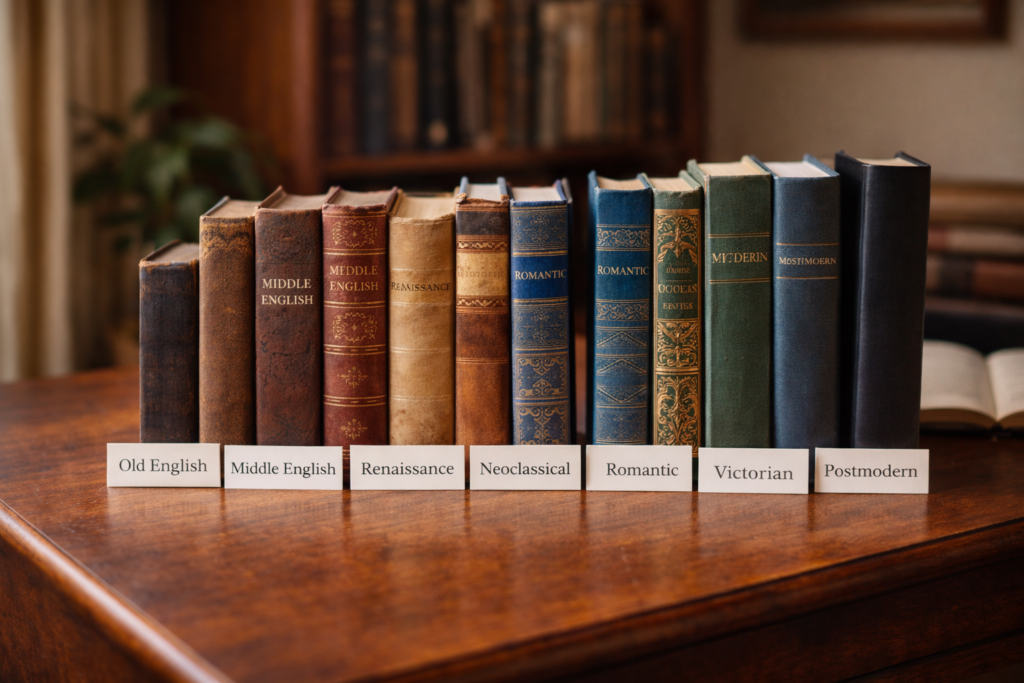
A clear understanding of literary periods helps students appreciate how English Literature evolved over time and how different genres reflect the concerns of their historical contexts

Abha Bhardwaj Sharma is a Professor of English Literature with over 25 years of teaching experience. She is the founder of Miracle English Language and Literature Institute and the author of more than 50 books on literature, language, and self-development. Through The Literary Scholar, she shares insightful, witty, and deeply reflective explorations of world literature.
Share this post / Spread the witty word / Let the echo wander / Bookmark the brilliance