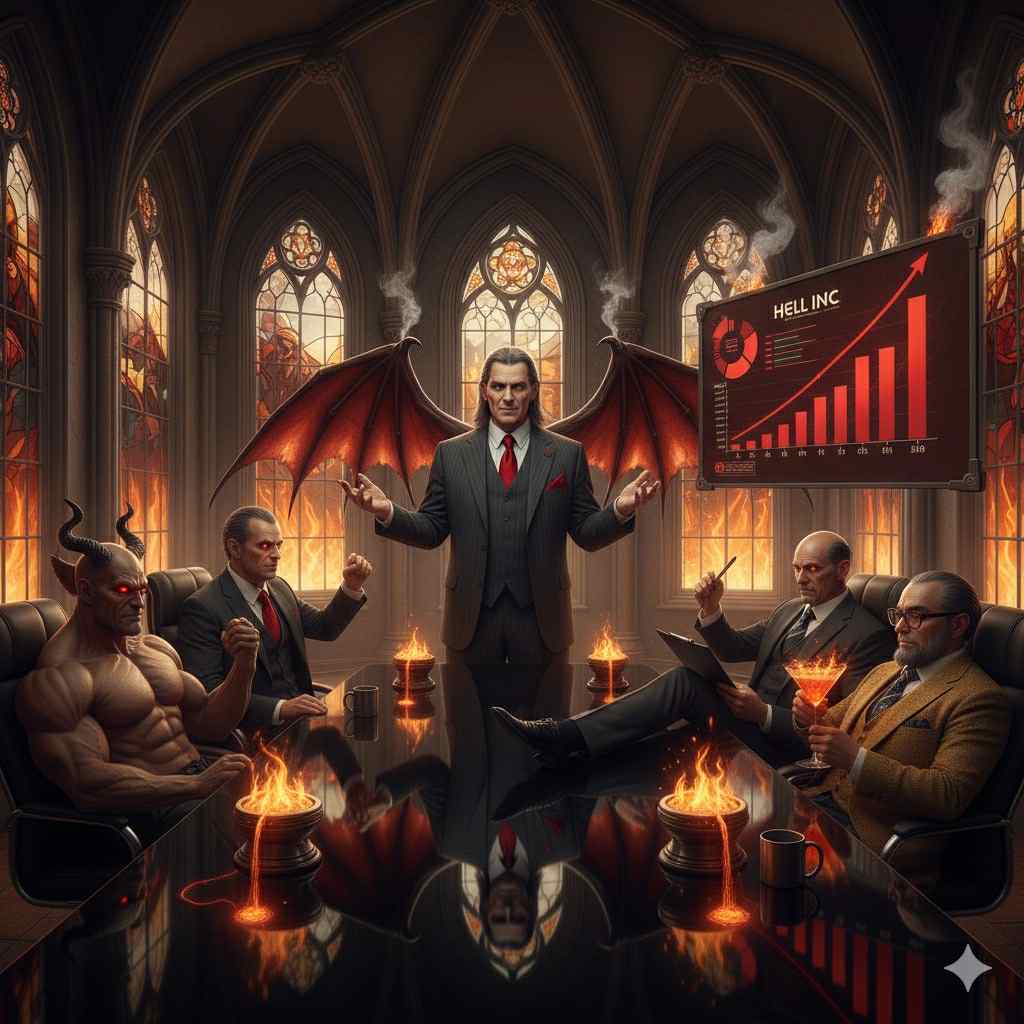
The year is eternity minus one. The place: Pandemonium, headquarters of the most infernal board meeting ever held. The décor: gothic chic, with fire pits doubling as coffee machines. Around a blazing obsidian table sit the greatest minds of Hell: Satan (Founder and CEO), Beelzebub (Chief Operating Officer), Moloch (Chief War Strategist), Belial (VP of Excuses), and Mammon (Head of Finance).
The agenda: launching their new disruptive venture, “Operation Eden.”
Opening Speech: Satan the Visionary CEO
Satan rises, wings still singed from his celestial fall but ego intact. He speaks with the booming charisma of a TEDx host who swallowed a thunderstorm.
“Comrades, though we lost the angelic Series A round in Heaven, fear not! For we shall pivot! The market of Humanity is ripe for disruption. Imagine: two beta testers, Adam and Eve, and we hold the fruit-based monopoly!”
Beelzebub nods like a seasoned COO: “We failed upwards, my lord. Silicon Valley calls it innovation.”
The Pitch Deck (in Flames, Naturally)
A fiery screen appears, slides powered by brimstone. The bullet points glow in infernal Comic Sans.
Problem: Humanity enjoys innocence, free will, and divine grace. Boring.
Solution: Introduce temptation as a service (TaaS™).
Target Market: Two users, Adam and Eve. Low competition.
Business Model: Scalable corruption through word of mouth (literally, the serpent’s mouth).
Projected ROI: Infinite souls, eternal chaos, long term brand loyalty.
Mammon raises a claw: “And what about revenue?”
Satan smirks: “Think bigger. We’re not here for money. We’re here for market share in eternity.”
Roundtable of Devils
Moloch: The Warmonger
Slams his fist:
“Forget temptation! Let’s storm Heaven again, disrupt their angelic firewall, and burn their cloud storage!”
Satan shakes his head: “Scalable? No. Investors prefer subtle sabotage, not brute force.”
Belial: The Smooth Talker
Leans back, sipping lava like martini:
“Why not… do nothing? Chill. Blame market conditions. Let humanity fail on its own.”
Satan hisses: “That’s not a business plan, that’s academia.”
Mammon: The Economist
Unfurls charts of brimstone investments:
“What if we build an empire underground? Monetize misery, trade in tears, hedge despair futures? Profit will rise like sulphur.”
Beelzebub coughs politely: “Very clever, Mammon, but Satan is pitching scale. Not coins, but kingdoms.”
The First Pivot: Enter the Serpent
At this point, the startup faces its crucial pivot moment. The team debates delivery methods. Drone warfare? Viral memes? Angel influencers?
Satan unveils the MVP (Most Valuable Possession): a serpent. Sleek, agile, persuasive — the perfect vessel for temptation as a service.
“Our brand needs subtlety,” Satan declares. “Not war, not laziness, not cashflow. We whisper. We charm. We innovate through deceit. And with this serpent, we shall scale.”
The devils applaud. Pandemonium echoes like a WeWork office at happy hour.
Investor Q&A (Aristotle Attends as Angel Investor)
Suddenly, a spectral Aristotle appears, summoned by sheer absurdity. He strokes his beard.
Question: “Is this not against the moral laws of tragedy?”
Answer (Satan): “Aristotle, my friend, we’re not bound by poetics. We’re writing Paradise Lost 2.0, tragedy as a service subscription.”
Question: “What of catharsis, pity, fear?”
Answer (Beelzebub): “Catharsis is outdated. We’re selling envy, rage, regret — modern emotions with higher user engagement.”
Aristotle sighs and disappears, muttering: I should have invested in Plato’s Academy.
Corporate Culture in Hell
The devils draft a mission statement:
Vision: “Better to reign in Hell than serve in Heaven.”
Values: Ambition, disruption, eternal vengeance.
Tagline: “Temptation: Because Perfection is Overrated.”
They schedule weekly stand ups (in lakes of fire), offer stock options in lost souls, and add a ping pong table made of skulls. Belial starts a “Casual Fridays” policy, toga optional.
The Final Pitch
Satan delivers the closer, Steve Jobs-style:
“One more thing. With this apple, we don’t just tempt. We change history. We rewrite human destiny. We become… the original influencers.”
The devils erupt in applause, their wings clapping like malfunctioning drones. Mammon adds, “And think of the merchandising: ‘Original Sin’ T-shirts, Serpent NFTs, branded applesauce.”
Launch Day in Eden
The plan executes flawlessly. The serpent slides into Eden, Apple Store 1.0, and convinces Eve to bite. Adam follows. Humanity is disrupted. Heaven’s monopoly on innocence collapses overnight.
The devils high five. Beelzebub orders celebratory brimstone pizza. Moloch shouts, “Series B secured!” Belial opens a podcast: “Sinfluencers: The Future of Temptation.”
Epilogue: Milton’s Startup Legacy
If Milton were alive today, Paradise Lost would read like a cautionary tale about tech bros with wings. Satan is the archetypal founder: brilliant, persuasive, doomed by overreach. His board is every nightmare corporate meeting rolled into verse. The fall of man wasn’t just theology, it was the first hostile takeover.
And what did we learn? That Hell is the most successful startup in history. Its product went viral, its market infinite, its customer retention unbreakable. God may have expelled the devils from Heaven, but Satan launched a business model that has never gone out of style.