



Fyodor Dostoevsky: The Man Who Put God, Guilt and a Murderer in the Same Room

A journey into the extraordinary mind of a novelist who discovered that the human soul is a battlefield, the conscience an unpaid interrogator, and even a murderer may have a philosophical argument ready before breakfast.

What ABS believes in

ABS believes that great literature does not merely tell us what people do; it takes us inside the complicated machinery of why they do it. Dostoevsky’s characters are rarely satisfied with being good, bad, sensible, or even sane.

The Writer Who Knew Life Could Turn into a Nightmare

Fyodor Dostoevsky’s life seems to have been planned by a novelist who had no respect for the principle of moderation. He faced poverty, imprisonment, a mock execution, years of hard labour in Siberia, epilepsy, debt, and a gambling habit that repeatedly treated money as if it were a temporary rumour. In 1849, he was taken with other members of a political discussion circle to face a firing squad. At the last moment, the execution was cancelled. Imagine being told that you have only minutes to live, then discovering that the authorities have changed their minds. Most people might spend the rest of their lives appreciating breakfast. Dostoevsky spent his writing about people who could not enjoy breakfast because they were busy debating the meaning of existence. His suffering did not automatically make him wise, nor should hardship be romanticised. But it gave him an unusually intimate knowledge of fear, humiliation, desperation, and the stubborn human need to believe that life still means something. He understood that a person can be crushed by circumstances and still remain morally complicated. His characters are not specimens displayed behind glass. They are people sweating, pleading, lying, hoping, and arguing with the universe. Dostoevsky’s biography is dramatic, but his real achievement was turning experience into psychological insight rather than simply turning it into autobiography.


Fyodor Dostoevsky stands in a snowy Siberian prison camp, holding a worn notebook as prisoners work behind him.
In the harsh silence of Siberian exile, Dostoevsky encountered suffering that would deepen his understanding of the human soul.
2. Crime and Punishment: The Murderer Who Could Not Stop Thinking

In Crime and Punishment, Rodion Raskolnikov commits murder and then discovers that the human conscience is a remarkably persistent tenant. He believes extraordinary people may have the right to step beyond ordinary moral rules. Napoleon, in his imagination, has apparently received permission to ignore the rules; Raskolnikov wonders whether he might qualify for the same exclusive club. Unfortunately, the theory looks less impressive when tested with an axe. After killing the pawnbroker and her sister, he does not become a triumphant superman. He becomes feverish, suspicious, isolated, and increasingly unable to manage his own thoughts. His mind turns into a police station where every officer is also a suspect. The novel’s suspense comes not only from whether he will be caught, but from watching him try to explain himself to himself. Dostoevsky exposes the distance between an idea admired in the abstract and an act endured in reality. Raskolnikov wants to treat morality as an intellectual problem, but suffering refuses to remain theoretical. Sonia, whose own life is marked by poverty and sacrifice, offers him compassion without pretending that his crime is harmless. Through their relationship, the novel asks whether confession and suffering can begin a process of renewal. It does not offer an easy cure. Raskolnikov’s punishment begins long before the law reaches him: it begins when his grand theory collides with the irreducible humanity of other people.


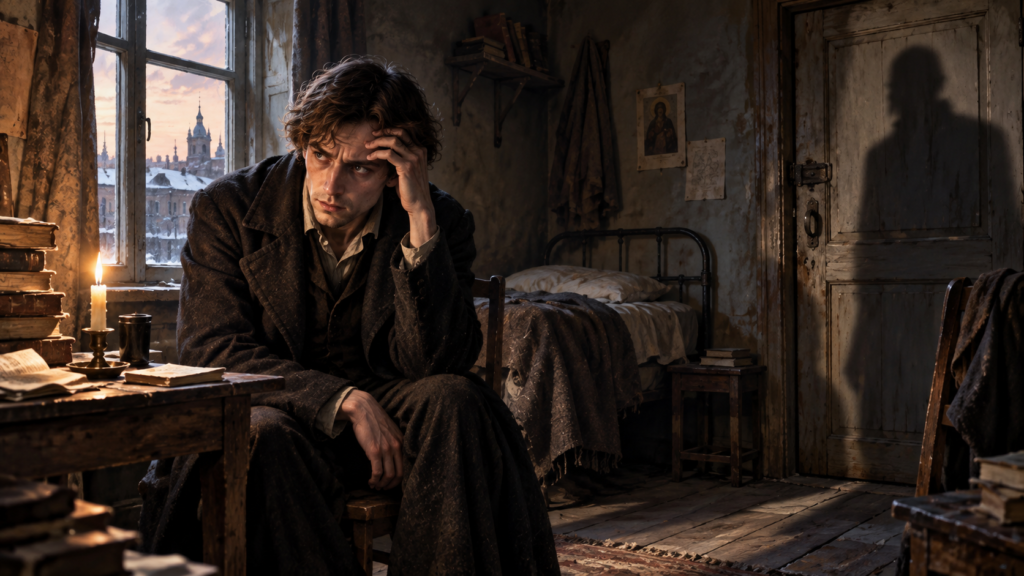
A troubled young man sits in a dim, shabby room, staring anxiously as a shadow falls across the door, evoking Raskolnikov’s guilt in Crime and Punishment.
Alone with his thoughts, Raskolnikov finds that the mind can become its own relentless interrogator.
3. The Brothers Karamazov: One Family, Several Philosophical Disasters

If a family gathering could become a philosophical conference with shouting, scandal, and a possible murder, it might resemble The Brothers Karamazov. The Karamazov family is a magnificent tangle of appetite, resentment, faith, doubt, and emotional immaturity. Fyodor Pavlovich, the father, is so selfish and grotesque that one almost expects the furniture to file a complaint. His sons respond to him in different ways: Dmitri is passionate and impulsive, Ivan is intellectually tormented, and Alyosha seeks goodness through faith and compassion. Their conflicts turn the family into a testing ground for some of the largest questions literature can ask. If God does not exist, what becomes of morality? Can human freedom survive without responsibility? Is suffering ever redeemed, especially the suffering of children? Ivan’s rebellion against a world containing innocent suffering is not a neat argument to be dismissed; it is a moral protest that unsettles the novel itself. Alyosha’s faith, meanwhile, is not presented as a magic answer that makes pain disappear. It is expressed through attention, kindness, and the difficult work of loving imperfect people. The novel’s brilliance lies in allowing its characters to disagree with extraordinary force without reducing them to cardboard representatives of ideas. Dostoevsky gives each voice emotional weight. Even when the family’s behaviour becomes unbearable, the questions remain serious. The Karamazovs may be a disaster at home, but their arguments reach far beyond the dining table.


Four men gather around a table in a candlelit study, one arguing passionately while another listens thoughtfully, evoking a tense family discussion in The Brothers Karamazov.
In the Karamazov household, family conflict quickly becomes a debate about faith, freedom, and human nature.
4. Notes from Underground and The Idiot: The Mind Refuses to Behave

Dostoevsky understood that people do not always want what is good for them. The Underground Man in Notes from Underground is proof that self-awareness can become its own spectacularly unhelpful hobby. He analyses every motive, contradicts every conclusion, and resents the world for failing to arrange itself around his misery. Give him a simple choice, and he will produce a philosophical crisis, reject the sensible option, and then complain that nobody understands him. His rebellion is not heroic; it is often petty, painful, and self-defeating. Yet Dostoevsky makes us listen because the Underground Man exposes something uncomfortable: human beings may prefer the freedom to make a terrible choice over the comfort of being treated like predictable machines. In The Idiot, Prince Myshkin offers a different kind of challenge. His gentleness and openness seem almost absurd in a society organised around vanity, money, status, and manipulation. People often mistake his goodness for weakness, then become unsettled when he refuses to play their games. Myshkin is not a simple saint dropped into a wicked world; his innocence cannot protect him from confusion or tragedy. Together, these novels examine two difficult possibilities: a person may sabotage himself to prove he is free, or remain compassionate in a world that treats compassion as foolishness. Dostoevsky’s psychological insight lies in refusing to make either condition comfortable. His characters are not solved by a diagnosis. They continue to surprise, embarrass, and trouble us.


A brooding man sits alone in a dark, cluttered garret while a gentle, fair-haired man stands among formally dressed guests in a bright ballroom, illustrating the contrasting characters in Notes from Underground and The Idiot.
One retreats into bitterness; the other meets the world with compassion. Dostoevsky explores the costs of both.
5. Dostoevsky’s Great Subject: The Human Soul Under Interrogation

Dostoevsky’s novels are crowded with criminals, gamblers, idealists, believers, sceptics, and people who appear to have mistaken a conversation for an opportunity to deliver a sermon. Yet beneath the noise is a persistent question: what happens when a human being is forced to face the truth about himself? His characters often construct elaborate explanations for their behaviour. They blame society, poverty, injustice, passion, ideology, or the wickedness of everyone nearby. Sometimes these explanations contain truth. But Dostoevsky keeps asking whether an explanation can become an excuse, and whether a person can recover moral freedom by accepting responsibility. His fiction is full of contradictions because people are full of contradictions. A character may crave love and reject it when it arrives; seek freedom and become enslaved by pride; profess faith while struggling with doubt. This is why Dostoevsky’s novels resist tidy moral summaries. He does not simply divide humanity into saints and sinners, then send the sinners to a corner for reflection. He lets goodness appear in damaged people and cruelty emerge from respectable arguments. His humour, often dark and uncomfortable, makes the psychology even sharper: people can be ridiculous precisely when they are most convinced of their own importance. Dostoevsky asks readers to look beyond the public performance and listen to the private argument. The soul, in his fiction, is not a peaceful garden. It is a restless courtroom, and the trial may continue long after everyone else has gone home.

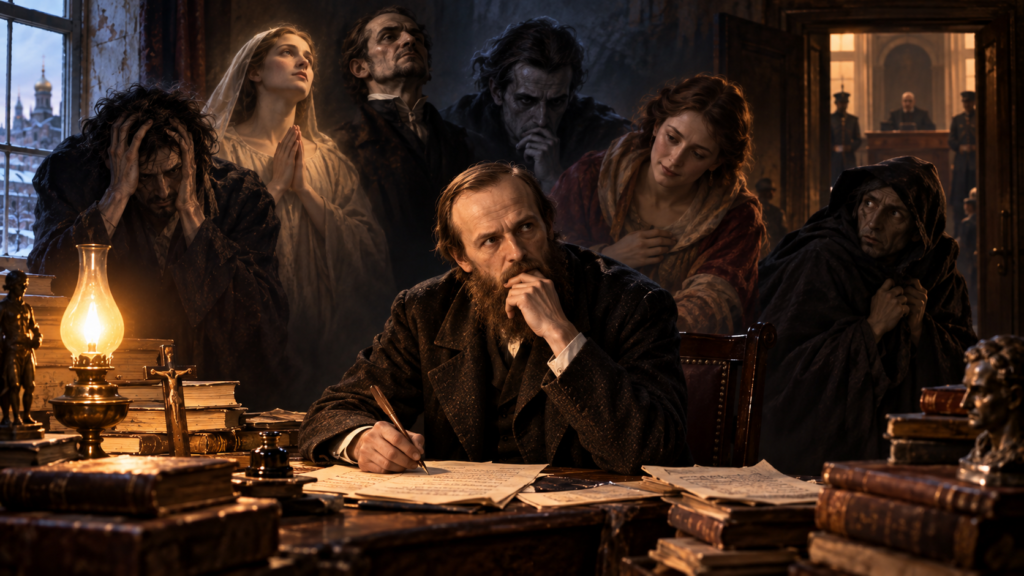
Fyodor Dostoevsky writes at a desk, surrounded by shadowy figures representing inner conflict, while a courtroom glows in the background.
In Dostoevsky’s world, the human soul becomes a courtroom where guilt, faith, doubt, and compassion confront one another.

ABS Folds the Scroll

Dostoevsky leaves us with no convenient instruction manual for the human soul. Instead, he gives us people who are difficult to forgive, difficult to understand, and sometimes painfully familiar. His novels remind us that intelligence does not guarantee wisdom, suffering does not automatically create goodness, and a convincing argument can still lead us somewhere disastrous.

Perhaps that is why we keep returning to him. He does not ask us merely to judge his characters. He asks us to examine the arguments we make for ourselves. And that, dear reader, is when the courtroom becomes uncomfortably quiet.

Share this post / Spread the witty word / Let the echo wander / Bookmark the brilliance

Leave a Comment

Your email address will not be published. Required fields are marked *

error: Content is protected !!