
A Comedy Where Gossip Does the Sword Work and Love Trips Over Its Own Feet
Welcome to Much Ado About Nothing, Shakespeare’s festival of misunderstandings, accidental villainy, accidental romance, and accidental intelligence. This is the play where people fall in love by arguing, fall apart because someone coughed suspiciously in the bushes, and repair everything so quickly you suspect Arden’s forest may have loaned them some magic.
At the heart of it stands Messina, a town where idle minds and sharp tongues create more chaos than battles ever could. Soldiers return from war, expecting peace. Instead, Shakespeare hands them an emotional battleground where reputations are fragile, lies spread like perfume, and everyone behaves like a detective who specialises in incorrect conclusions.
Enter Beatrice and Benedick, the two greatest verbal duelists Shakespeare ever wrote. They hate each other with such theatrical beauty that even their insults sparkle. Their war of words is more entertaining than any swordfight, and their eventual surrender to love is one of literature’s finest victories. Love does not defeat them. Language does.
Then we have Claudio, a romantic with the emotional stability of a wet leaf. He falls in love with Hero in five seconds and nearly destroys her in another ten because someone whispered a rumour. And Hero, poor Hero, becomes the center of a false accusation so stupid it could only be invented by Shakespeare’s most useless villain, Don John, who hates happiness simply because he exists.
Hovering in the background is Shakespeare’s favourite comedic weapon: Dogberry, a constable with the IQ of a furniture piece and the confidence of a king. His vocabulary is a collection of wrong words used with complete self-assurance. And ironically, he solves the crime everyone else is too emotional to notice. Shakespeare loves humiliating the smart by empowering the foolish.
Much Ado is a play driven by tongues, not swords, rumours, not evidence, emotion, not logic. It is the closest Shakespeare comes to pure romantic comedy, but he still sprinkles just enough darkness to remind you that laughter sits very close to cruelty in human behaviour.
The ending gives you marriages, forgiveness, celebration, and dancing, but Shakespeare makes sure you feel the sting of how stupid people can be when pride and insecurity hold the pen.
ABS Believes
ABS believes that Much Ado About Nothing is Shakespeare’s sharpest commentary on gossip, his proof that words can wound deeper than daggers. ABS also believes Beatrice deserves her own empire, Benedick deserves applause for surviving her, Claudio deserves a timeout, and Dogberry deserves a dictionary.
ACT ONE
Where Soldiers Return, Tongues Sharpen, And Two Geniuses Pretend They Hate Each Other
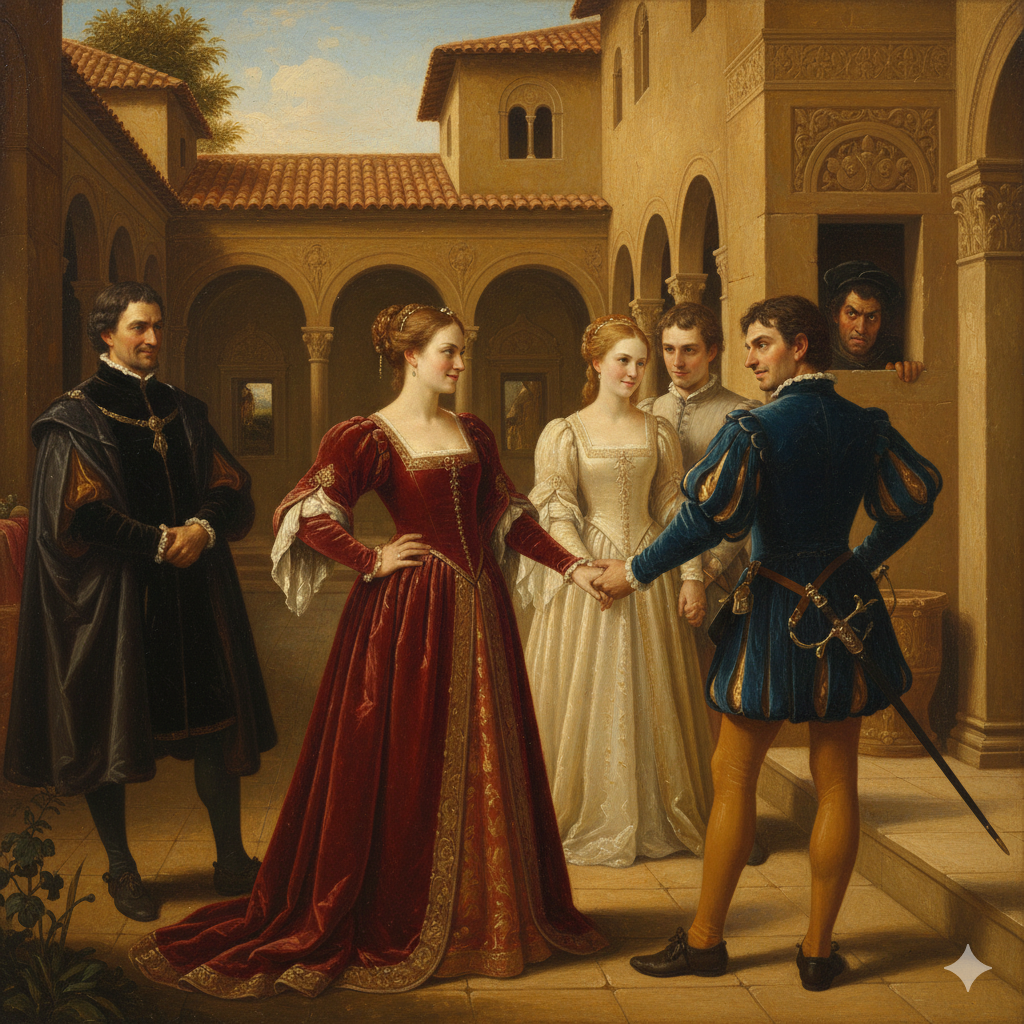
Act One opens in Messina, a place where the sun is warm, the gossip is hotter, and everyone’s emotional intelligence hovers somewhere between brilliant and catastrophic. Leonato, the governor, receives news that Don Pedro and his victorious company of soldiers are on their way. Which sounds peaceful until you realise Shakespeare is about to unleash romance, ego battles, and weaponised wit upon this poor city.
Leonato reads the messenger’s letter with the calm of a man used to chaos. But the messenger, excited beyond reason, gives us the first hint of the play’s main disaster. He announces that Benedick, the self proclaimed bachelor king, and Beatrice, the sarcasm queen, will meet again.
Everyone in Messina tenses because they know what this means.
Verbal bloodshed.
And sure enough, the moment Beatrice hears Benedick’s name, she fires the first missile.
“I pray you, is Signior Mountanto returned from the wars.”
ABS translation,
Has that sword swinging showoff survived again.
Beatrice pretends she is asking casually. The entire city knows she is not. Benedick annoys her by merely existing. And the hilarious part is that Benedick is exactly the same. These two do not flirt. They duel. They do not chat. They clash. They do not like each other. They are obviously in love.
When the soldiers finally arrive, Claudio, the sweet nobleman with the emotional steadiness of wet sugar, takes one look at Hero, Leonato’s daughter, and immediately falls in love. Claudio’s romantic instinct is strong. His judgement is weak. Shakespeare approves. Hero blushes like a professional.
Don Pedro promises to help Claudio win Hero’s heart. Meanwhile Benedick walks in with the confidence of a man who thinks he is irresistible. He is greeted by Beatrice who hits him with insults so sharp he probably felt them through his armour.
“I had rather hear my dog bark at a crow than a man swear he loves me.”
ABS translation,
Love is fine for other people, but keep that nonsense away from me.
Benedick retaliates. They spar. They roast. They scratch each other’s dignity with every line. The others watch the drama like spectators enjoying premium theatre for free. Leonato shrugs. He has accepted that these two are a permanent hazard in his household.
Then the plot thickens when Don Pedro overhears Claudio confess his love for Hero. Benedick reacts with horror because romantic affection terrifies him the way sunlight terrifies vampires. Don Pedro offers to play Cupid. He will pretend to be Claudio at the masked ball, woo Hero in Claudio’s name, and arrange the marriage.
Claudio melts. Benedick mocks. Don Pedro smiles. Shakespeare rubs his hands because the real chaos is only beginning.
Meanwhile, we meet Don John, Shakespeare’s favourite brooding troublemaker. This man behaves like permanent bad weather. He hates Don Pedro. He hates happiness. He hates peace. He hates smiling. He is practically allergic to joy. Don John vows to ruin something, anything, simply because ruining things gives him purpose.
Act One ends with plans for love, plans for mischief, and the promise of social disaster. Claudio dreams of marrying Hero. Don Pedro plans the strategy. Beatrice and Benedick sharpen their tongues. Don John sharpens his villainy. And Messina prepares for a week of passion, pettiness, and poetic chaos.
ABS leans back and says,
Act One is Shakespeare whispering, Get comfortable, your favourite warfare is verbal today.
ACT TWO
Where Masques Hide Faces, Fools Hide Wisdom, And Everyone Pretends They Are Not In Love
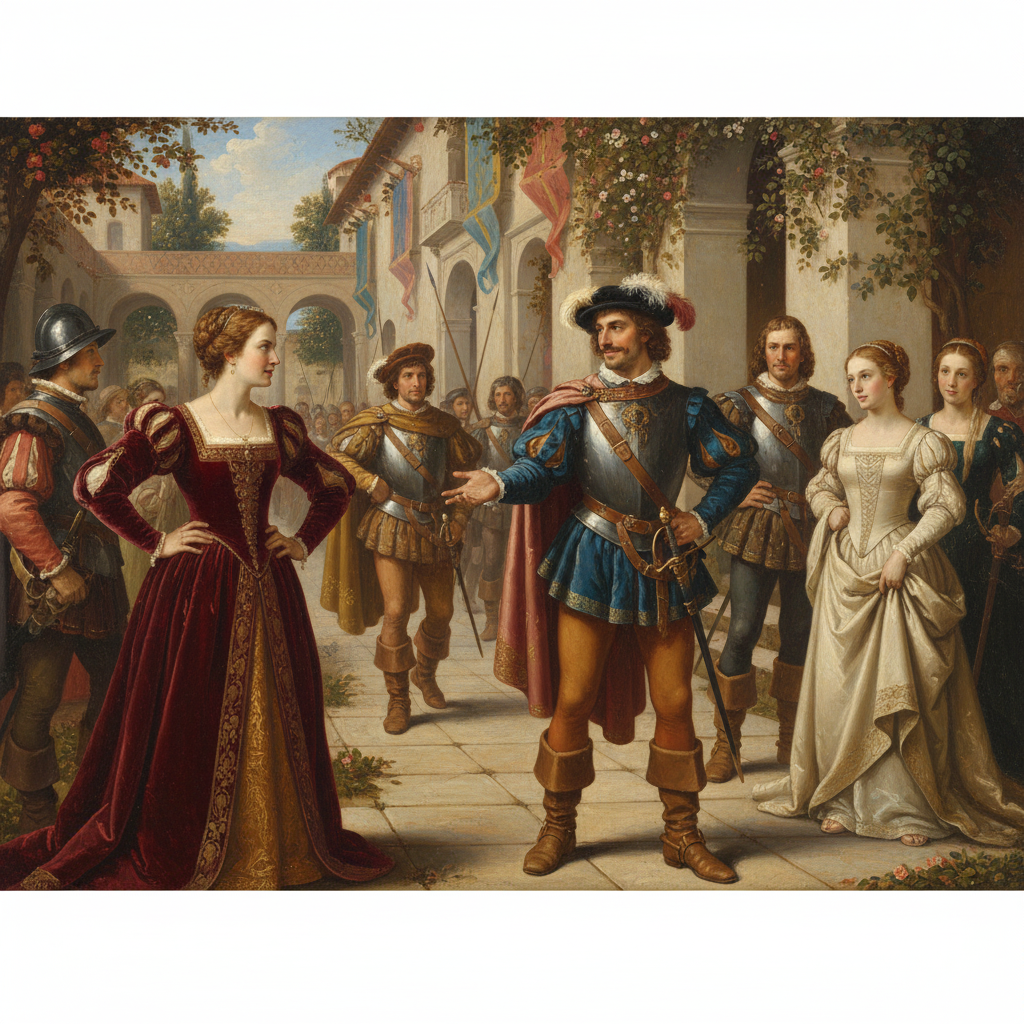
Act Two opens with Leonato’s household buzzing like a political rally disguised as a tea party. Everyone is preparing for the masked revels, because Shakespeare knows nothing exposes truth faster than hiding your face. The entire scene feels like a social experiment where people flirt, lie, confess, deny, and accuse, all while pretending they do not know who they are talking to.
First, Leonato, Hero, Beatrice, and the others discuss marriage. A dangerous topic, because Beatrice is in the room. Beatrice immediately launches into her usual sport: verbally destroying the male ego. When asked why she refuses marriage, she says men are either too perfect to want her or too flawed to deserve her.
“I had rather hear my dog bark at a crow than a man swear he loves me.”
ABS translation,
Love is noise, lies, and maintenance. No, thank you.
Meanwhile, Hero speaks softly like a good Elizabethan daughter who has been trained not to scare society.
Then everyone prepares for the masked dance. This is Shakespeare’s playground. When you cannot see someone’s face, you hear their truth. Or nonsense. Usually nonsense.
At the masque, Beatrice unknowingly dances with Benedick and proceeds to insult him to his masked face. Benedick, who thinks he is immune to humiliation, gets absolutely obliterated. She calls him the prince’s fool, the jester of the army, and a man whose wit is as shallow as his beard growth. Benedick goes into emotional cardiac arrest.
Benedick later rants to Don Pedro, complaining that Beatrice’s words cut deeper than swords. Don Pedro laughs because it is not happening to him.
“She speaks poniards, and every word stabs.”
ABS translation,
Her vocabulary is sharp enough to kill people legally.
Now comes Don Pedro’s masterstroke. He announces to Claudio that he has wooed Hero on his behalf. Claudio does not believe him. Claudio’s insecurity enters the room like a trembling goat. Once it is cleared that Hero said yes, Claudio turns into a puddle of obedient joy.
Leonardo is thrilled. Hero blushes. Claudio stands awkwardly in the corner like a man who cannot believe his luck. Don Pedro promises the wedding. Shakespeare warms up the choir.
Enter Don John, the human raincloud. His speciality is destroying happiness because he was created without a serotonin gland. When he hears that Claudio is to marry Hero, he decides to break the relationship like cheap glass.
“I am a plain dealing villain.”
ABS translation,
I have nothing to do, so let me ruin something.
Don John plants doubt in Claudio’s mind, telling him Don Pedro wooed Hero for himself. Claudio believes it instantly, because Shakespeare loves men whose confidence evaporates faster than dew on a hot day.
Then Don Pedro arrives and clears the confusion. Claudio realises he is the problem. Again.
Meanwhile, Beatrice and Benedick resume their war of words. They insult each other like two master chefs exchanging recipes of disdain. Everyone watching can see they are soulmates except the two of them. Shakespeare knows this is comedy gold.
Then Don Pedro, the secret matchmaker of Messina, decides to play Cupid. He announces his plan to bring Beatrice and Benedick together. The household cheers because they are tired of the constant intellectual warfare.
The act ends with conspiracies ready, lovers insecure, villains plotting, fools observing, and Shakespeare rubbing his hands with glee because he knows Acts Three and Four are going to explode.
ABS smirks and says,
Act Two is Shakespeare proving masks reveal more truth than faces.
ACT THREE
Where Love Plots Explode, Egos Crack, And Shakespeare Turns Gossip Into Architecture
Act Three is where Much Ado About Nothing stops flirting with comedy and commits to it like a lover ready to kneel. Shakespeare now pulls every string he has set up in Acts One and Two, and every character becomes a willing participant in the world’s most elegant manipulation game.
And the best part:
Everyone thinks they are running the show.
No one actually is.
Except Shakespeare, and he is enjoying himself like a playwright on vacation.
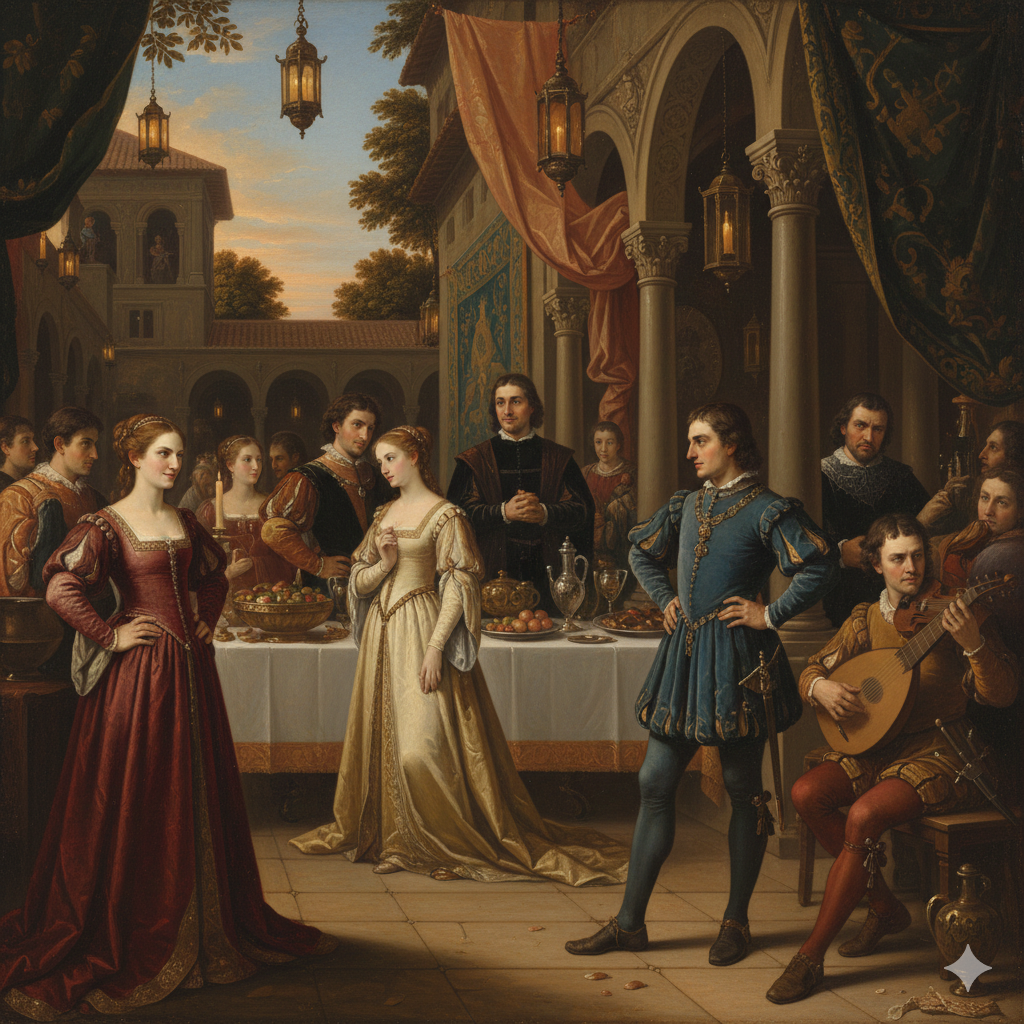
We begin with Hero, Margaret, and Ursula, the quiet trio who finally get to shine. Their mission. Trigger the emotional earthquake known as Beatrice admitting she has feelings. This is not a light task. Beatrice’s spine is made of sarcasm. Her pride is a fortress. Her tongue is a military weapon. But Hero is determined.
So the three ladies stage the garden scene, a masterpiece of feminine strategy. They talk loudly enough for Beatrice to “accidentally” overhear, which is Shakespeare’s poetic way of saying, “This woman needs emotional manipulation, not reasoning.”
“Some Cupid kills with arrows, some with traps.”
ABS translation,
If love doesn’t work naturally, we force it with theatrics.
Hero and Ursula paint Benedick as a man hopelessly in love with Beatrice. They describe his sighs, his agony, his devotion, and the way he would rather die than admit it. They elevate him to a romantic saint, which is a hilarious contrast considering Benedick normally behaves like a man allergic to commitment.
Beatrice hides behind hedges, bushes, truth, shame, everything she can find, listening like a spy who just discovered her own feelings. The transformation begins. Her pride starts cracking. Her sarcasm starts trembling. Hero and Ursula keep praising Benedick until Beatrice’s heart gives up its defences.
She steps out ready for war and marriage simultaneously.
“Benedick, love on. I will requite thee.”
ABS translation,
Fine. I accept. Tell no one.
This is where Beatrice shifts from verbal assassin to dramatic romantic, and watching her fall in love is Shakespeare’s personal victory lap.
Meanwhile, the men execute their own version of the trap. Claudio, Don Pedro, and Leonato set up the gulling scene for Benedick. They talk about Beatrice’s “secret love” for him with the exaggerated sadness of opera singers who lost their favourite fans.
Benedick hides behind a tree, leaning so close he might as well announce, “I am spying now.”
“The world must be peopled.”
ABS translation,
Marriage sounds necessary because loneliness is starting to itch.
He believes every word. Benedick, previously the ambassador of bachelor life, now becomes a full time believer in destiny. He vows to love Beatrice back, as long as nobody tells him he was manipulated. Shakespeare does not give him that dignity.
Now we shift to the dark undercurrent.
Enter Don John, Shakespeare’s most bored villain. He has no ambition, no charm, no real motive. He just likes ruining things the way a child likes breaking toys. He tells Borachio and Conrade about his plan to destroy Claudio and Hero’s upcoming wedding. The plot. A staged deception. A window silhouette. A fake betrayal. Claudio and Don Pedro fall for it like amateurs because their egos have the IQ of warm bread.
This is where Shakespeare reminds us that comedy still contains the bones of tragedy.
Act Three’s second half shifts into a different rhythm. We get Dogberry, the constable whose vocabulary is a collection of words that don’t mean what he thinks they mean. Dogberry enters speaking like a dictionary that was dropped in water. He leads the Watch, a group of men who could not detect a crime if it bit them.
Yet ironically, these idiots overhear Borachio bragging about the entire scheme, and thus the fools become the heroes. Shakespeare loves chaos. And justice through incompetence is one of his favourite jokes.
Dogberry’s entire existence boils down to this:
He saves the plot by accident.
He ruins the English language on purpose.
“Our watch, sir, have indeed comprehended two auspicious persons.”
ABS translation,
I caught criminals, I just don’t know how to speak.
Act Three ends with two opposite realities colliding.
On one side, love blossoms through staged revelations.
On the other, destruction begins through staged betrayal.
Comedy and tragedy stand side by side, both smiling, both sharpening their knives.
ABS leans back and says,
Act Three is Shakespeare’s way of proving that the truth never arrives politely. Someone must overhear it, mishear it, or completely misunderstand it first.
ACT FOUR
Where Love Collapses, Honor Screams, And Shakespeare Pulls The Floor From Under Everyone
Act Four is where the play stops giggling and drops straight into emotional carnage. Up until now, you had gossip, flirting, eavesdropping, and two people falling in love by accident. Now Shakespeare kicks open the church doors and says, let us destroy Hero’s life for fifteen minutes.
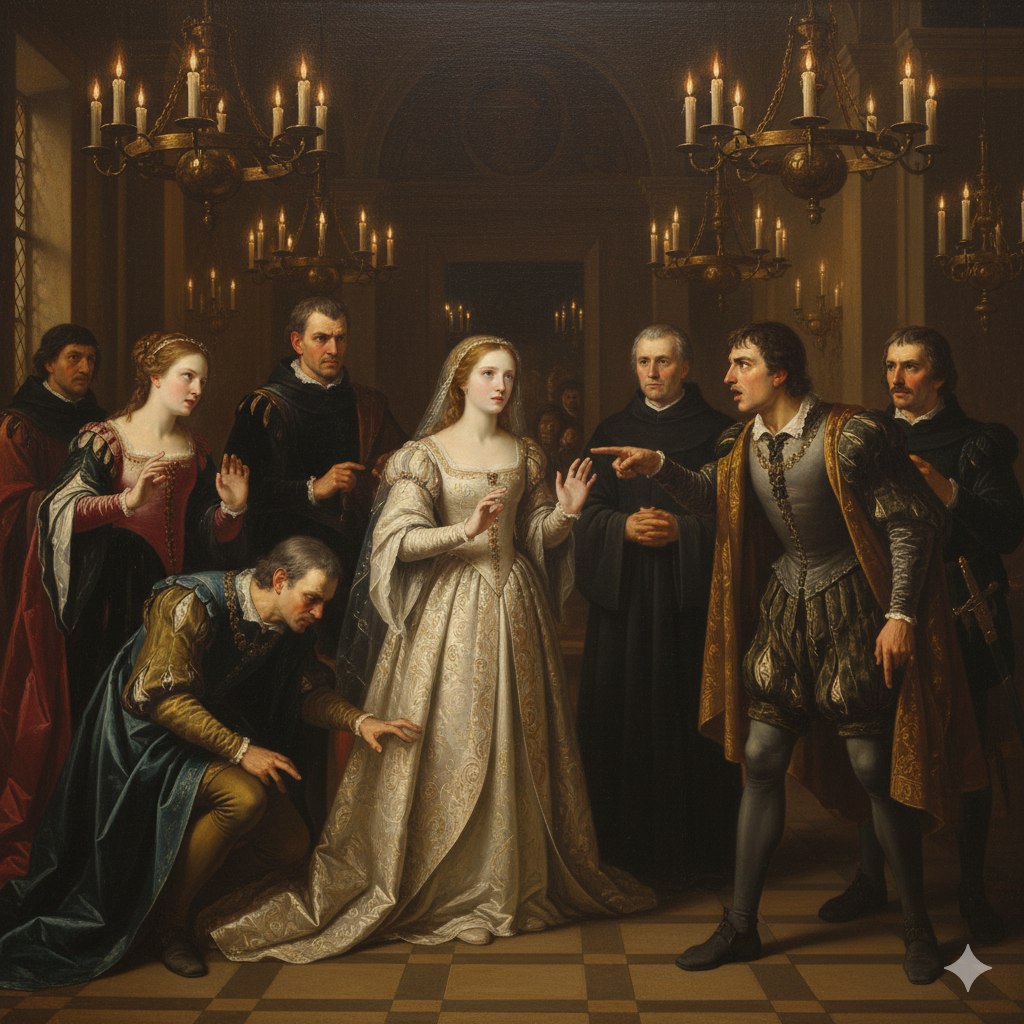
The act begins at the wedding altar, that sacred space where Shakespeare traditionally allows joy to bloom. Instead, he lets Don John plant a bomb under it. Leonato beams. Hero blushes. Claudio smiles like a man who thinks life will finally behave.
And then Claudio detonates.
“There, Leonato, take her back again.”
ABS translation,
Return your daughter, she has been discounted.
He calls Hero a liar, a cheat, a façade wrapped in lace. Claudio, who has the emotional depth of a teaspoon in this moment, accuses her of being unfaithful because Don John fed him a bedtime story and he swallowed it whole.
Hero stands shocked, trembling, the picture of innocence and confusion. Benedick looks like he just watched someone kick a puppy. Beatrice is two seconds away from becoming a weapon.
Claudio continues, piling insult upon insult with self righteous confidence. Don Pedro joins in, nodding solemnly like a man who thinks he is part of divine justice but is really just part of a prank gone too far.
Leonato, Hero’s father, reacts in the most dramatic Italian uncle manner possible. He does not comfort her. He does not investigate. He immediately believes the men.
“Hath no man’s dagger here a point for me?”
ABS translation,
I will now collapse emotionally and make this all about me.
Hero faints not from guilt, but from the sheer stupidity of the men around her. And thank heaven, Friar Francis steps in. Shakespeare uses him as the lone functioning adult in a room full of peacocks.
The friar declares Hero innocent. Not because of evidence, but because he actually looks at her face for two seconds instead of listening to noisy egos. He proposes a brilliant plan. Fake Hero’s death. Let guilt season these men like over salted stew.
This is Shakespeare at his best.
Comedy breaks.
Tragedy enters.
Logic finally speaks.
Then we shift scenes and what happens next is so absurd it circles back to genius.
Benedick and Beatrice remain behind, alone, the act finally giving them emotional privacy. They confess love in a moment so tender it almost heals the damage from earlier. Then Beatrice drops the line that detonates Benedick’s brain.
“Kill Claudio.”
ABS translation,
If you love me, handle my enemies.
This is the moment ABS lives for.
Beatrice’s world just exploded.
Her cousin was publicly slandered, humiliated, discarded.
She has no power in society, but she does have Benedick.
And she uses her voice like a blade.
Benedick, to his credit, crumbles then rebuilds himself into a better man within thirty seconds. He agrees. He will challenge Claudio. He will stand against his prince. He will choose love over loyalty. Shakespeare gives him a backbone just when it matters.
Meanwhile, in another corner of the play, the comic subplot crashes into the main tragedy like drunk wedding guests entering the wrong venue.
Dogberry and Verges — two men who speak fluent nonsense — accidentally arrest Borachio and Conrade. Borachio confesses everything, bragging about the scheme like an idiot who forgot evil requires secrecy. Dogberry, with heroic incompetence, delivers the evidence despite confusing every sentence he says.
And that is the beauty of Act Four.
While noblemen ruin a woman with their arrogance, two fools save her with their stupidity.
Shakespeare is saying the quiet part aloud.
Honor fails.
Authority fails.
Love wavers.
But truth finds the most unreliable messengers.
Act Four ends with:
Hero’s reputation destroyed
Leonato living in melodrama
Claudio pleased with himself
Don Pedro clueless
Don John fleeing like a guilty lizard
Dogberry accidentally becoming the hero
Benedick sharpening his sense of justice
Beatrice standing like a storm waiting to break
ABS dusts off the chaos and says,
This is the act where love grows teeth and comedy stops pretending everything is fine.
ACT FIVE
Where Reputations Are Repaired, Fools Redeem the Smart, and Shakespeare Wraps Chaos With a Ribbon
Act Five begins exactly how Shakespeare likes to begin his endings: with men panicking because their stupidity has finally caught up with them. Claudio walks around with the emotional gravity of a man who knows he messed up so spectacularly that even heaven is embarrassed. Leonato, still bruised by the wedding disaster, refuses to let Claudio breathe comfortably.
“I say thou hast belied mine innocent child.”
ABS translation,
You broke her heart, her spirit, and my patience. Prepare to suffer.
Claudio tries apologising, but his sincerity is as late as his judgment. Leonato is not buying it. Antonio joins in with enough rage to power the entire town of Messina. Claudio stands there absorbing insults like a sponge designed specifically for guilt. Even Don Pedro looks ashamed, which tells you how bad the situation is.
But Shakespeare does not stay in tragedy. Because waiting in the wings is the hero no one asked for but everyone needs: Dogberry.
Yes, Dogberry, the man whose vocabulary is allergic to accuracy.
He barges in with his squad of undertrained watchmen to present the captured villains, Borachio and Conrade, who accidentally revealed the entire plot while drunk enough to consider honesty a personality trait.
Dogberry explains the crime with the elegance of a collapsing bookshelf. Leonato cannot understand half his sentences. Don Pedro looks like he wants divine intervention. Claudio looks ready to combust from shame.
But the truth lands.
Hero is innocent.
The plot was fake.
The shame belongs to the men, not the woman.
“What your wisdoms could not discover, these shallow fools have brought to light.”
ABS translation,
The smart men failed, the idiots won, and you all deserve the humiliation.
Claudio and Don Pedro instantly transform into repentant monks, promising to do anything Leonato asks. Leonato does not waste a second. He orders Claudio to marry a “niece” who closely resembles Hero. Claudio, drowning in remorse, agrees.
Meanwhile, Benedick and Beatrice finally get their moment.
Benedick professes his love with the sincerity of a man who has finally stopped pretending. Beatrice softens, but only slightly, because softness is not her brand. Their banter becomes a confession disguised as sass.
“I love you with so much of my heart that none is left to protest.”
ABS translation,
If I deny it again, I’ll explode.
Their romance becomes the play’s true centre: two sharp minds, two defensive hearts, finally surrendering without losing an inch of wit.
Then comes the final reveal.
Everyone gathers for the “replacement bride.” Claudio looks ready to accept any punishment, even marriage to a stranger, because guilt has transformed him into a compliant houseplant.
Hero enters masked. She speaks. Claudio recognises her voice. She unmasks. Claudio nearly evaporates from shock.
“Another Hero!”
ABS translation,
My entire brain has rebooted. Please hold.
Hero forgives him with a gentleness that ABS does not endorse but respects as Shakespeare’s choice. Claudio collapses into gratitude.
Now comes the final comedic avalanche.
Benedick and Beatrice’s love poems are discovered, proving they ARE in love and leaving them no escape. Their friends shove them together like the world’s happiest bullies.
Benedick finally declares boldly:
“I will stop your mouth.”
(And yes, Shakespeare means a kiss.)
ABS translation,
Enough talking. Come here.
The dancing begins.
The music rises.
The comedy completes its circle.
And just when you think the curtain will fall sweetly, one last note arrives: Don John, the architect of misery, has been captured and must face judgment.
Shakespeare ends the play with the gentle lesson that villains always get caught, fools sometimes win, lovers usually argue, and the truth—no matter how late—arrives before the final dance.
ABS closes Act Five with a smirk and says,
Messina survives the drama, the lovers survive themselves, and Dogberry survives the dictionary. A perfect ending.
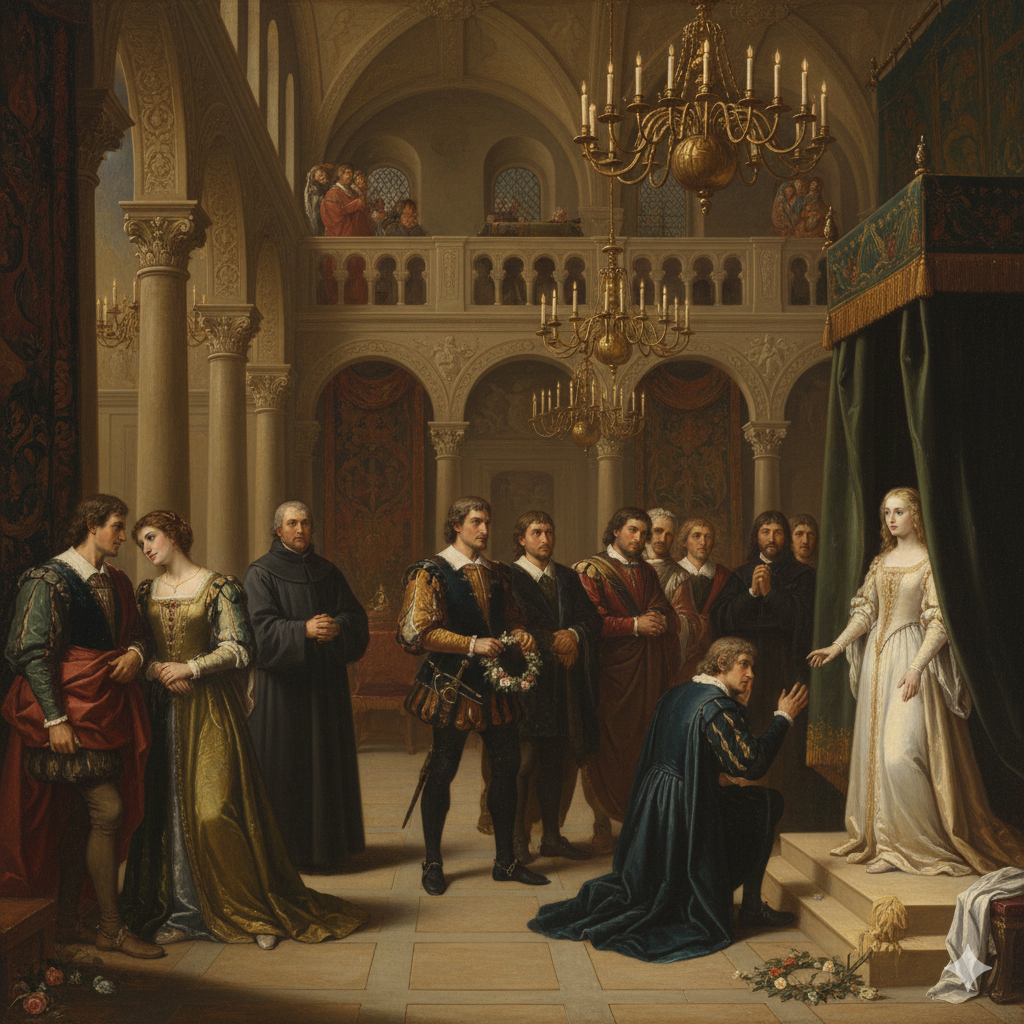
A Comedy Where Gossip Does the Heavy Lifting and Love Arrives Fashionably Late
Much Ado About Nothing is Shakespeare’s proof that you do not need ghosts, witches, or murderers to create chaos. All you need is a rumour, a bored villain, a gullible hero, two geniuses pretending they do not like each other, and a town small enough for every whisper to echo like a thunderclap.
This play survives centuries because it understands human nature better than most psychology textbooks. People fall in love before they admit it. People ruin relationships before they think. People believe lies faster than truth. And people, quite embarrassingly, love watching other people make fools of themselves.
Beatrice and Benedick are the sharpest swords Shakespeare ever forged. Their wit is honest, their pride ridiculous, and their love a battlefield that the audience roots for long before they do. Claudio and Hero, on the other hand, are the emotional opposite: soft, naive, and vulnerable to the kind of manipulation that makes the entire wedding scene feel like a punch to the jaw.
Shakespeare balances cruelty with humour, heartbreak with music, and mistakes with redemption. Don John may try to poison the story, but the play’s heart belongs to forgiveness, second chances, and the glorious victory of truth over nonsense.
The last act ties every knot, but Shakespeare never forgets to sprinkle in his favourite spice: irony. Hero rises from disgrace. Claudio kneels from regret. Benedick and Beatrice finally surrender to the love everybody else knew existed. And the whole town becomes living proof that human beings are emotional disasters who somehow manage to find love anyway.
It is messy.
It is hilarious.
It is painfully accurate.
It is Shakespeare.
ABS folds the scroll, thinking about how hearts mishear, rumours mislead, and Shakespeare always lets love win after it has been thoroughly dragged through the mud.

Abha Bhardwaj Sharma is a Professor of English Literature with over 25 years of teaching experience. She is the founder of Miracle English Language and Literature Institute and the author of more than 50 books on literature, language, and self-development. Through The Literary Scholar, she shares insightful, witty, and deeply reflective explorations of world literature.
Share this post / Spread the witty word / Let the echo wander / Bookmark the brilliance