
A tour of the masterpieces their creators wished would stop following them
ABS BELIEVES
Writers regret their works not because they are flawed but because they reveal too much truth.
The only thing more dramatic than a novel is the author trying to disown it.
Some books are born brilliant. Others are born unfortunate. And then there are the strange creatures in between, the ones authors write on a whim, in a crisis, in a moment of emotional turbulence, or worse, in complete confidence. These books burst into existence carrying all the enthusiasm of a literary experiment and then spend the rest of their lives being denied by their own creators.
Every writer has at least one embarrassing child. A novel they regret. A poem they pretend never happened. A play that makes them want to peel their own name off the cover. These works sit in the attic of literary history like badly framed family photos. Readers love them. Scholars analyze them. Authors wish they would spontaneously combust.
Regret is the most underrated literary genre.
“A writer can forgive critics. Forgiving one’s own published mistakes is far harder.”
The joy of exploring these disowned or rewritten works is simple. They reveal the raw machinery behind genius. They show us writers not as flawless icons but as human beings who sometimes overestimate their talent or underestimate their limits. They expose the insecurity behind the confidence, the chaos behind the craft, the impulse behind the masterpiece.
Some authors rewrote their books obsessively, believing perfection was always one revision away. Others tried something experimental and then panicked when readers responded with confusion instead of applause. Some simply grew out of their early selves and could not bear the sight of their old voices. And a few truly despised their own creations with the passion of a sworn enemy.
Every abandoned book is a confession disguised as literature.
“Art ages. Ego ages faster.”
There is something refreshing about watching the mighty backtrack. Tolstoy disowned his youthful works. Hardy fled from fiction after critics wounded his pride. Hemingway regretted some of his early writing with a level of contempt only Hemingway could manage. Even greats like Dickens and Shelley had moments of honest disappointment with their own creations.
These regrets are not failures. They are milestones in a creator’s evolution. A bad book is a rehearsal for a great one. A rejected draft is the foundation of a masterpiece. Literary regret is proof that even the brightest minds must occasionally wander into the dark.
So this scroll is not about shame. It is about honesty. Courage. Growth. And the peculiar comedy of watching brilliant people run from their own ideas.
Welcome to the museum of unintended errors, overconfident drafts and artistic recoil.
Please keep your sense of humour ready. It will be needed.
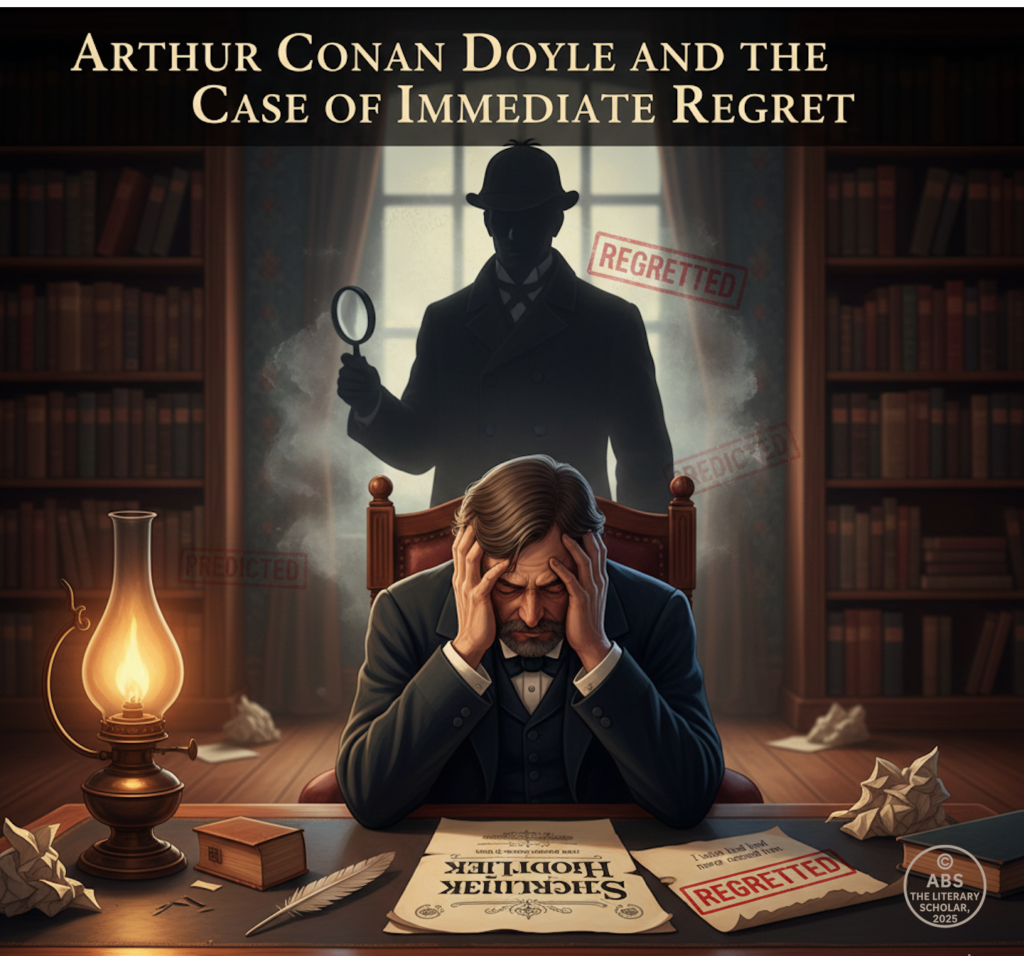
Sir Arthur Conan Doyle
The Genius Who Created Sherlock Holmes and Then Tried to Replace Him With Ghosts.
Every writer makes questionable choices, but Sir Arthur Conan Doyle took the cake, fed it to spiritual beings, and insisted they were real. The man who gave the world its most rational detective suddenly decided that fairies, séances and floating spirits were the future of intellectual life. Readers were not amused. Sherlock Holmes was busy solving crimes with logic and deduction while his creator was attending tea parties with invisible guests.
It is one of literature’s great ironies. Conan Doyle wrote the most brilliant rationalist in fiction, yet personally abandoned reason at the door like an umbrella on a rainy day. And this was not a passing hobby. This was a full conversion. He lectured about spirits. He defended psychic mediums. He believed in the Cottingley Fairies as if they were paying rent.
Conan Doyle did not simply lose the plot. He misplaced the entire genre.
“The creator of Sherlock Holmes tried to convince the world that fairies posed for photographs.”
The backlash was immediate. Readers wanted murder and deduction. Conan Doyle wanted spirit photography. Readers wanted clues. He wanted clairvoyance. The two sides were destined for a dramatic literary custody battle, and everyone knew which child was the favourite.
Holmes remained the rational adult in the room while Doyle wandered further into mystical enthusiasm. Newspapers mocked him. Scientists laughed. His fans pretended to look away. Even his friend Harry Houdini kept trying to explain that mediums were performing tricks, not contacting the dead. Doyle refused to reconsider. He believed the dead were practically hosting weekend brunches through psychic channels.
This was the moment literature learned that even brilliant minds can do wild things when boredom strikes.
“His biggest regret was not the fairies. It was underestimating how loudly readers would protest.”
The problem was not that Conan Doyle enjoyed spiritualism. The problem was that he tried to promote it as serious truth while simultaneously killing off Sherlock Holmes in The Final Problem. And that was the unforgivable part. If writers want to dabble in questionable beliefs, readers will tolerate it. But kill their favourite detective, and suddenly spiritualism begins to look like a personal attack.
The public revolt forced Doyle into literary repentance. People mourned Holmes more dramatically than some mourn actual relatives. Readers wore black armbands. Fans stormed newspaper offices. Critics wrote essays about betrayal. Doyle was horrified. He had expected applause for freeing himself from his fictional burden. Instead, he received rage mail.
Regret arrived politely at Doyle’s door and unpacked its luggage.
“He tried to escape Holmes, but Holmes refused to stay dead.”
Under pressure, Doyle resurrected Holmes, a decision that must have tasted like swallowing pride with a side of ghost infused tea. Meanwhile his spiritualist works aged like milk left on a sunny windowsill. His detective stories remain classics. His séance era remains a cautionary tale.
What Doyle never fully understood was that readers forgive flaws, mistakes and experiments. What they do not forgive is literary abandonment. Holmes was their compass. Doyle was supposed to be the captain. Instead he attempted to sail into the fog of spiritualism and leave everyone behind.
The universe responded by forcing him to bring Holmes back whether he liked it or not.
Conan Doyle did not just regret an idea. He regretted underestimating his own creation.
The result is one of the most fascinating chapters in literary history. A genius who tried something wild, soared into mystical skies and was promptly yanked back to earth by a detective with a pipe, a sharp mind and absolutely no patience for nonsense.
Part One closes with a simple lesson.
Writers may abandon their stories.
But their stories do not always agree.
2.
JAMES JOYCE
James Joyce and the Novel He Wanted to Pretend Never Happened
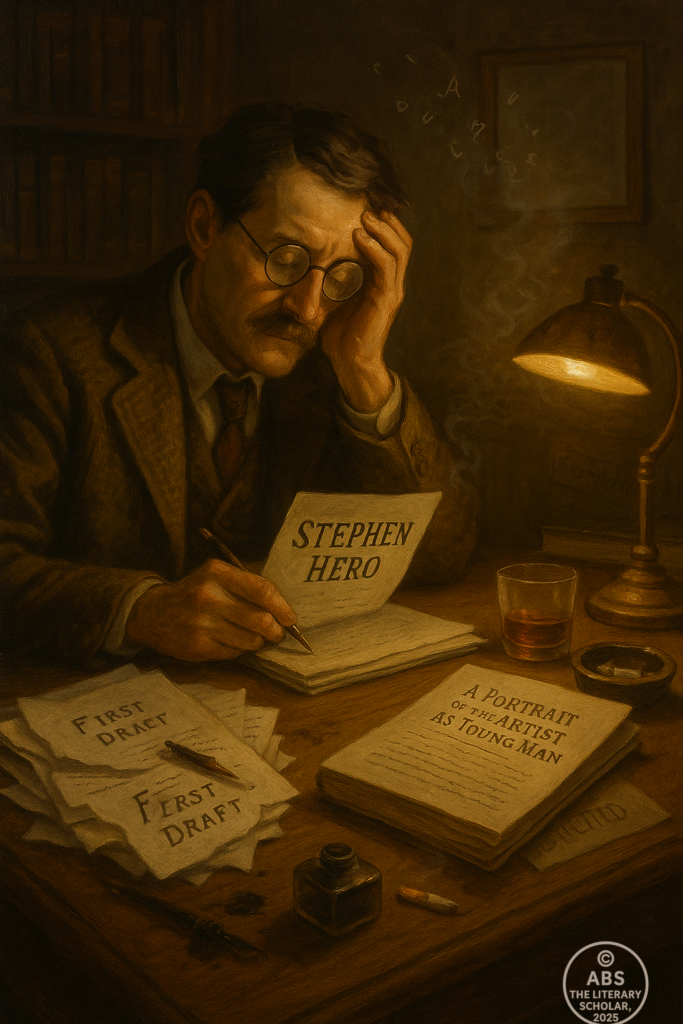
Before James Joyce became the patron saint of difficult literature, he wrote something so ordinary, so painfully normal, that he spent the rest of his life pretending it did not exist. The book is Stephen Hero, the earliest version of what would become A Portrait of the Artist as a Young Man. Joyce abandoned the manuscript halfway through, rewrote the entire thing and then acted like the first attempt had never happened.
Writers call this revision.
Joyce called it self defense.
He read his own draft and realised that the work was dangerously close to being understandable. The horror. Readers might actually follow the plot. Characters might speak like humans. Sentences might obey gravity. Joyce was not ready for this level of clarity. So he did what every ambitious writer does when the work feels too normal. He destroyed it and rebuilt it into something gloriously complicated.
Joyce did not revise a book. He escaped it.
“Stephen Hero was so straightforward that Joyce abandoned it out of creative panic.”
The most amusing part is that Stephen Hero is not bad. It is simply readable. It has a clear narrative. It follows young Stephen through school, family conflict and intellectual rebellion. There are emotions that resemble emotions. There are scenes that resemble scenes. Joyce realised he had accidentally written a novel that could be explained to other people.
Absolutely unacceptable.
So he tore it apart.
He broke its spine.
He rebuilt it into A Portrait of the Artist as a Young Man, a book that tries very hard to look like normal narrative but keeps drifting into something stranger, richer and unmistakably Joyce.
Joyce was allergic to simplicity.
“If Stephen Hero had survived, Joyce’s reputation for difficulty would have been in danger.”
His regret was not emotional. It was strategic. Stephen Hero exposed a version of Joyce that was tidy. Linear. Traditional. He could not allow that. He preferred a style that felt like thought in motion, bursting out with intensity, contradiction and lyrical rebellion. The older Joyce would have looked at Stephen Hero and said, This is fine for someone else, but not for me. Then he would have quietly set it on fire.
Modern readers treat the manuscript like archaeological treasure. It is the key to understanding Joyce before Joyce became Joyce. It shows the early scaffolding of his ideas. The softer edges of his artistic ego. The more polite version of a writer who later decided that politeness was optional.
Joyce regretted the draft because it lacked the chaos he needed to tell the truth.
“Some writers regret mistakes. Joyce regretted clarity.”
What makes his regret fascinating is that it created something extraordinary. If Joyce had not abandoned Stephen Hero, he would never have discovered the voice that defines modernist literature. That voice came from frustration, not confidence. It came from recognising that the safe version of the story was not good enough.
Joyce did not discard the draft because it was weak. He discarded it because it was obedient. And genius does not obey. Genius burns the draft, rewrites it and pretends it never happened.
Joyce did not lose a book. He gained a legend.
T. S. Eliot
The Poet Who Tried to Edit His Own Regret Out of Existence
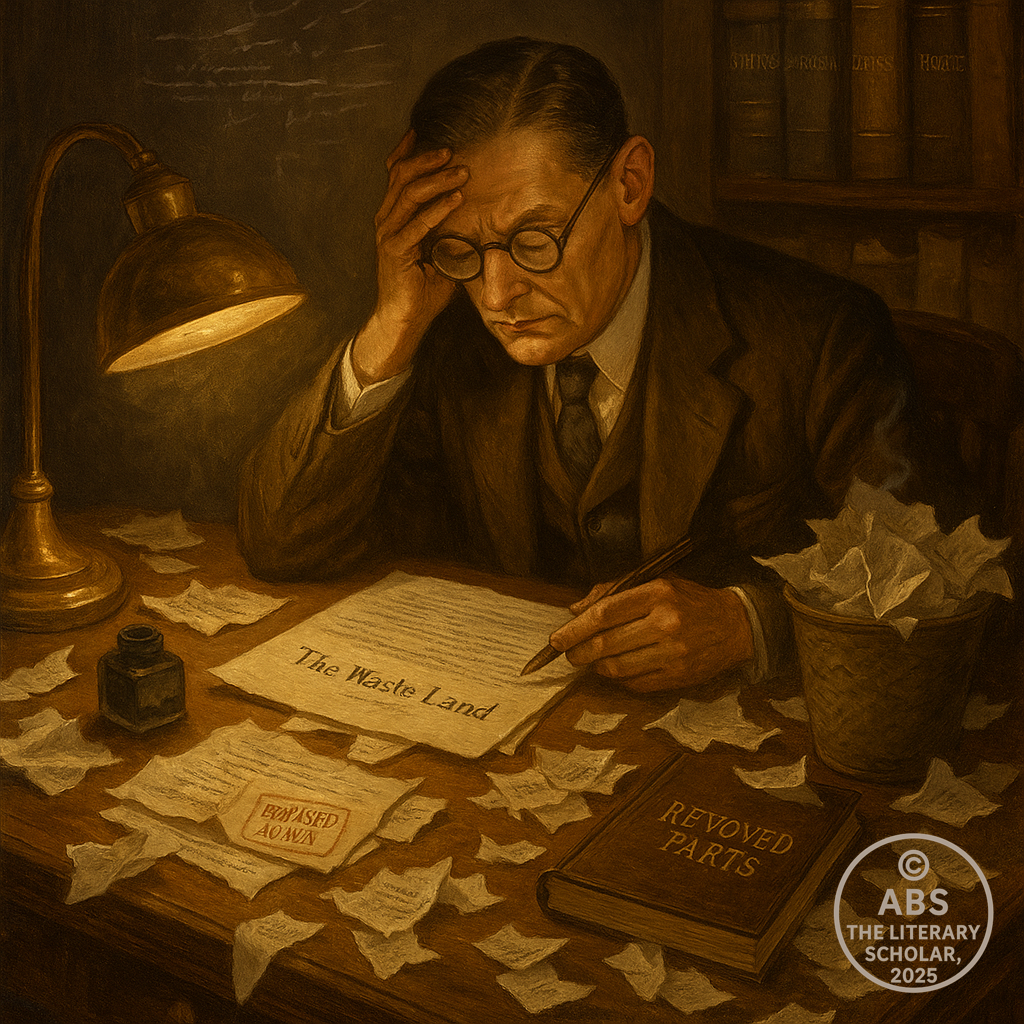
T. S. Eliot spent his career polishing poems until they sparkled like glass shards. Beautiful. Precise. Painful if touched incorrectly. But before he became the high priest of modern poetry, Eliot wrote a youthful collection titled Poems that he would later spend years trying to bury under the floorboards of literary history. It was emotional. It was raw. It was messy. In other words, it was everything Eliot did not want people associating with the future author of The Waste Land.
So he tried to destroy it. Not metaphorically. Literally.
He asked friends to burn copies. He asked publishers not to reprint it. He behaved like someone who drunkenly texted the wrong person and then tried to steal their phone before they read it.
Eliot was not escaping bad poetry. He was escaping his own younger self.
“Every writer has a past work that feels like an uninvited guest.”
What Eliot regretted was not the content alone. It was the exposure. The vulnerability. The fact that these early poems revealed how much he felt before he learned how to disguise feeling with technique. They were the emotional sketches that came before the masterpiece. They showed a poet in formation. And nothing horrifies a perfectionist more than evidence of becoming.
When The Waste Land arrived, Eliot became the grim architect of modern poetry. Dignified. Intellectual. Controlled. Meanwhile, his youthful poems stood in the corner like embarrassing relatives waving enthusiastically at the critics. Eliot wanted them gone. Scholars wanted them preserved. One side was behaving emotionally. The other side called it literary integrity. Both sides were correct.
Great writers do not regret mistakes. They regret the versions of themselves they outgrew.
“Regret is simply the artist arguing with yesterday.”
Eliot’s panic over his early work reveals something universal about creative people. They all begin with sincerity, and sincerity is mortifying. There is nowhere to hide. No technique to shield you. No layers of meaning to confuse readers into thinking you are smarter than you feel. Young Eliot wrote poems with his guard down. Older Eliot built an empire of suspicion, layering the world with fragments and footnotes and a studied seriousness that made everyone forget he ever had emotional impulses.
The tension between these two Eliots is what gives this story its charm. It is a reminder that even the most formidable intellectuals began as ordinary writers who experimented, stumbled and occasionally wished the earth would swallow their early work.
Regret is the tax that talent pays to time.
“Art lives forever. Artists do not. Their mistakes do not cooperate.”
Of course, the universe loves irony. The more Eliot tried to erase those poems, the more scholars wanted to study them. He accidentally created the most academic form of scarcity. Today, his early poems are not just preserved. They are dissected. Annotated. Collected. Expanded. Everything he feared they would become.
His attempt to erase them made them immortal.
What Eliot teaches us is simple.
Writers cannot control how the world receives their work.
They can only control how loudly they beg for it to disappear.
And even that often fails.
Eliot’s youthful poems survived because regret is powerless against curiosity.
A poet can destroy drafts but cannot destroy history.
Once a work enters the world, it grows legs, lights a cigarette and walks around without permission.
T. S. Eliot did not regret writing poetry.
He regretted letting anyone read it too soon.
The world, naturally, thanked him by reading it forever.
4.
D. H. Lawrence
The Writer Who Tried to Outrun His Own Scandal
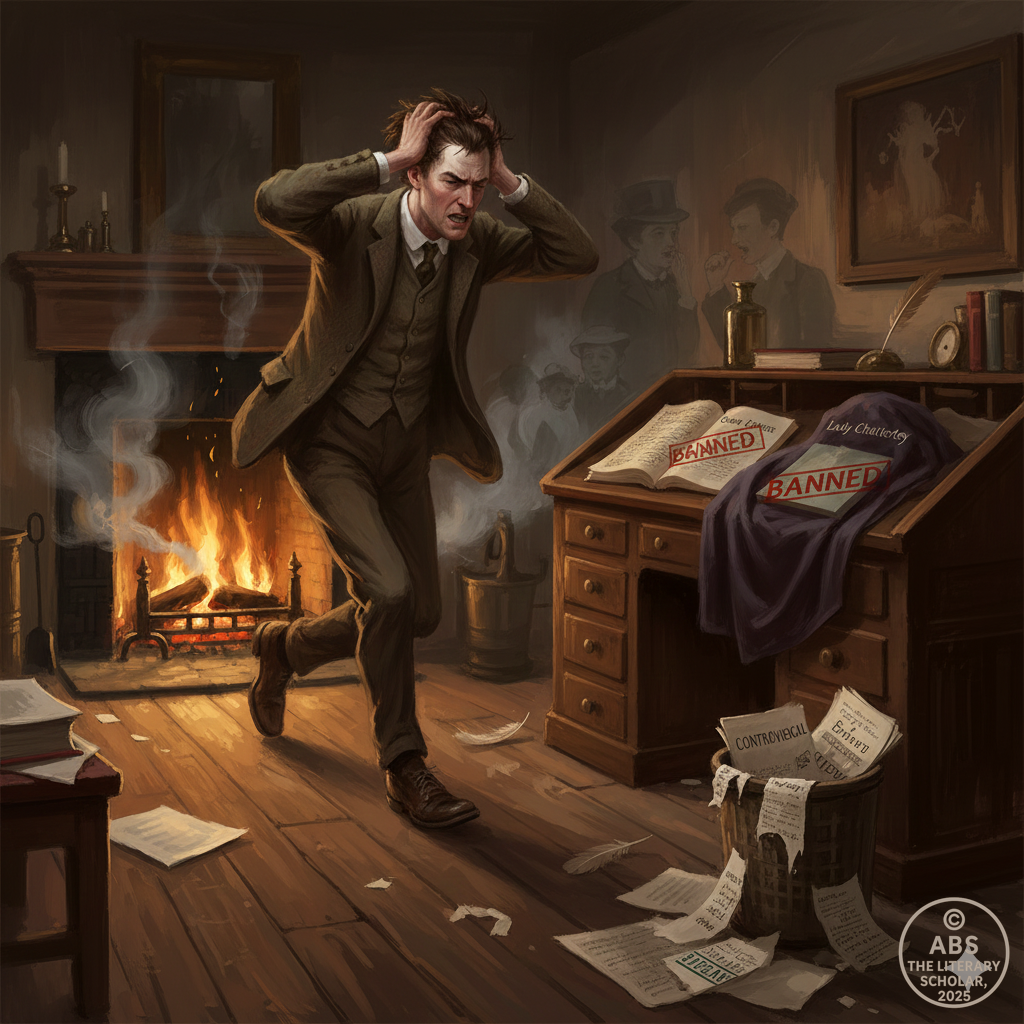
D. H. Lawrence spent his career wrestling with one enemy that never stopped winning. Outrage. Every time he published something bold, someone else published a complaint. Lawrence wrote about bodies, desire, emotion and the parts of human life everyone pretended did not exist. His punishment was simple. People pretended he should not exist either.
Among his many controversial works, the one he grew visibly tired of defending was The Rainbow, a novel that dared to treat intimacy like a natural human experience instead of a Victorian secret covered with lace and denial. The book was banned almost immediately for being morally corrupting, socially destabilising and, worst of all, honest.
The backlash grew so loud that Lawrence found himself permanently exhausted by the novel’s reputation. He wanted to discuss symbolism, psychology, human connection and spiritual longing. Society wanted to discuss page numbers that made them blush.
Lawrence did not regret writing the book. He regretted the world refusing to read it like adults.
“People attacked the novel for revealing what they already knew and feared others might notice.”
The truly tragic comedy of Lawrence’s career is that he kept trying to move forward while the world kept dragging him back to his scandals. He wrote poetry. Essays. Short stories. Philosophical reflections. Travel books. He explored the limits of human consciousness with an intensity that terrified polite society. Yet everywhere he went, people brought up The Rainbow as though it were a crime scene.
Lawrence wanted his career to be a cathedral. The public wanted it to be a courtroom.
He spent his life writing about liberation while being chained to other people’s embarrassment.
“His novel was banned for being human. Not explicit. Human.”
What Lawrence feared most was not censorship. It was misreading. He believed that intimacy in literature was not a cheap thrill but a mirror. A way of cutting through the polite fictions society used to avoid self interrogation. He wanted literature to reveal, not decorate.
The world wanted decoration.
The result was predictable. Lawrence wrote with sincerity. Readers responded with scandal. He offered emotional truth. Critics offered moral panic. He invited people to face themselves. People filed complaints instead.
By the time he reached the later stages of his career, Lawrence had grown almost allergic to hearing the title The Rainbow. He believed he had created something spiritually exact and emotionally daring. Society insisted he had created a problem.
Regret is not always about the work. Sometimes it is about the audience.
“Lawrence did not regret the novel. He regretted the century.”
His letters reveal a man who desperately wanted to be understood. Not praised. Not forgiven. Understood. He longed for a readership capable of reading without fainting. He hoped for critics who could debate ideas instead of counting moral impurities like tax auditors of the soul.
He died believing the world would never catch up.
Ironically, the world eventually did. The novel that once destroyed his peace is now taught, analysed, respected and celebrated. A century too late, society finally grew into the courage Lawrence expected from them.
He did not write a scandal.
He wrote a future.
The scandal was the present.
5.
Ernest Hemingway
The Man Who Spent a Lifetime Pretending His First Novel Did Not Exist
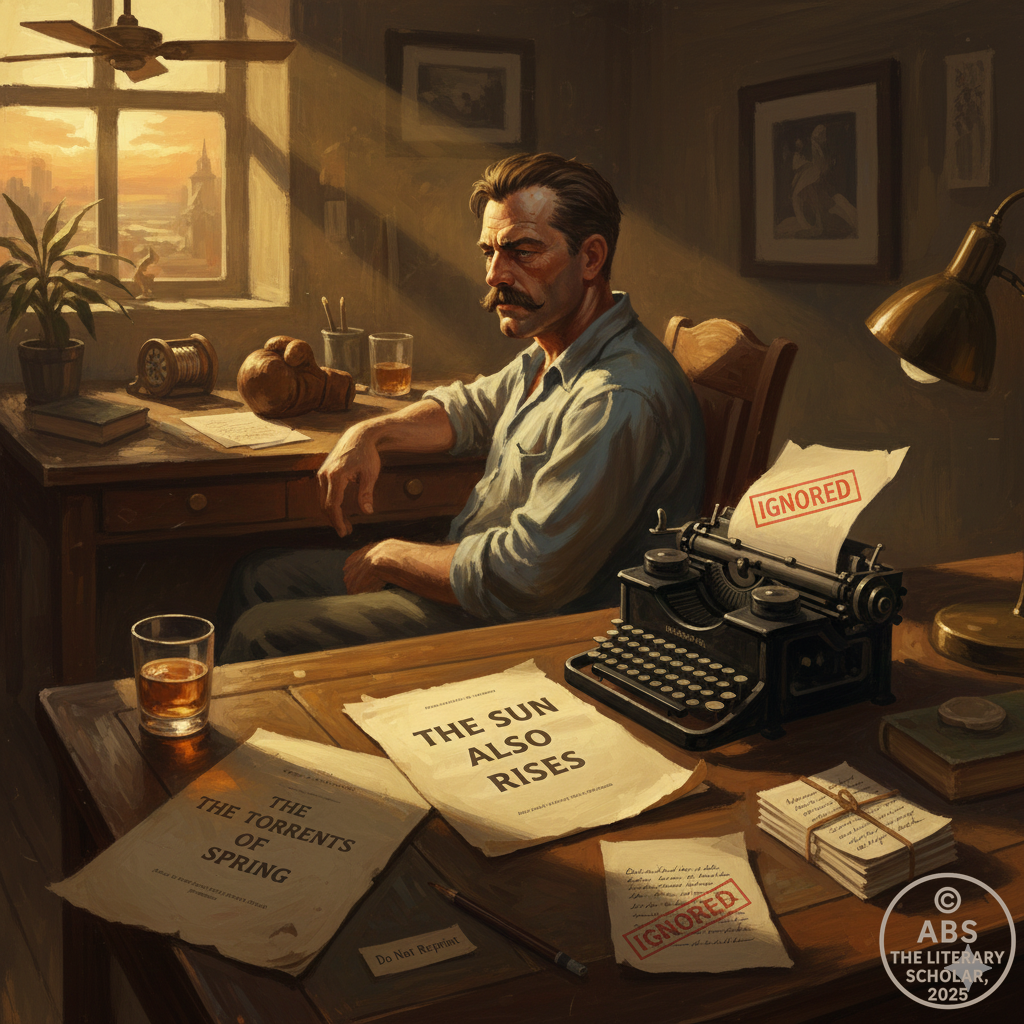
There are literary regrets, and then there is Ernest Hemingway’s towering, muscular refusal to acknowledge that his very first full length book ever happened. Before the world got the clean sentences, the bullfights, the stoic men drinking stoic drinks, Hemingway wrote something that did not quite fit the legend he later constructed. And instead of embracing it, he spent decades treating it like an embarrassing tattoo obtained during poor judgment and cheap rum.
The novel in question, The Torrents of Spring, was a parody. A silly one. A rushed one. A book he later described with the emotional enthusiasm of a person discussing medical bills. Hemingway wrote it to break a contract, to get out of an unwanted publisher, and to leap into the arms of a far more impressive one. The book served its purpose. He got the contract he wanted.
And then he spent the rest of his life wishing the book would quietly dissolve into mist.
Hemingway did not regret writing. He regretted being young enough to write impulsively.
“The best writers edit. The great writers erase their own pasts.”
What bothered him was not the humor. He liked humor. What bothered him was that The Torrents of Spring looked nothing like his later image. It was chaotic, unserious, almost slapstick. It contradicted the carefully carved persona he curated: the man of precision, restraint, economy and emotional minimalism.
Hemingway wanted to be a myth, and myths do not begin with parodies written to escape contracts. They begin with perfect manuscripts arriving at the right publisher like loyal hunting companions.
But reality is far less poetic. His career began with a joke. A joke he outgrew. A joke he tried to quietly bury under success, fame and a wall of masculine silence.
Every writer has a draft they hope nobody finds. Hemingway simply published his.
“The book was not bad. It was just wrong for the man he wanted to become.”
The funniest part
The book is not a disaster. It is clever. Sharp. Comedic. But Hemingway did not want to be clever. He wanted to be monumental. He wanted to write sentences with the weight of thunderstorms. He wanted to build a legacy without cracks. And this early work was a crack he could not plaster over.
In the grand literary tradition of denial, he refused to discuss it. Critics avoided it. Fans did not know it existed. Publishers quietly rejoiced. The novel became the most polite scandal in literary history: everybody understood they were not supposed to mention it.
Hemingway’s regret teaches something important about literary identity. Writers do not fear failure. They fear contradictions. They fear the version of themselves they left behind. They fear the immature work that exposes how long the path to mastery truly was.
Regret is not about quality. Regret is about identity.
“He wanted to be a monument. But monuments do not have early drafts.”
Hemingway tried to revise history by erasing the parts that did not flatter him. It did not work. Nothing ever fully disappears in literature. Especially not the first book a writer tried to pretend was a clerical mistake.
He did not regret the writing.
He regretted the reminder that he was once human.
6.
F. Scott Fitzgerald
The Brilliant Novelist Who Wrote One Play And Immediately Wished He Had Not
There are literary failures.
There are artistic miscalculations.
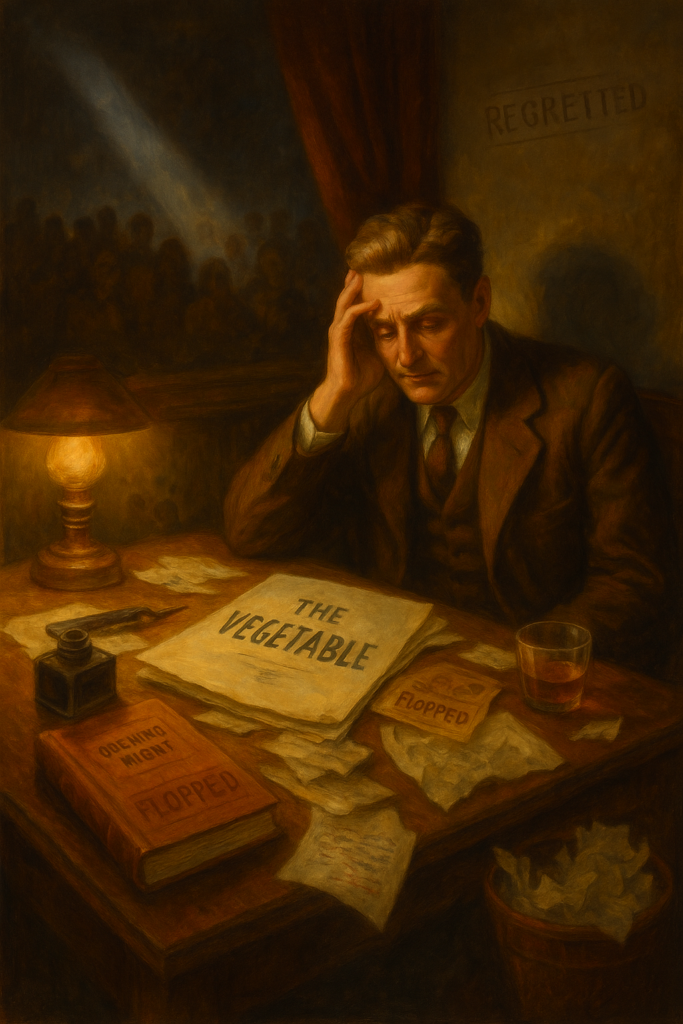
And then there is The Vegetable, F. Scott Fitzgerald’s theatrical catastrophe that arrived on stage, tripped over the curtain, fell into the orchestra pit and stayed there.
Fitzgerald wrote The Great Gatsby.
He understood glamour.
He understood tragedy.
He understood the human condition dressed in glitter and sorrow.
But when he attempted a political satire for the stage, he created something so spectacularly confused that audiences sat in stunned silence, wondering whether they had accidentally walked into the wrong building.
It was the kind of disaster that makes even brave writers consider a career in accounting.
“Fitzgerald called it a fiasco. The critics were far less kind.”
The story followed a man who wants to become the Postmaster General and then President. It was meant to be funny. It was meant to be sharp. Instead, it performed the rare trick of being both chaotic and boring at the same time. Viewers could not follow it. Actors could not save it. Fitzgerald himself could not explain how it had gone so wrong.
The premiere was a nightmare.
Audience members began leaving before the second act.
Some left before the first act ended.
Some left spiritually while still sitting in their seats.
The play collapsed with more energy than it was written with.
“People blamed the script. Fitzgerald blamed himself.”
After the humiliation, Fitzgerald did something extraordinary. He tried to erase the play from existence. He discouraged people from reading it. He joked about it in letters. He refused to discuss it in interviews. And unlike many authors who secretly still love their failures, Fitzgerald genuinely wanted this one gone.
What makes The Vegetable fascinating today is not the play itself. It is the psychology behind it. Fitzgerald was a masterful writer with a fragile confidence. He put enormous pressure on his success. When the play failed, he internalised it with such intensity that it became part of his mythology.
He treated the failure as a personal scandal rather than an artistic experiment.
“Fame is loud. Failure is louder.”
The irony, of course, is that the failure helped him. It pushed him back into fiction. It drove him toward the emotional landscapes that became his legacy. Without the collapse of The Vegetable, would the world have received Tender Is the Night in the form we know
Would he have sharpened his emotional honesty as powerfully
Sometimes writers run from their mistakes and accidentally run straight into brilliance.
What Fitzgerald teaches today is simple.
Great writers are not protected from bad ideas.
Inspiration does not always behave.
Even geniuses wander into creative deserts.
The difference is what they do after the sandstorm passes.
Fitzgerald did not defend his mistake.
He did not glorify it.
He did not pretend it was misunderstood genius.
He acknowledged the failure and kept writing.
His career survived because his ego did not.
“Every artist has a drawer of pages that should never see daylight. Fitzgerald’s just happened to be performed on stage.”
The beauty of regret in literature is that it reveals the human behind the masterpiece. Fitzgerald wanted to be great. He feared being ordinary. And nothing feels more ordinary than a flop. Yet time has been generous. The world remembers Gatsby. The world remembers the Jazz Age glow. The world remembers the melancholy.
The world does not remember The Vegetable.
And that is exactly how Fitzgerald wanted it.
He tried something wild.
He regretted it loudly.
And then he wrote himself back into immortality.
7.
Mary Shelley
The Genius Who Wrote A Masterpiece And Spent Years Wishing It Behaved Better
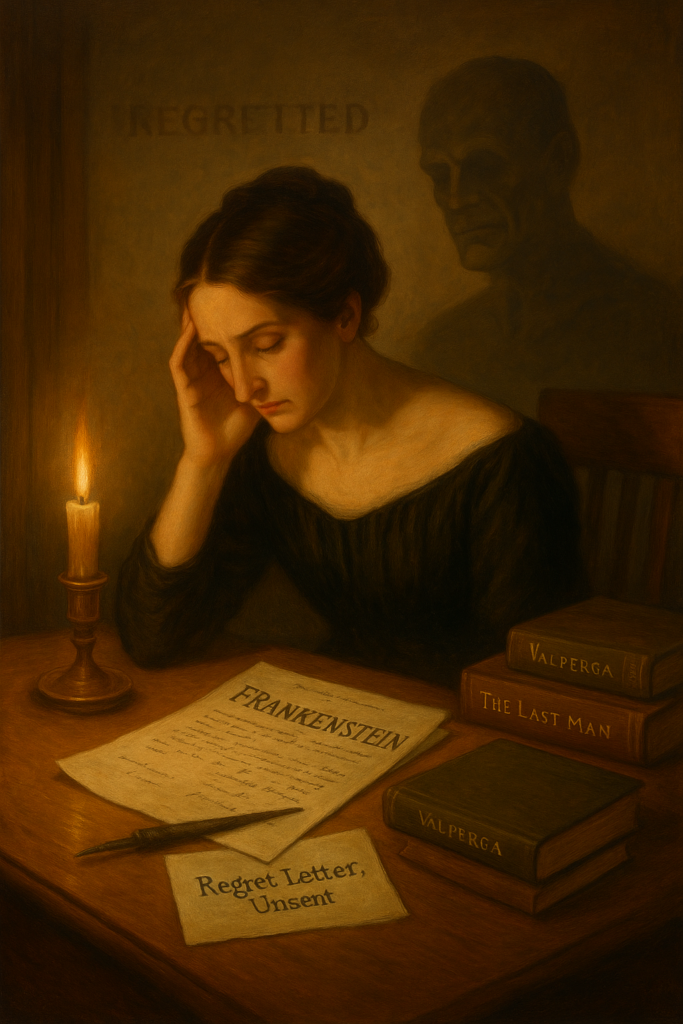
Mary Shelley is remembered as the prodigy who wrote Frankenstein at nineteen, redefining science fiction before science even understood what it was doing. But what people forget is that Shelley did not spend the rest of her life celebrating the novel. She spent much of it wrestling with it.
Her creature refused to obey her.
Her fame refused to behave.
Her legacy insisted on making her uncomfortable.
Shelley never disowned Frankenstein, but she often wished the world would stop treating it like her entire personality. What she regretted was not the creation. It was the afterlife of the creation.
The book became louder than the author.
And that is a very modern problem.
She feared the novel would trap her inside her own success.
“The monster walked out of the book and refused to leave her alone.”
Shelley’s letters reveal a complicated relationship with her novel. She wanted to be known for her other works. She wanted critics to acknowledge her historical writing, her essays, her biographies, her mature novels. Instead, the world pressed its nose against the glass of Frankenstein and refused to look away.
Her regret was subtle, elegant and painful.
She worried the book would swallow the woman.
Shelley tried to revise the text, soften it, refine it, distance herself from the audacity of her teenage imagination. She rewrote the introduction. She edited the tone. She adjusted the voice. She tried to tidy the chaos.
But genius does not negotiate.
Frankenstein refused revision.
“The story was stronger than her intentions.”
She regretted the fact that people misunderstood her message. The creature was meant to be the victim. Instead, he became a Halloween mascot. Victor was meant to be the moral failure. Instead, people called him a visionary. Shelley watched the world perform literary gymnastics and sighed politely in the background.
Her regret was not embarrassment. It was exasperation.
She had written a warning, and the world turned it into entertainment.
Shelley’s later prefaces read like carefully phrased apologies for the storm she unleashed. She respects the work. She does not resent it. But she carries the unmistakable tone of someone wishing she could whisper, Please do not judge me forever by the book I wrote before my adult brain was installed.
Every gifted teenager eventually grows up.
Not every gifted teenager accidentally creates Western literature’s most indestructible metaphor.
Her regret was not the book. It was being frozen inside it.
“She created a myth and lost custody of it.”
Mary Shelley did not disown Frankenstein.
But she outgrew it, and the world stubbornly refused to notice.
This is the quiet tragedy of being a young genius. People remember the creation.
Not the creator.
Thomas Hardy
The Novelist Who Watched His Own Book Get Scandalised Into Oblivion
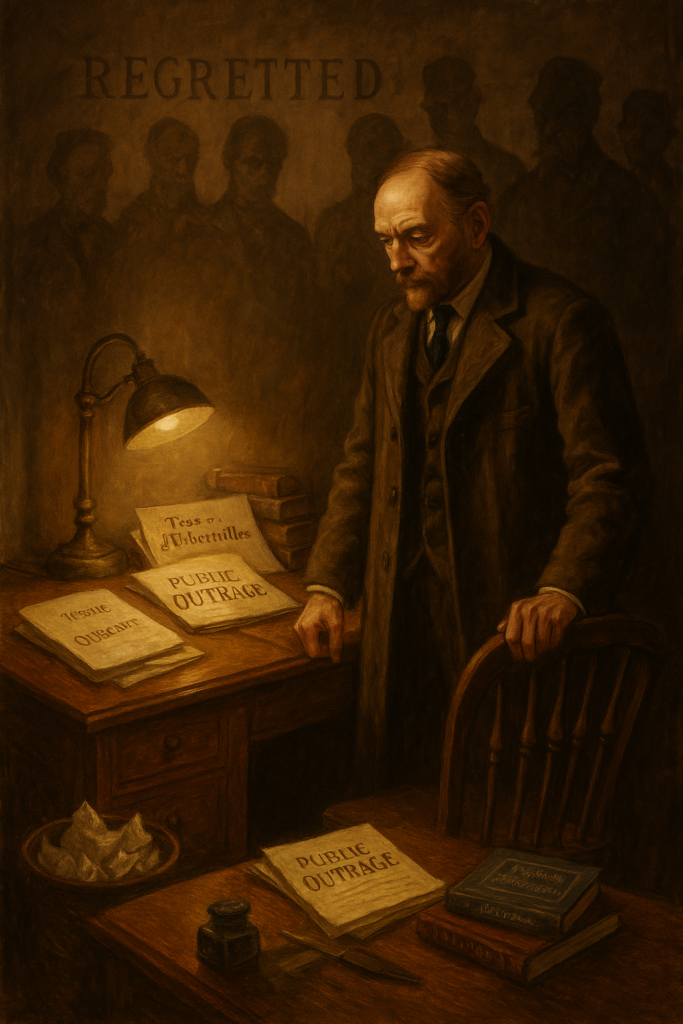
Thomas Hardy did not regret writing Tess of the D Urbervilles.
He regretted publishing it around humans.
Hardy wrote Tess with an intensity that burned through every page. He wanted readers to see her as pure, tragic and morally luminous. Victorian critics responded with the delicacy of a brick through a window.
Hardy watched in disbelief as reviewers called Tess immoral, improper, dangerous, unfit for respectable households and a threat to social decency.
Hardy did not regret the novel. He regretted the species reading it.
“Tess offended people who specialised in being offended.”
The backlash was so intense that Hardy began revising the text simply to survive it. He softened scenes. He rewrote descriptions. He tried to appease the moral police. Nothing worked. The public insisted on being outraged.
Victorian society had a remarkable ability to misunderstand literature while sounding confident about it. Hardy learned this the hard way.
He realised that he had created something too honest for a century addicted to pretending.
Tess’s trauma was too real.
Her choices were too human.
Her fate was too uncomfortable.
And nothing upsets a moralist faster than accuracy.
Hardy began to resent the entire process of writing novels. The endless edits. The censorship. The purity committees. The publishers who flinched at honesty. The audiences who attacked the book for revealing truths they were desperate to avoid.
He did not regret writing Tess. He regretted writing for people who preferred lies.
“Readers wanted entertainment. Hardy gave them humanity. They hated him for it.”
Then came Jude the Obscure, a novel so heavily criticised that Hardy basically put his pen down and walked away from fiction entirely. He abandoned the form. He turned to poetry. He shut the door on the Victorian novel with the exhaustion of a man who had given literature more than it deserved.
Hardy’s regret was not scandal.
It was fatigue.
He realised that writing truth in a dishonest culture feels like volunteer torture.
His final years reveal a resigned acceptance. He did not apologise for his novels. But he did regret the noise that followed them. The endless explanations. The distorted interpretations. The fury directed at characters who had done nothing wrong except exist.
Hardy wanted to show the human heart.
The world wanted melodrama.
The mismatch broke him.
“He wrote literature. His critics read theatre.”
Thomas Hardy did not disown his work.
He disowned the environment surrounding it.
And honestly
who can blame him.
Writers like to pretend they are in control of their own genius, but the truth is far less flattering. Most of these authors wrote their regretted works when they were young, hungry, impulsive, or simply desperate to prove they were clever. Youth hands you confidence long before it hands you judgment, which is how masterpieces and disasters are often born in the same decade.
What came later, of course, was experience. Life has a way of rearranging the furniture inside the mind. The same sentences that once looked thrilling begin to look reckless. A character once admired begins to feel embarrassing. Entire chapters begin to smell of self importance. With maturity comes the painful realisation that your past self had the pen before your present self grew the wisdom.
What these writers regretted was not the act of writing but the version of themselves who wrote. They evolved, their ideas evolved, and their sense of responsibility evolved. Literature, unfortunately, does not evolve with you. It stays exactly as foolish or as brilliant as the day it was printed.
And their regrets whisper a simple truth that every writer knows but refuses to say aloud: creation is easy, comprehension is slow. The world judges instantly. Writers judge themselves forever.
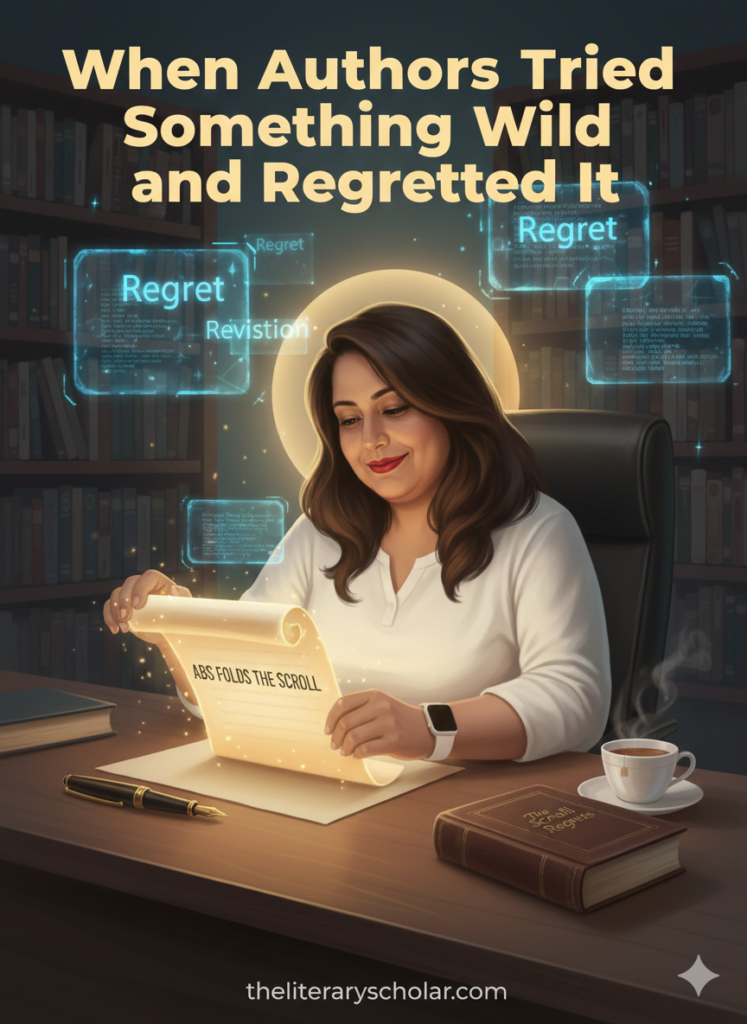
ABS Folds the Scroll
The scroll is finished, the ink settles, and ABS folds it with the thoughtful caution of someone who has just watched great writers apologise to their own pages. The gesture is quiet, deliberate, almost amused.
There is a flicker of suspicion in the air. ABS seems to wonder if tomorrow’s self will look at today’s scroll and mutter the universal writer’s lament: “What was this person thinking?” The scroll is folded anyway, because regret is a problem for the future and creation belongs to the present.
The crease is firm. The smile is subtle. The scroll is done.
ABS folds the scroll.

Abha Bhardwaj Sharma is a Professor of English Literature with over 25 years of teaching experience. She is the founder of Miracle English Language and Literature Institute and the author of more than 50 books on literature, language, and self-development. Through The Literary Scholar, she shares insightful, witty, and deeply reflective explorations of world literature.
Share this post / Spread the witty word / Let the echo wander / Bookmark the brilliance