The world, as it turns, produces absurdity in relentless abundance. From the moment the sun rises to the unholy hour when the moon glares down, life presents situations so trivial, so ordinary, and yet so undeniably ridiculous, that laughter becomes not merely optional but necessary. It is in the small, everyday spectacles, the little contradictions, unspoken ironies, and quiet disasters, that the modern human finds comedy.
Humanity is, as T.S. Eliot observed, “full of petty, trivial pursuits,” and the more one observes the rhythms of daily existence, the more the absurd becomes evident. The minor catastrophes of ordinary life, a conversation interrupted by technology, an unexpected obstacle in a perfectly mapped day, a gesture of human illogic repeated a hundred times in different forms, form an ongoing theater of the ridiculous. There is a poetry to these moments, a secret rhythm in the chaos, and the clever reader finds humor where the unobservant sees mere inconvenience.
Poets and writers have long noted this propensity. Alexander Pope, with his acerbic wit, remarked that “a little learning is a dangerous thing,” a maxim that applies as much to human interactions as to encyclopedic knowledge. Indeed, people stumble, fumble, and contradict themselves in ways that would make even the most disciplined logician despair. It is in this very struggle, this constant misalignment of expectation and reality, that the comic genius of daily life emerges.
The modern world, with its constant buzz of information and relentless demands on attention, provides a particularly rich canvas. Every minute is filled with unnoticed absurdities, tiny paradoxes, brief humiliations, and fleeting, unrecorded triumphs. These are the moments that reveal the human condition at its most contradictory. William Blake’s admonition that “the road of excess leads to the palace of wisdom” resonates here, for the excess of routine and ritual often produces the most unexpectedly hilarious moments, whether it is the futility of a plan gone awry or the sheer stubbornness of everyday objects resisting their intended purpose.
This is humor without malice, irony without cruelty. It is the quiet, shared recognition of the oddities that make life simultaneously exasperating and delightful. As Jane Austen knew, “It is a truth universally acknowledged that a single man in possession of a good fortune must be in want of a wife,” but equally, it is a truth universally acknowledged that humans will create endless, laughable complications out of situations that require no effort whatsoever. Literature has always found its mirrors in these moments, the comedies of Shakespeare, the social satires of Swift, and the subtle ironies of Frost all capture the uncanny humor of ordinary experience.
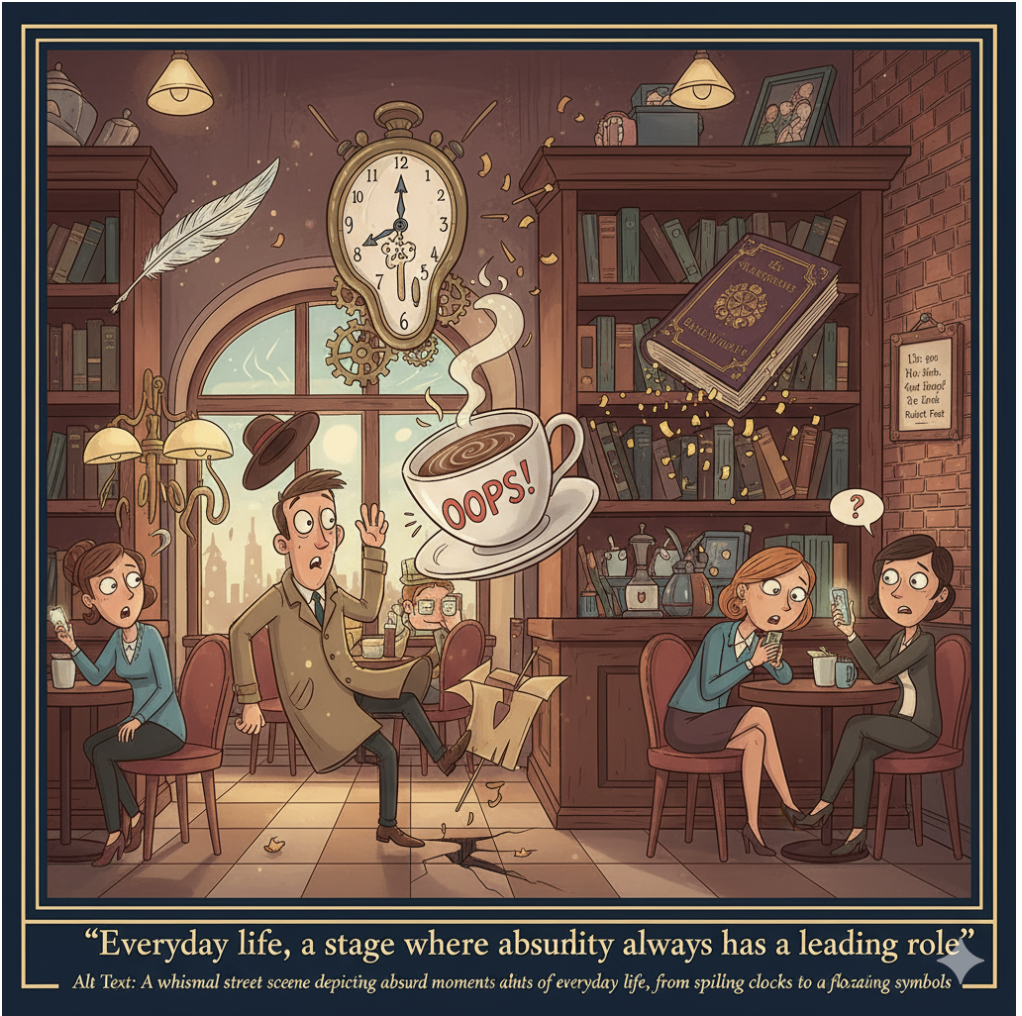
The funny side of life is not manufactured. It is discovered, revealed in the micro drama of the mundane. In elevators, offices, kitchens, streets, and bedrooms, the everyday conspires to remind humans of their inherent absurdity. As Robert Frost suggested, “The best way out is always through,” and perhaps that is why so many modern moments of comedy involve navigating the banal, the inconvenient, and the inexplicably stubborn. Humor arises not in spite of life’s tedium but because of it, a spontaneous response to the constant friction between expectation and reality.
 Echoes Between Coffee and Chaos