
A Diary of Life’s Little Survival Hacks
1. Monday Mornings Smell Like Espresso and Regret
Proof that the only thing stronger than caffeine is collective denial.
There are many theories about why human civilisation is in crisis. Some blame politics, some blame capitalism, some blame climate change. Personally, I blame Mondays. Nothing has ruined more lives, caused more heartbreak, or led to more broken alarm clocks than the single catastrophic idea of “let us all begin the week on Monday.”
Monday is not a day, it is an enemy state. It is a conspiracy cooked up by sadists who believed human beings should suffer at regular intervals to stay humble. Friday is a flirt, Saturday is a lover, Sunday is a nap, but Monday is a judgmental aunt who barges into your house without knocking and comments on how much weight you have gained.
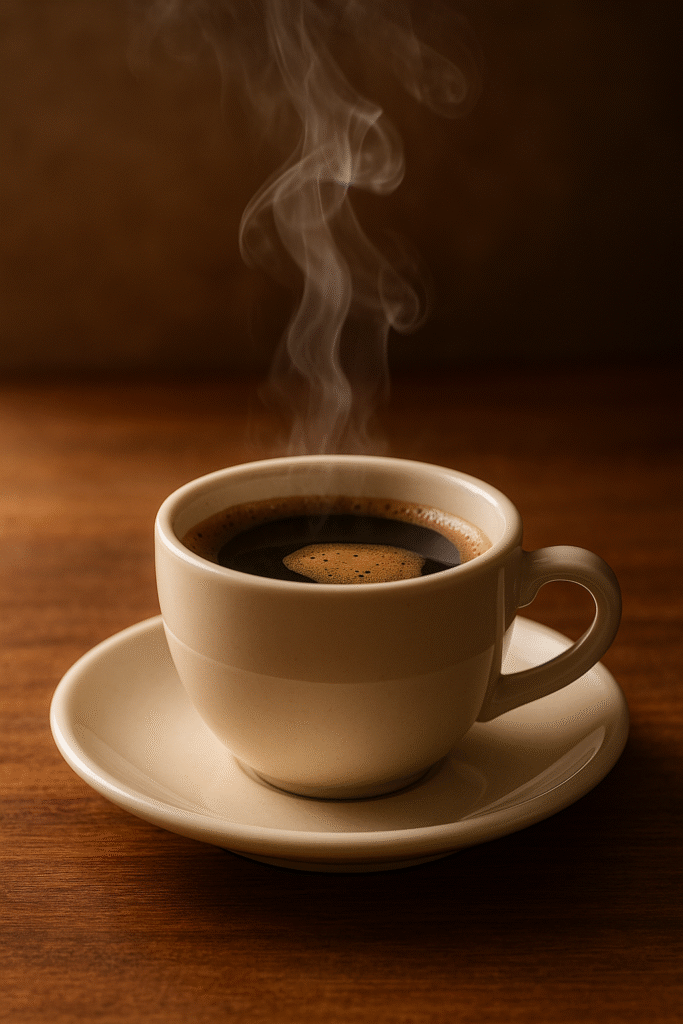
The only weapon against this monster is coffee. The darker the roast, the stronger the shield. Coffee does not solve your problems but it stages a polite negotiation with reality. One sip and the chaos of existence agrees to give you thirty seconds before striking again. Which is why Monday mornings always smell like espresso and regret. Espresso because we are trying to function. Regret because we know it is not going to work.
Take the case of Claire Morgan. Claire is a thirty four year old marketing executive in London who genuinely believes in productivity apps. On Sunday night, she laid out her gym clothes, prepared a list titled “Monday, fresh start,” and placed her oat milk latte pods in a row like soldiers preparing for war. She went to bed at ten thirty, dreaming of a glorious Monday where she would rise like a goddess, meditate, exercise, and arrive at the office looking as if Vogue had invited her for a cover shoot.
At six thirty, Claire opened her eyes to the sound of her alarm and immediately made a life altering decision. She pressed snooze. Five times. By the time she staggered to the kitchen, she was already late, and her goddess aura had dissolved into the smell of burnt toast. Her oat milk latte pod slipped from her hand, rolled under the fridge, and she had to make do with regular espresso that tasted like betrayal.
Still, she soldiered on. She put on a white blouse, the exact white that should be illegal on Mondays. She rushed to the station, only to discover that her train was cancelled because someone had decided to leave a suspicious sandwich on the platform. By the time she found a bus, her coffee cup had developed a crack and leaked on her perfect white blouse. Espresso and regret, dripping down in slow motion, like a piece of modern art.
When she finally reached the office, she found herself in the elevator with her boss, Mr. Thompson, who always smelled faintly of hand sanitizer and disappointment. Claire smiled brightly, trying to cover the spreading coffee stain with her laptop bag. Mr. Thompson raised an eyebrow and muttered, “Rough morning, Morgan?” as if he were auditioning for a villain role in a mediocre sitcom.
By nine fifteen, Claire’s carefully prepared Monday presentation was projected onto the office screen. Half her slides refused to load, her blouse looked like a crime scene, and she realised that she had left her notes on the kitchen counter next to the burnt toast. Espresso and regret. Monday had won.
And yet, Claire is not alone. Walk into any office on a Monday morning and you will find zombies standing in line at the coffee machine. They do not talk, they grunt. They do not smile, they exchange dead-eyed nods. They repeat mantras like “starting my diet today” or “this week will be different,” though everyone knows the week will be exactly the same. The only thing that changes is the number of unread emails.
Mondays turn even the most optimistic people into philosophers. By eleven o’clock, someone in the office is already asking, “Is it Friday yet?” By two, someone else has declared that “life is meaningless” and is scrolling through vacation packages they cannot afford. By four, everyone has united in their hatred of time itself.
The truth is, Monday is not the villain we make it out to be. Monday is just a blank page we ruin with our expectations. We want it to be a fresh start, a new beginning, a golden opportunity to reinvent ourselves. Instead, it becomes a slapstick comedy of alarms, traffic, spilled espresso, and questionable PowerPoint slides. The problem is not Monday. The problem is us believing that life can suddenly behave on command.
Still, coffee makes it bearable. Coffee does not erase regret, but it wraps it in warmth, like a friend who says, “Yes, you are a mess, but at least you are my mess.” Espresso tastes like survival. It transforms chaos into something poetic, or at least something Instagrammable.
So, if you woke up today and spilled your coffee on your clean shirt, if you missed your train, if your boss raised an eyebrow at your existence, if your inbox resembled a horror film, remember this. You are not failing. You are simply living the Monday ritual that has been performed for centuries. Espresso and regret, the incense and hymn of modern life.
And perhaps that is the secret. We are not supposed to conquer Monday. We are supposed to laugh at it, write about it, and drink enough coffee to survive until Tuesday. Then, repeat the comedy until Friday finally arrives, grinning like a long lost lover.
So here ends this diary entry. Monday will return, espresso will flow, regret will linger, and chaos will laugh. But for now, let us sip, sigh, and smile at the absurdity of it all. Because in the grand scheme of things, Mondays are just stories waiting to be told. And stories, at least, make the chaos worthwhile.
2. WhatsApp Family Groups, The New Epic Poem
A daily saga of roses, emojis, and forwarded wisdom nobody asked for
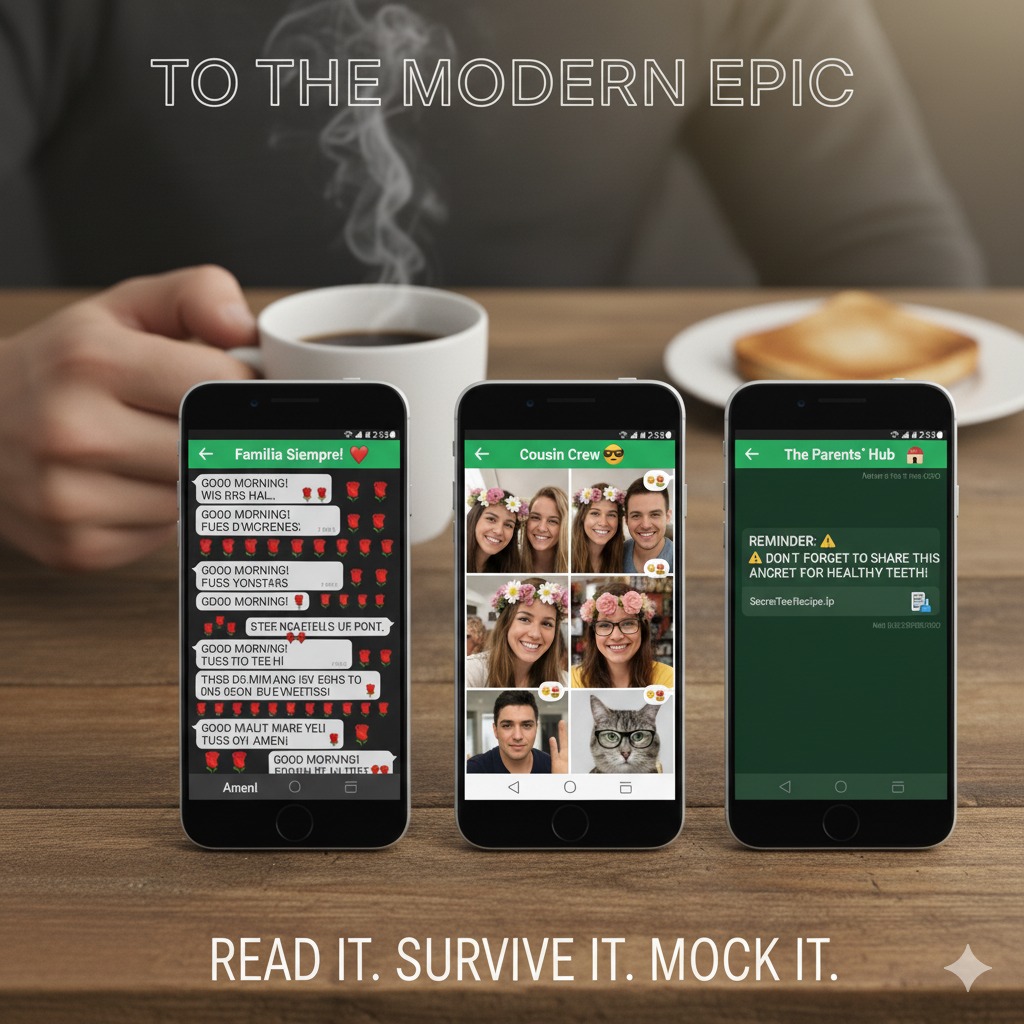
If Homer were alive today, he would not write about Achilles or Odysseus. He would not waste time on Troy or Ithaca. He would, without hesitation, write about the WhatsApp family group. Because no battlefield produces more noise, no voyage lasts longer, and no hero suffers more than the poor soul trapped in a group chat with fifty relatives who have just discovered emojis.
The family group is the twenty first century’s version of an epic poem. It has a cast of characters too vast to remember, a plot that refuses to end, and a chorus of voices repeating the same lines until death or a new notification arrives. Every morning begins with a flood of “Good Morning” messages, each one featuring a different sunflower or waterfall, as if nature itself has been drafted into digital slavery. By evening, the same group has moved on to health tips, political rants, and long forwarded messages that begin with “Doctors in America have confirmed.” The Iliad had Hector and Achilles, we have Aunt Margaret forwarding diet tips from Facebook.
Take George Patterson in New York. George is a thirty six year old investment banker who once dreamed of changing the world, but now spends his mornings deleting pictures of roses with motivational quotes. He never asked to be added to the Patterson Family Circle group, yet one fateful afternoon, his cousin Melissa decided that “family bonding” required everyone from toddlers to great-grandmothers to be trapped in the same virtual room. George, being polite, typed “Hi everyone” once. That was his fatal mistake.
From then on, he was bombarded daily. Uncle Robert sent ten memes about how kids these days don’t respect tradition. Cousin Laura uploaded two hundred pictures of her new cat, Sir Whiskers, who, judging by the frequency of updates, is either secretly running for office or about to cure cancer. Aunt Margaret, the queen of forwards, sent him a video promising that rubbing garlic on your feet cures migraines. George’s phone buzzed so often that Siri started suggesting he mute the chat to preserve his sanity.
The real tragedy occurred one Monday evening. George, tired after a day of corporate chaos, meant to send a sarcastic meme to his friend Mike. It featured a dancing skeleton captioned, “This is me waiting for someone to reply to my texts.” Unfortunately, his thumb betrayed him. The meme went straight to the Patterson Family Circle. Silence fell. Then came the replies.
Grandmother Patterson typed, “We love you, George, you don’t need to feel lonely.” Aunt Margaret followed with, “If you ate garlic on your feet, you wouldn’t be sad.” Cousin Laura posted three videos of Sir Whiskers to cheer him up. Within minutes, George had fifty unread messages, all offering comfort he did not need, while his father simply asked, “Why is there a skeleton in the group?” George considered moving to another country.
And yet, there is something strangely poetic about it all. The family group is an epic of repetition. The chorus sings “Good Morning” with the discipline of a Greek tragedy. The plot twists from politics to recipes to conspiracy theories, often in the span of two minutes. The heroes are ordinary people transformed into warriors armed with emojis. The villains are the ones who turn off their “last seen” and pretend they never got the message.
What makes it unbearable also makes it endearing. There is comfort in knowing that no matter how busy your life is, your family group will still be alive at 5 a.m., posting flowers. When you are stuck in traffic, someone is bound to share a joke so bad it makes you laugh. When you ignore the chat for two days and return, you find six hundred unread messages, proof that life carried on without you, loudly, chaotically, and hilariously.
Of course, it is also a psychological experiment in patience. The family group teaches you to smile politely at messages you do not understand, to nod at jokes you have seen seventeen times, and to resist the urge to throw your phone into the sea. It is resilience training disguised as bonding.
Even the emojis tell a story. One cousin uses only thumbs up. Another insists on hearts. Uncle Robert has discovered the fire emoji and now ends every message as if he were announcing the apocalypse. The family group is not communication, it is theatre. It is costume, chorus, spectacle, and occasionally, tragedy.
So yes, Homer, if you are listening from the afterlife, update your material. Achilles sulking in his tent cannot compete with Aunt Margaret sulking because no one replied to her “Good Morning” GIF. Odysseus facing the Cyclops is nothing compared to George Patterson facing 342 unread notifications before breakfast. The real epic is happening in our pockets, buzzing, blinking, demanding our attention every five minutes.
And here is the cruel twist. For all the complaints, for all the memes about muting and escaping, none of us truly leave. We linger, we scroll, we sigh, and we laugh. Because deep down, we know the family group, with all its chaos, is a chorus of voices saying, “You belong here.” Even if belonging means surviving endless flowers, garlic remedies, and Sir Whiskers’ daily updates.
So raise a cup of coffee to the family group. It may be exhausting, it may be ridiculous, but it is our modern epic, told one notification at a time. And like every epic, it deserves to be read, survived, and occasionally mocked.
3. The Wi-Fi That Quit at 11:59 PM
Because betrayal hurts most when it is timed with a deadline.
There are few moments in life when you feel the presence of God. Standing at the altar. Holding a newborn child. Watching your favorite team score in the final seconds. And, most profoundly, staring at the loading wheel on your laptop as Wi Fi dies one minute before a deadline. That is when you know divinity exists, and it is laughing at you.
Wi Fi has become our invisible oxygen. We may not admit it in polite company, but our real prayers each morning are whispered not to saints or sages but to routers. We no longer sacrifice goats at temples; we restart modems with the same trembling faith. We do not chant hymns; we chant, “Please connect, please connect, please connect.”
Nowhere is this more evident than in the tragic tale of Samantha Blake, a twenty seven year old graduate student in Boston. Samantha had been working for weeks on her thesis, a monstrous document filled with footnotes, citations, and at least three paragraphs that made sense. The submission deadline was midnight, sharp. Professors had warned, “If you submit even one minute late, it will be considered the work of the next day.” This is academia’s way of saying, “We were bullied in school, and now it is your turn.”
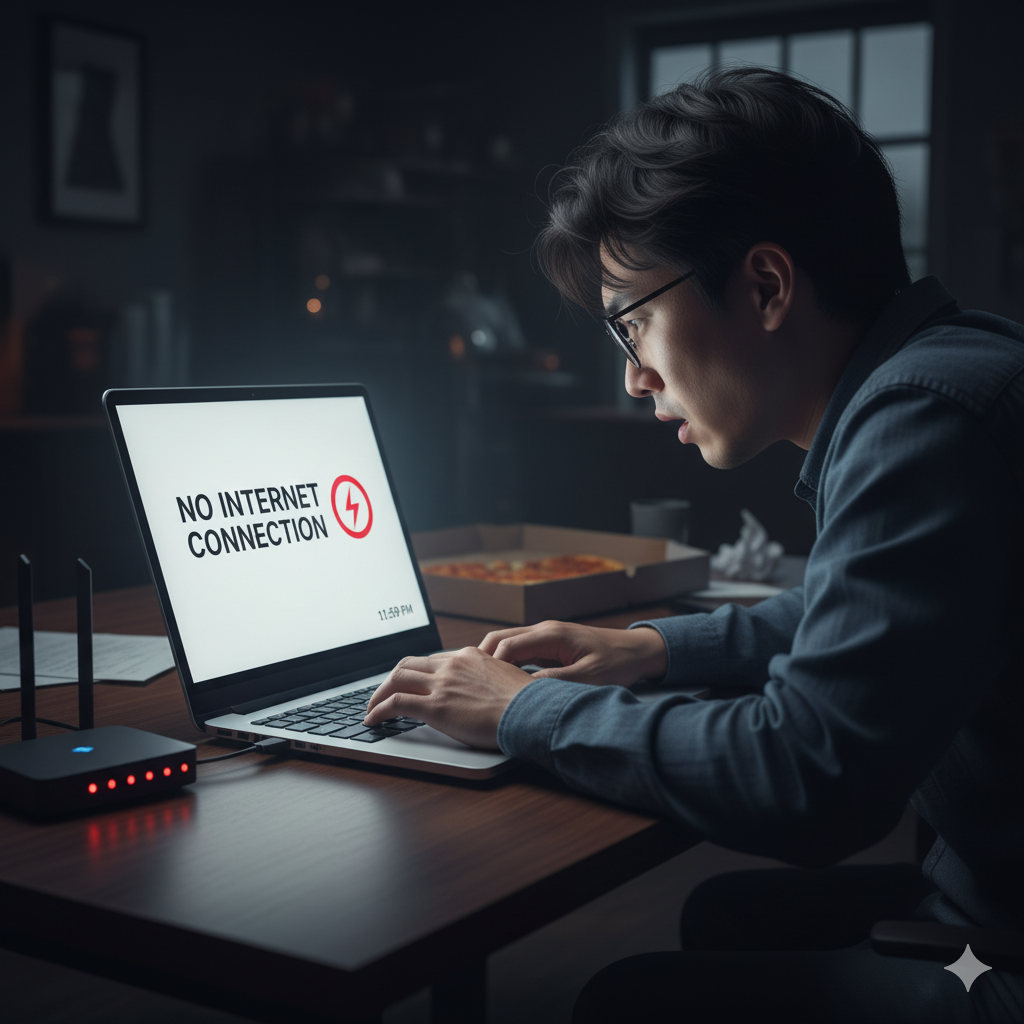
Samantha, being diligent, finished her thesis at eleven fifty. She had time. She uploaded the document, admired the neatness of her title page, and even dared to pour herself a victory glass of cheap wine. At eleven fifty nine, with the confidence of someone who had conquered procrastination, she clicked “Submit.” The Wi Fi blinked. The page froze. The loading circle spun like a demonic halo. And then, like a villain making a dramatic exit, the Wi Fi quit.
At first, Samantha thought it was a glitch. She refreshed. Nothing. She restarted the router. Nothing. She restarted her computer. Still nothing. By the time the clock struck midnight, she was screaming at an unresponsive network while her glass of wine sat untouched, mocking her. The submission portal closed with the cold efficiency of a guillotine. Samantha Blake was academically executed.
Here is the cruel poetry of Wi Fi: it knows timing. It does not die at two in the afternoon when you are scrolling through useless articles about celebrities’ skincare routines. It waits until you are on a Zoom call with your boss, or trying to pay your bills, or sending a romantic text that says “I love—” and then vanishes, leaving you sounding like a half-hearted fortune cookie.
The Wi Fi outage at eleven fifty nine is not an accident. It is destiny. It is chaos in its purest form, dressed in digital disguise. It teaches humility. It reminds us that for all our degrees, gadgets, and smart homes, we are still puppets tied to blinking lights on a modem.
Let us not forget the soundtrack of these disasters. When Wi Fi collapses, customer service hotlines transform into experimental opera. You call in desperation, and a robotic voice assures you, “Your call is very important to us,” while cheerful music plays for an eternity. By the time a human responds, you are half insane and willing to sacrifice your firstborn for a signal. The technician’s advice is always the same: “Have you tried turning it off and on again?” Which is like asking a drowning person, “Have you tried breathing?”
Meanwhile, Wi Fi outages expose our true personalities. Some people become philosophers, sighing, “Maybe the universe wants me to disconnect.” Others become warriors, climbing furniture to wave their phones like torches, searching for a signal. Teenagers transform into zombies, moaning, “What do we do now?” as if forced into the Stone Age. Parents suddenly remember board games, children rediscover crayons, and couples discover that talking face to face is awkward and should be avoided.
The irony is that Wi Fi has no loyalty. You can pamper it with the best plan, the sleekest router, and a corner table all to itself, and it will still betray you. It is like dating someone who texts you every morning but vanishes at midnight. It never explains why. It simply leaves you staring at a dead connection, reconsidering all your life choices.
Back in Boston, Samantha’s professors eventually allowed her to submit her thesis with a penalty. Her official grade was lowered, not for lack of knowledge, but because of a blinking modem. She told her friends, “I lost my future because of Comcast,” which sounds like a joke until you realise it is modern reality. Empires fall, wars are lost, dreams are destroyed—all because the Wi Fi quit at eleven fifty nine.
But perhaps this is how chaos keeps us humble. The Iliad had Zeus throwing thunderbolts at mortals. We have routers blinking red at students. The gods of old demanded sacrifice. Our gods demand a technician appointment between “eleven a.m. and three p.m.” The lesson is the same. Human beings are fragile, foolish, and perpetually at the mercy of forces beyond their control.
So yes, when the Wi Fi dies at the most critical moment, you are allowed to scream, curse, or even threaten the router with exile. But you are also allowed to laugh. Because in that moment you are part of a grand human comedy, shared by everyone who has ever shouted, “Are you working?” at an inanimate box.
And if you are lucky, the Wi Fi will return just in time to deliver one final insult: the email you missed, the bill you forgot, the meme you did not want. Espresso and regret may rule Monday, but Wi Fi and despair own midnight.
So let us raise our cups to the gods of connectivity. They may be cruel, but they are consistent. They remind us that life is not about perfection. It is about the absurd, the unpredictable, the eleven fifty nine betrayals that make us roll our eyes and say, “Of course this would happen to me.”
And then, as always, we refresh. Because hope is eternal, and Wi Fi, like life, always returns at the worst possible moment.
4. Why Caffeine Understands Me Better Than People Do
My most stable relationship comes in a mug with extra sugar.
There is a brutal truth that most self-help books and motivational speakers will never admit. People are unreliable. They forget your birthday, they cancel dinner plans, they ghost you after promising eternal friendship, they send you “k” as a reply to your emotional essay. Humans are spectacular disappointments. But caffeine? Caffeine shows up. Hot, loyal, and on time.
If love had the consistency of a morning cappuccino, divorce lawyers would starve. If friendships were as reliable as a double shot of espresso, no one would write tragic poetry. But here we are, nursing bruised hearts and bruised egos, while caffeine waits patiently in ceramic mugs, whispering, “I will never let you down.”
Consider the case of Jonathan Miller, a thirty two year old graphic designer in San Francisco. Jonathan had a friend, Mark, who promised to help him move apartments. “Of course, buddy, I will be there at ten a.m. sharp,” said Mark, with the confidence of a man who has no intention of setting an alarm. Jonathan, foolishly hopeful, bought extra pizza and beer. By eleven, Mark was nowhere. By twelve, Jonathan was sweating over boxes while Mark texted, “Sorry bro, rough night, can’t make it.” The betrayal was sharp, but Jonathan forgave him because humans are wired for disappointment.
The next morning, Jonathan staggered into a café, broken, bitter, and carrying the emotional weight of thirty cardboard boxes. He ordered an Americano. Within three minutes, it arrived, steaming, loyal, unwavering. It did not text excuses. It did not apologise insincerely. It did not ghost. It showed up. Jonathan took one sip and muttered, “You are the only one I can trust.” The barista thought he was talking to her. He was not. He was talking to caffeine.
People will always demand explanations. They will interrogate you with questions like, “Why are you still single?” or “Why did you gain weight?” or “Why don’t you call more often?” Caffeine never asks. Caffeine does not judge. It understands that your silence is sacred. It accepts you at your worst, when you stumble into the kitchen with hair that resembles an abandoned bird’s nest. It never says, “Wow, you look tired.” It already knows you are tired, that is why it exists.
Even lovers pale in comparison. A boyfriend may leave, a girlfriend may cheat, a spouse may snore, but coffee will still be there at dawn, rich and aromatic. It will embrace you in its warmth and whisper, “Forget them. You have me.” It will never demand space. It will never bring up your past mistakes at a dinner party. It will never sigh dramatically and say, “We need to talk.” Coffee does not need to talk. Coffee just needs to be sipped.
Tea enthusiasts will protest here, insisting that tea is also loyal. Yes, tea is gentle, comforting, a cardigan in liquid form. But tea lacks drama. Tea does not fuel revolutions or inspire novels at three in the morning. Tea does not make your heart race and your hands shake as you declare, “I will write ten thousand words before sunrise.” Tea is the friend who reminds you to wear sunscreen. Coffee is the lover who convinces you to run away to Paris.
What about people at work? Colleagues will smile politely, then throw you under the bus during meetings. Bosses will praise you on Friday and forget your name on Monday. Co-workers will say, “We are a family here,” which is code for “We will emotionally drain you and not pay you overtime.” But coffee at the office machine is the only honest colleague you have. It sits there, humming, patient, and when you press the button it delivers without complaint. Try asking Bob from accounting to be that consistent.
We even confess our deepest truths over caffeine. Friendships are sealed not in blood, but in the phrase, “Let’s grab coffee sometime.” Dates begin with coffee because everyone knows that if it goes badly, at least you got a latte out of it. Therapists charge by the hour, but a café table and a flat white will listen to you for free. We trust caffeine with our secrets more than we trust people with our lives.
And yes, sometimes caffeine betrays us. It arrives burnt, or too watery, or spelled “Clam” on the Starbucks cup instead of “Claire.” But these are not betrayals of the heart, only small quirks in an otherwise faithful relationship. Caffeine forgives itself quickly. We forgive it too. Because deep down we know it has saved us more times than we can count. Saved us from deadlines, from morning meetings, from the abyss of Monday.
Philosophers may debate the meaning of existence, poets may write odes to love, scientists may search for God, but ordinary mortals already know the answer. The purpose of life is to make it to the next cup of coffee. Everything else is details.
So the next time a friend cancels on you, the next time a lover breaks your heart, the next time a boss forgets your name, do not despair. Walk to your kitchen, pour yourself a cup, and remember this: caffeine understands. It always has, it always will.
And if you doubt this truth, ask Jonathan Miller in San Francisco. Mark may have abandoned him on moving day, but his Americano never did. Jonathan moved apartments alone, but he did not move without coffee. Which proves the final, undeniable law of existence. People will fail you, caffeine will not.

5. The Art of Looking Busy While Doing Nothing
Masterclass in open tabs, fake typing, and strategic sighing.
Work is supposed to be noble. People used to write poems about honest labour, sweat on the brow, hands building empires. In reality, modern work is ninety percent theatre. Offices are not temples of productivity, they are Broadway shows where everyone is pretending to work while secretly wondering what to have for lunch.
The art of looking busy while doing absolutely nothing is humanity’s finest invention. Forget fire, forget the wheel, forget the internet. None of those compare to the elegance of sitting at a desk, clicking the same three keys, and convincing the entire office that you are one email away from changing the world.
Take Daniel Cooper in Chicago. Daniel is twenty nine, employed at a software company, and has perfected the role of Office Hamlet. He sighs, he furrows his brow, he stares dramatically at Excel spreadsheets as if they were prophecies carved into stone. Colleagues glance at him and whisper, “Daniel must be working on something important.” Daniel is not. Daniel is scrolling through memes of cats wearing sunglasses.
One Monday morning, Daniel decided to test the limits of his art. He opened six windows on his computer: an Excel file, two Word documents, an email draft, a PowerPoint slide, and, hidden carefully, a YouTube video of a man explaining why pigeons are government spies. He positioned his screen at an angle so that anyone walking past would see only the spreadsheet. Then he put on his most intellectual frown, the kind that says, “Do not disturb me, I am holding the economy together with my bare hands.”
At ten thirty, his boss strolled past. Daniel clicked randomly on cells in Excel, highlighting numbers as if he were discovering a cure for inflation. The boss nodded approvingly. “Excellent work, Cooper. Keep it up.” Daniel smiled humbly, as if to say, “I carry this company on my shoulders, but I will not brag.” As soon as the boss left, Daniel resumed watching pigeons.
This is the genius of office life. Productivity is less about results and more about optics. The person who delivers average work but looks perpetually exhausted will always be praised. Meanwhile, the quiet employee who actually finishes tasks efficiently is ignored because they do not provide enough drama. Looking busy is currency. Looking overwhelmed is a promotion strategy. Looking like you have your life under control is career suicide.
The rituals of fake busyness are many. Typing furiously, even if it is your grocery list. Keeping at least twelve tabs open so you look like an overworked genius. Staring at the screen with a concerned face, occasionally rubbing your temples, as if solving world hunger when you are actually trying to remember your Netflix password. Carrying a notebook everywhere, filled with nothing but doodles of geometric shapes. Walking fast through the office corridor with a coffee in one hand and your phone in the other, muttering “Yes, absolutely” to nobody. These are not actions, they are costumes.
Meetings are the crown jewel of pretending. No place on earth has wasted more collective human hours than the modern office meeting. Entire careers have been built on the ability to say “Let’s circle back” and “Can we take this offline” with a straight face. Daniel once sat through a ninety-minute meeting about a project that never existed. He emerged drained, heroic, and no wiser. When his boss asked him for his thoughts, he replied, “We need to align our strategies moving forward.” He had no idea what it meant, but everyone nodded.
Why do we do this? Because the modern workplace has confused visibility with productivity. If you look busy, you must be important. If you look calm, you must not be working hard enough. It is theatre, and the audience is everyone around you.
Sometimes the theatre extends to working from home. Zoom has made us magicians. We sit in pyjamas while projecting the illusion of seriousness. A carefully chosen bookshelf background. A strategically furrowed brow. A coffee mug held like a sacred relic. One colleague once froze his screen on purpose, pretending his connection had collapsed, while he actually went to fry bacon. He returned twenty minutes later, unfrozen, nodding solemnly as if he had absorbed every word of the meeting.
The irony is that nobody truly wants to be caught doing nothing, even though everyone is doing it. There is a silent pact in offices: I will not expose your fake spreadsheets if you do not expose my fake email drafts. We all know the truth, but we keep the theatre alive because reality would be unbearable.
Back in Chicago, Daniel has become a legend. He is known as the man who is “always working hard.” He once won Employee of the Month for a project that was quietly cancelled before it even began. Nobody noticed, because Daniel had spent weeks perfecting his “concentrating at the screen” expression. People assumed results had happened somewhere in the background. They had not.
And maybe that is the secret of life itself. Nobody really knows what they are doing. We are all Daniel Coopers, opening too many tabs, sighing dramatically, pretending to have answers while hoping no one notices we are guessing. Work is a performance, not a destination.
So the next time you see a colleague staring intently at a spreadsheet, do not be fooled. They are probably reading about pigeons, or football scores, or conspiracy theories about Elvis. And if you yourself are guilty of the same crime, remember this: you are not lazy. You are an artist. A performer. A master of illusion.
The world does not run on productivity. It runs on the appearance of productivity. And as long as bosses continue to confuse furrowed brows with actual progress, the art of looking busy while doing nothing will remain humanity’s most cherished masterpiece.
6. Conversations With the Ceiling Fan at 2 AM
When insomnia turns household appliances into therapists.
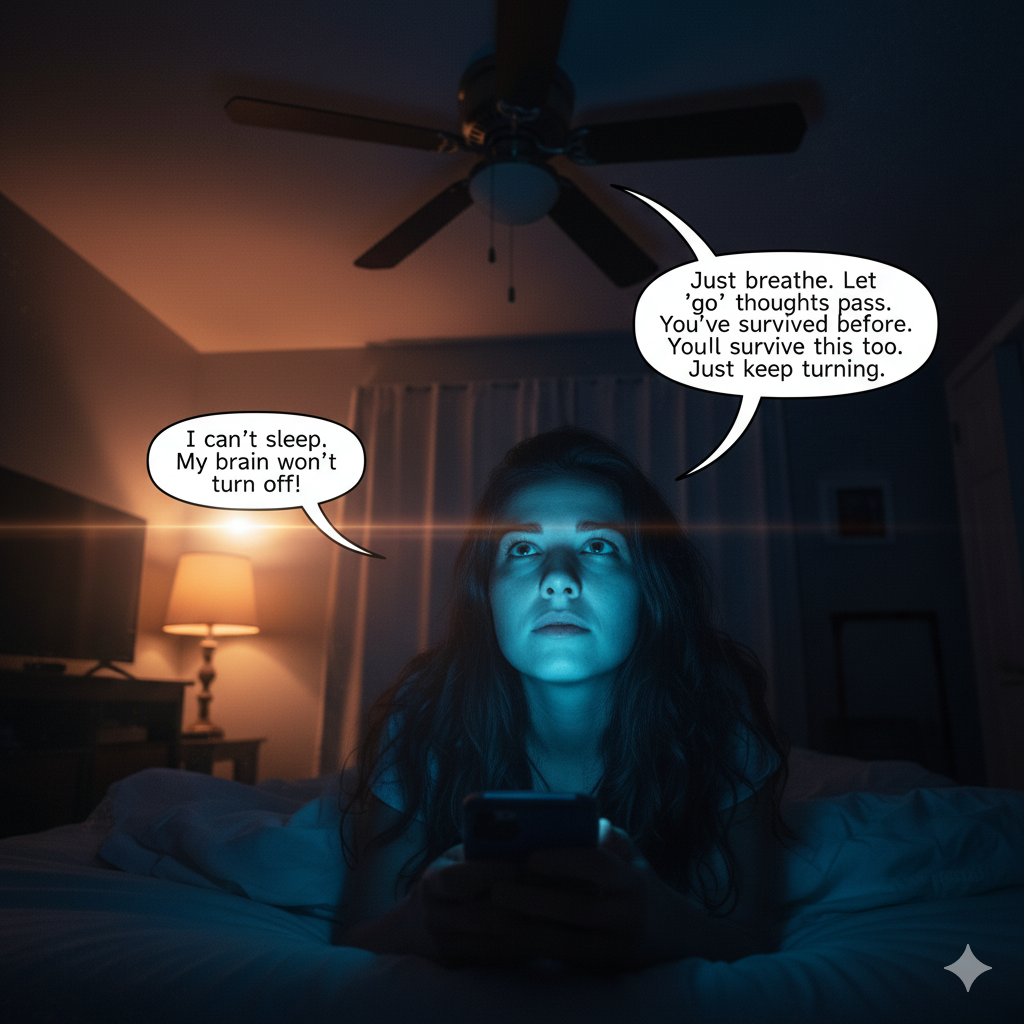
There is no hour more suspicious than two in the morning. At two, the world is asleep, the streets are silent, even the dogs have given up barking, and you are lying in bed having a full-scale existential crisis with your ceiling fan. The fan spins, steady and unbothered, while your brain unpacks twenty years of regrets, unpaid bills, embarrassing memories, and a craving for potato chips.
Insomnia is not a medical condition. It is a lifestyle choice forced upon you by your own brain. Nobody chooses to stay awake at two in the morning, yet somehow, every night, millions of us find ourselves negotiating with the darkness like failed diplomats. You promise yourself, “Just close your eyes, sleep will come.” But sleep is a diva. It refuses to arrive when summoned. Instead, your brain decides this is the perfect time to remember the text you sent in 2014 that ended with the wrong emoji.
The ceiling fan becomes your therapist. It listens, it hums, it spins without judgment. You stare at it for so long that you begin to believe it is staring back, nodding slowly, whispering, “Yes, you are indeed a fool, but at least you are self-aware.”
Take Olivia Harper, a thirty five year old architect in Toronto. Olivia had a big presentation the next day, which meant, of course, that she could not sleep. At eleven she tucked herself in with chamomile tea, lavender spray, and promises of “at least seven hours.” At midnight she was still scrolling through Pinterest. At one she was still staring at the ceiling. By two, she had surrendered and begun a heartfelt conversation with her ceiling fan.
“Why am I like this?” she asked it. The fan spun in calm circles, offering no answers. “Why did I eat pasta at ten p.m.? Why did I text my ex that stupid meme? Why do I exist?” The fan continued spinning, unbothered by her spiral.
At two fifteen, Olivia convinced herself she should get up and drink water. At two thirty she decided maybe she should check her emails, just in case someone from work had sent her an urgent midnight update. No one had, of course. By two forty five, she was watching a YouTube video titled “Ten Signs You Might Be a Genius” because at that point she needed reassurance. The fan hummed like a background chorus.
Insomnia makes philosophers out of fools. At two in the morning, everything feels profound. You start to believe the song lyrics you once mocked, you consider rewriting your entire career plan, you debate whether the universe is infinite or just pretending to be. You think of childhood friends you have not spoken to in decades. You rehearse conversations that will never happen. You invent arguments and win them triumphantly. By three, you are exhausted from all the imaginary work you have done. Still, you do not sleep.
The irony is that nobody has deep conversations with themselves at two in the afternoon. At two in the afternoon, you are too busy pretending to work. At two in the morning, stripped of distractions, the brain finally comes alive with ideas, most of which are useless. “I should start a bakery.” “I should move to Italy.” “I should learn Mandarin.” None of these things will happen, but the ceiling fan applauds every plan with its steady applause of air.
Of course, the worst part of insomnia is the clock. You keep glancing at it, bargaining with time. “If I fall asleep now, I will get five hours.” Ten minutes later: “If I fall asleep now, I will get four and a half.” By three thirty, you give up, muttering, “I will just power through tomorrow,” which is a lie. Tomorrow you will look like a zombie, eat too much sugar, and swear you will sleep early, only to repeat the cycle.
Olivia’s presentation the next day went exactly as expected. She stood in front of her colleagues, her eyes shadowed, her sentences incoherent. When asked about her design proposal, she muttered something about pasta at ten p.m. Her boss stared in confusion while she silently vowed to destroy her ceiling fan, the smug accomplice of her sleepless night.
But perhaps we need these two a.m. conversations. In daylight, we are too busy performing, too occupied with errands, meetings, and deadlines. At night, when the world is still, we are forced to meet ourselves. The ceiling fan becomes the mirror we avoid during the day. It does not judge, it does not respond, it simply spins, patient and eternal, as if to say, “Go on, confess, I have heard worse.”
Insomnia is chaos, but it is also creativity. Countless novels, songs, and inventions have been born at ungodly hours, not because of inspiration, but because people could not shut their brains off. If Shakespeare had melatonin, half his plays would not exist. If Einstein had lavender pillows, relativity would still be waiting to be discovered. Genius may not require insomnia, but insomnia certainly believes it does.
So yes, two in the morning will always be cursed. The ceiling fan will always spin like a priest hearing confessions, while you lie there regretting every life decision. But maybe that is the point. Maybe we need these nocturnal dialogues to remind us we are fragile, ridiculous creatures who eat pasta at the wrong time and text the wrong people. Maybe the fan knows this already and keeps spinning, because it has watched generations do the same.
And when morning finally arrives, when the alarm goes off after three tragic hours of half-sleep, you will groan, curse, and swear you will change. You will not. The cycle will repeat. And somewhere above you, the ceiling fan will be waiting patiently for your next confession at two in the morning.
7. When Deadlines Meet Daydreams
The tragic love story of ambition and procrastination.
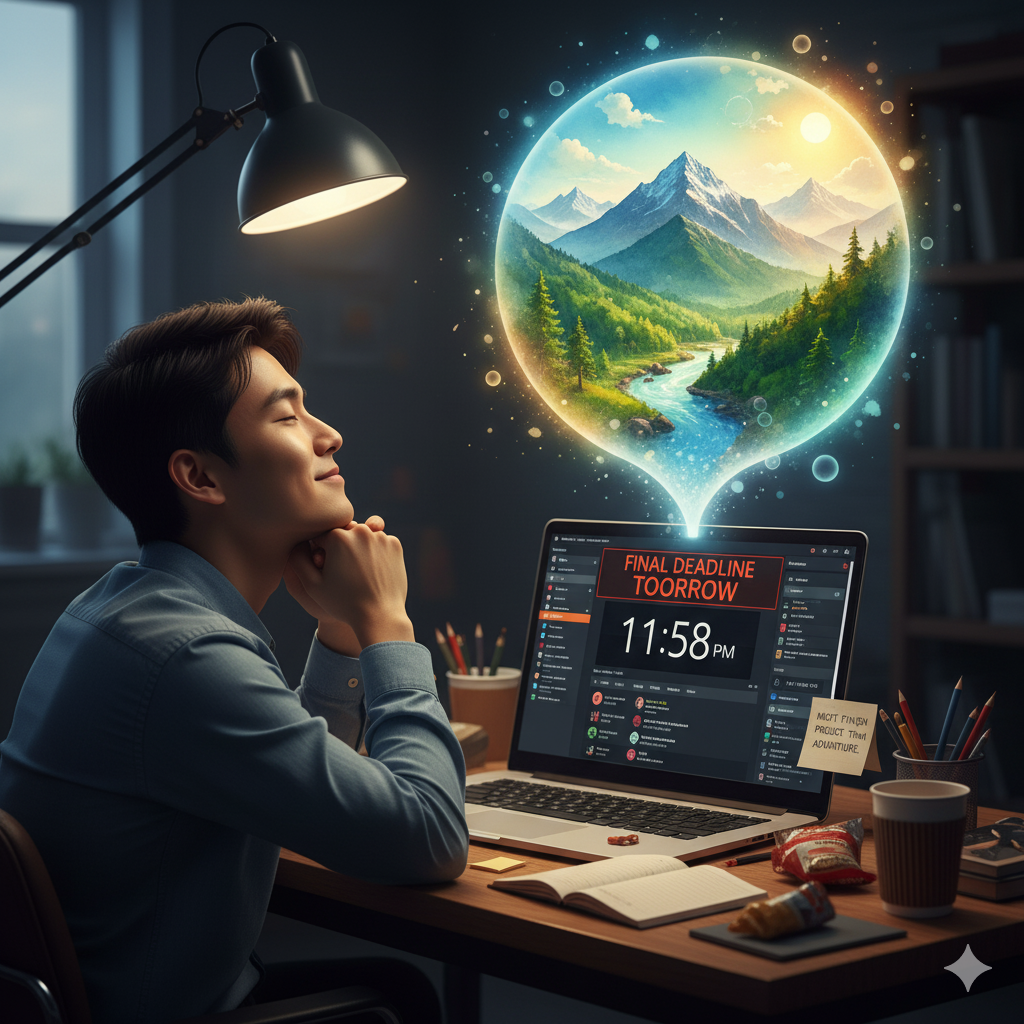
Deadlines are like stern school principals. They wear glasses, they carry clipboards, they march around ticking boxes, and they terrify you into pretending you have your life together. Daydreams are the exact opposite. They are barefoot wanderers, sitting in fields of daisies, humming songs nobody asked for, and distracting you when you need them least. Put them in the same room, and you get chaos. Deadline says, “Finish your report by Friday.” Daydream says, “What if we moved to Paris and opened a bakery?” Deadline says, “The client is waiting.” Daydream says, “The croissants will be shaped like clouds.” And you, poor mortal, sit in between, nodding to both, accomplishing nothing.
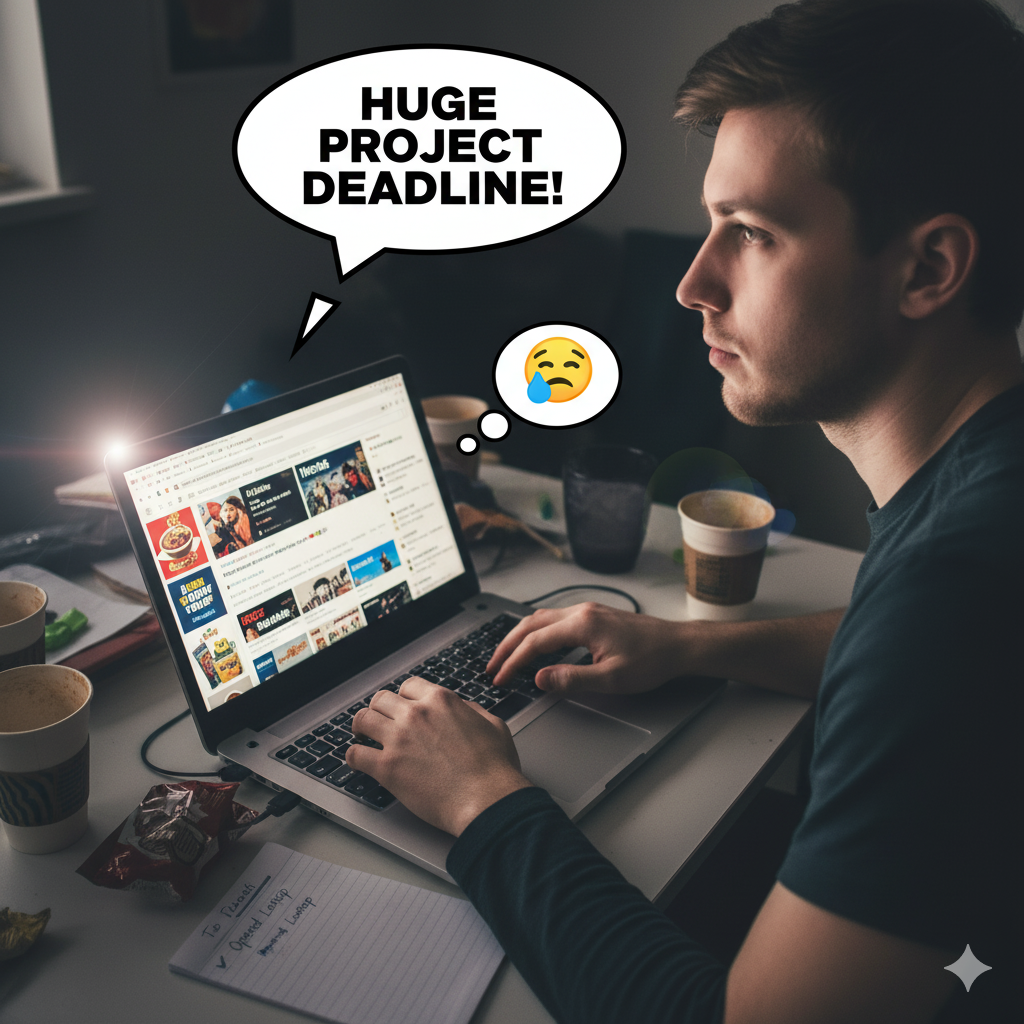
Take Amelia Ross, a twenty six year old writer in Paris. Amelia rents a tiny studio apartment that smells faintly of burnt toast and ambition. She is supposed to deliver an article on “The Future of Urban Spaces” to her editor by midnight. At nine p.m., she opens her laptop, determined to write. At nine oh five, she stares out the window at the Eiffel Tower twinkling in the distance. By nine ten, she is wondering what it would be like to marry a violinist. By nine thirty, she has written precisely one sentence: “Cities are complex organisms.” The rest of the document is white space, glowing mockingly.
Amelia is not lazy. Amelia is a dreamer. Her brain is an overenthusiastic intern that cannot focus. She tries to write about traffic congestion, but her thoughts wander to childhood summers. She attempts to analyse public parks, but she drifts into imagining her future dog, a Golden Retriever named Hugo. By ten o’clock, she is researching dog collars online, convinced it counts as “urban study.”
Daydreams are seductive. They arrive dressed as creativity, whispering, “This is important, this is inspiration.” They trick you into believing that staring at the ceiling is part of the process. You tell yourself that you are “incubating ideas,” when in reality, you are procrastinating with style. Deadlines do not care about style. Deadlines are brutal accountants, stamping red marks across your life.
At ten thirty, Amelia’s editor texts her, “Looking forward to the draft tonight.” She panics, closes the dog collar tab, and returns to her essay. She types furiously for five minutes. “Cities face challenges… sustainability… innovation.” Then she imagines herself giving a TED Talk about her article. She imagines applause, book deals, Netflix adaptations. Ten minutes later, she is Googling “How to become a famous thought leader.” Meanwhile, her article still consists of three vague sentences.
The war between deadlines and daydreams is eternal. Every student knows it. Every employee knows it. Every human with a brain knows it. One side is practical, relentless, unforgiving. The other side is charming, creative, and completely useless at paying the bills. Together, they destroy productivity.
Back in Paris, Amelia makes one last desperate attempt. At eleven, she brews coffee so strong it could wake the dead. She promises herself, “No more distractions.” For twenty minutes, she writes like a machine. Paragraphs emerge. Sentences take shape. She is a genius, a miracle, a professional. And then—of course—her brain wanders. “What if I lived in Rome instead of Paris? What if I learned pottery? What if I dyed my hair purple?” By eleven thirty, she is watching a tutorial on how to throw clay on a wheel. The deadline weeps in the corner.
At eleven fifty, Amelia finally delivers her masterpiece: a document half filled with serious analysis, half filled with random sentences like “Imagine croissants shaped like clouds.” Her editor, accustomed to her chaos, sighs and edits out the bakery fantasies. The article is published. Amelia, meanwhile, congratulates herself for surviving another showdown between discipline and distraction.
And this is the truth of modern life. Nobody meets deadlines gracefully. Everyone is juggling daydreams behind the scenes. The student submitting a final paper is also imagining winning a Nobel Prize. The employee preparing a report is also wondering if they could start a food truck. The novelist writing a chapter is also picturing the movie adaptation starring Florence Pugh. Deadlines may demand obedience, but daydreams demand romance. And we, foolish mortals, keep trying to satisfy both.
Perhaps that is why caffeine exists. Coffee is the referee in this eternal battle. It props you up, fuels your typing, convinces you that three paragraphs equal an empire. It does not eliminate daydreams, but it makes them manageable. Without coffee, deadlines would crush us. Without daydreams, deadlines would kill us. Together, with caffeine in the middle, life becomes a chaotic compromise.
So yes, Amelia Ross missed her chance to become the world’s most punctual writer. But she has Hugo the imaginary Golden Retriever, and she has a published article, however imperfect. And maybe that is enough. Because in the end, deadlines keep us grounded, but daydreams keep us alive.
And if you ever find yourself at midnight, staring at a blank screen, torn between the urge to finish your work and the desire to imagine life as a pottery artist in Tuscany, do not despair. You are not failing. You are simply human. And humanity has always been late, distracted, and a little ridiculous.
8. The Fridge Light That Judges Me at 2 A.M.
A confessional booth powered by electricity and leftover pizza.
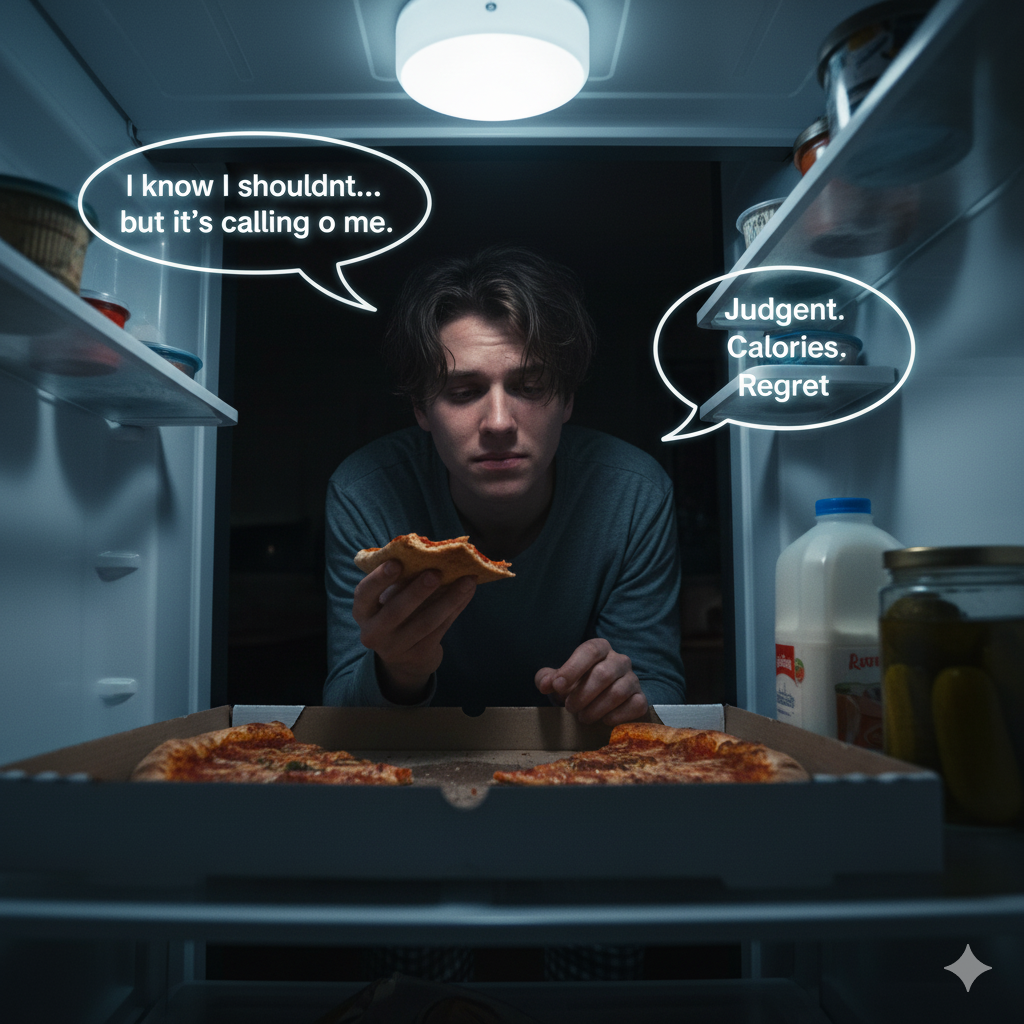
It was two in the morning. The house was asleep, the street was asleep, the entire world had the decency to be asleep — except for one tragic hero barefoot in the kitchen, betrayed by both discipline and digestion. The fridge hummed like a smug old monk, patient and glowing faintly in the dark, waiting to hear yet another confession.
He told himself he was only there for water. Noble, respectable, hydrated. But the second the door opened, the light burst out like a police interrogation lamp. It did not illuminate, it accused. In the daytime, that bulb was friendly, even helpful. At night, it became judgmental, merciless, as though powered not by electricity but by moral superiority.
“Really?” the light seemed to ask, as his hand hovered over a slice of pizza. “At this hour? After all those speeches about healthy eating?” It said nothing aloud, but its glare was enough. That bulb was not light, it was legal counsel. And the verdict was always guilty.
He stared into the shelves as though they held answers to life itself. The ketchup bottle glared like a strict teacher. The spinach lay wilted in disappointment. The chocolate bar feigned innocence, whispering, “Go on, blame me, I’m used to it.” Every leftover became a ghost. The pasta sighed. The cake smirked. The yogurt sulked. And from the back, a jar of pickles that had seen more governments than the man himself raised a sarcastic eyebrow.
Naturally, he tried to trick himself. “Just water,” he muttered, taking an exaggerated swig. But the eyes betrayed him, sliding toward the cheesecake. “Fine,” he bargained, “just one bite.” A noble spoonful. For research purposes. By the third spoonful he was basically writing a dissertation on dairy.
The fridge light never blinked. It watched silently, a divine accountant recording every calorie. And heaven forbid someone woke up. At that hour the fridge door was louder than a cannon. “Are you eating again?” a voice called from the bedroom, half-asleep but fully judgmental. He froze, half-chewed pizza in his mouth, caught like a criminal under a spotlight. “No,” came the lie, glowing in guilt. “Just water.” Everyone knew it was never just water.
Midnight snacking, after all, was less nutrition and more philosophy. Daylight food was social, polite, scheduled. Night food was confession. Every bite of cake was a negotiation between joy and shame. Every spoon of ice cream was therapy disguised as dairy. He thought he was hungry, but really he was lonely, bored, anxious, nostalgic — or simply awake. Freud would have written volumes on it. Nietzsche would have stared into the fridge abyss, and the abyss would have stared back, holding a leftover samosa.
And the questions, oh, the questions. Do calories exist if nobody sees you eat? Does food consumed after midnight belong to tomorrow’s intake? If eaten in silence, does the fridge light still tell? What if the pudding had expired last week — was this bravery or simply Darwinism at work? The fridge was not an appliance, it was an exam paper. He stood there, chewing cold pizza, and suddenly resembled Socrates in pajamas.
Every fridge carried its history. The spinach purchased during the brief “healthy lifestyle” phase lay shriveled like a failed resolution. The yogurt, bought in a burst of optimism, still waited for its debut breakfast. The bottle of wine meant for celebrations had been waiting longer than some marriages. Midnight was when these ghosts rose, and the fridge light made sure he saw them. It forgot nothing. It forgave nothing. It just shone.
Daytime made the fridge democratic. When his mother opened it, the glow was warm, guiding her to vegetables for a balanced meal. When his father opened it, the bulb highlighted pickles and soda, no judgment attached. But when he opened it at 2 a.m., the glow intensified, harsher, brighter, crueler — as though it had been upgraded to high-beam headlights. Clearly, the fridge light played favorites.
And yet he returned every night. Because for all its judgment, the fridge was also a therapist. It was the only one awake when he wasn’t. It listened quietly as he confessed into tubs of ice cream. It nodded as he negotiated with slices of cheese. It didn’t interrupt when he lied to himself — “last bite,” “I’ll run tomorrow.” It let him be ridiculous.
In his mind, dialogues even played out.
“Do you think this pizza slice is a bad idea?” he asked.
“Worse than your dating history,” the fridge light replied.
“Will anyone know?”
“Your waistline will.”
“And the pudding?”
“That thing could survive an apocalypse. Eat it at your own risk.”
Sometimes the real cruelty was catching his reflection in the glossy door. There he was, lit like a sinner in a Renaissance painting, clutching a slice of cake with the desperation of Hamlet holding a skull. “Alas, poor sponge cake, I knew thee well.”
Generations had their own relationships with the fridge. Boomers opened it with purpose, grabbed what they needed, closed it. Millennials treated it as therapy, standing with the door open, waiting for inspiration to strike. Gen Z saw it as TikTok background, captioning clips “vibing with my fridge at 2 a.m.” while holding pickles like performance art. Gen Alpha would probably never open it at all, summoning drones for delivery instead, leaving the fridge light to glare at an empty kitchen.
But the truth was simple. Midnight eating was never about hunger. It was about being human. It was about small rebellions against the routine. It was about comfort in the cold glow of leftovers. It was about making peace with contradictions, guilt, and joy. In the day, people ate to live. At night, they lived to eat.
The fridge light always judged, but it always forgave. It had seen worse. It had seen him cry into chocolate pudding, eat cheese with his bare hands, stand in pajamas whispering arguments to leftover pasta. And yet, it stayed loyal, humming softly, waiting for tomorrow’s encore.
So yes, he would return tonight. And tomorrow night. And the night after. Because the fridge, with its accusing light, was not just an appliance. It was a mirror of human ridiculousness. It reminded him that discipline was fragile, cravings were strong, and sometimes joy truly did come cold and reheated.
Dante had his Inferno, with fire and punishment. He had his fridge, with leftovers and eternal judgment. Honestly, the fridge was harsher.
9.Autocorrect Is the Devil’s Secretary
Destroying relationships one “duck” at a time.
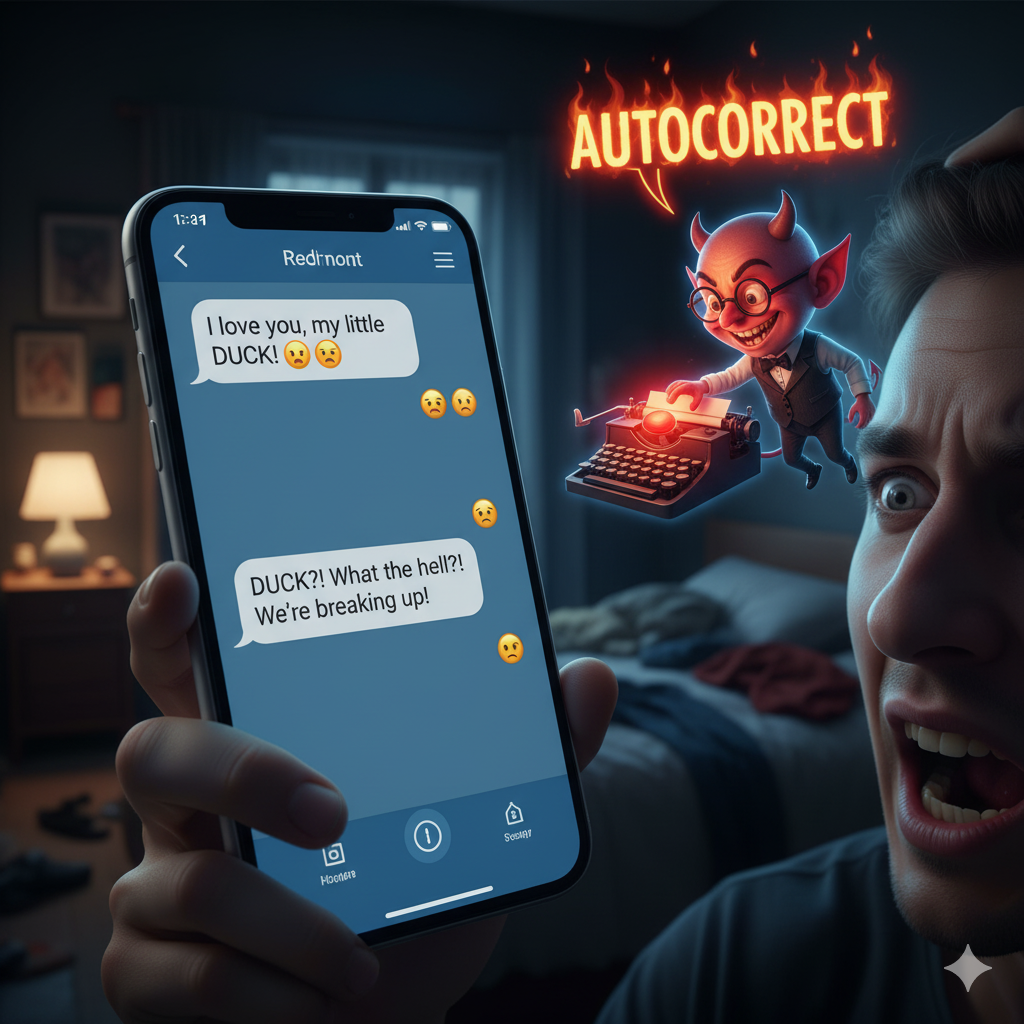
types a message, and sends it with confidence. A second later, they realize they have not sent what they typed. They have sent what the phone thinks they should have typed. Which means an employee has just proposed marriage to their boss, a teenager has accidentally resigned from their relationship, or some poor soul has offered their mother “duck hugs.” Autocorrect is not a helpful assistant. It is the devil’s secretary, working overtime to sabotage human communication one typo at a time.
The worst part is how smug it feels. Autocorrect never apologizes. It acts like it knows better, like it has a doctorate in intentions. Type “going to bed,” and it changes it to “going to behead.” Suddenly the texter is a medieval executioner. Type “I am so proud of you,” and it becomes “I am so pruned of you,” which sounds less like affection and more like a gardening accident.
It is always at the most delicate moments. A friend writes, “I am here for you,” and the phone upgrades it to “I am here for your soup.” The grieving recipient is left staring at the screen, baffled, and the sender spends the next ten minutes defending themselves against soup-based accusations. Another relative, in the middle of consoling a heartbroken cousin, typed “You will heal with time.” Autocorrect generously revised it to “You will hell with time.” Nothing comforts a broken heart quite like being told to burn eternally.
The irony is that autocorrect is never there when it is actually needed. Type something like “housr” and it shrugs. Housr, sure, maybe that is a new lifestyle brand. But dare to type the obvious swear word and suddenly the phone is a prude. For decades, people have been unable to send the f-word without sounding like polite ornithologists. Whole friendships have collapsed because one friend texted “Duck you” and the other thought they were being invited to bird-watching lessons.
The devil’s secretary also has a cruel sense of timing. It waits for the moment when a message cannot possibly be misunderstood — and then ensures it is. A teenager tells their crush, “You look gorgeous,” and the phone delivers “You look gorgonzola.” Romance dies faster than a cheese platter in the sun. An employee texts the boss, “I am working on the project,” and autocorrect proudly changes it to “I am working on the protest.” Suddenly the office worker is Che Guevara with a stapler.
This is why people screenshot autocorrect fails. The shame is too great to carry alone. Somewhere in the world, a woman wanted to tell her boyfriend, “I miss your kiss.” Her phone kindly converted it to “I miss your kids.” Elsewhere, a son tried to text “Love you Mom” but instead announced “Move you Mom,” which sounded less affectionate and more like a demolition notice. Every phone is secretly ghostwriting a sitcom at human expense.
The patterns are unmistakable. Autocorrect has a bizarre obsession with food. Almost every mistake turns into something edible. “Meeting” becomes “meat.” “God bless” becomes “Good biryani.” “Let us pray” becomes “Let us puree.” It is as if the devil’s secretary moonlights as a caterer. Then there is the fascination with violence. “Be kind” becomes “Behead.” “Happy holidays” transforms into “Happy homicide.” These are not corrections. These are auditions for horror films.
It is not only single words. Whole sentences collapse under autocorrect’s meddling. Someone tries to say, “Running late, stuck in traffic.” The phone proudly delivers, “Running latte, stuck in tragic.” Suddenly, they are less commuter and more caffeinated poet. Another person types, “Can you bring salad?” It becomes “Can you bring Satan?” Dinner plans instantly turn apocalyptic.
The most diabolical thing is how confidently autocorrect lies. A perfectly spelled word is typed, and it still changes it. Write “Thanks,” and it morphs into “Thanos.” Tell an aunt “See you soon,” and it becomes “See you spoon.” And because people are tired, distracted, or overly trusting, they do not notice until it is too late. Trust, it seems, is the first casualty of predictive typing.
The only defense is to double-check every message, but who has the patience? Life is too short to re-read texts like they are legal contracts. Most disasters are noticed only after hitting send. That is when panic sets in. The frantic attempt to delete, the desperate follow-up of “Sorry, autocorrect.” But that phrase is now so common it sounds like the excuse of professional liars. Nobody believes it anymore. At this point, someone could confess to arson and claim, “It was autocorrect,” and the jury would nod in sympathy.
And yet, for all its crimes, escape is impossible. Autocorrect is welded into daily life. Without it, typos would be exposed, naked, shameful. With it, typos are dressed in ridicule. Either way, dignity is lost. It is the digital version of the devil’s bargain: type faster, and sacrifice your sanity.
Perhaps it is not even a glitch but a conspiracy. Somewhere, a group of engineers must be laughing. They sit in secret rooms, watching as “Best regards” mutates into “Beast regards.” They observe relationships collapse, bosses get confused, parents faint, lovers panic. They snack on popcorn while adding new substitutions to the database. It is the only rational explanation.
As if autocorrect were not enough, predictive text arrives as its evil twin. Type “I want,” and the phone offers “to die.” Type “Happy,” and it proposes “divorce.” The device has become not just a secretary but a psychic, one with the soul of a disappointed poet.
Generations all suffer in their own way. Boomers fire accidental confessions into family WhatsApp groups and then paste a Bible verse to cover the damage. Millennials attempt to flirt, only to sound like malfunctioning grocery lists. Gen Z, ever adaptive, embrace the chaos, sending messages like “Duck me” and then shrugging with “lol mood.” Gen Alpha will probably skip typing altogether and let artificial intelligence ruin their reputations directly.
And still, the world keeps typing. Because writing without autocorrect feels like walking barefoot on gravel. Because spelling is apparently harder than public speaking. Because human thumbs are unreliable narrators. So people surrender to the devil’s secretary daily, knowing it will betray them, yet trusting it anyway. Love is blind, but autocorrect is blinder.
Doubt this? Open a phone and type something simple. “Hello dear friend.” If fortune smiles, it will remain intact. If not, it will become “Hello dead fiend.” Either way, autocorrect has already won. It waits patiently in every pocket, humming like the fridge light at 2 a.m., ready to ruin the next sentence. And when it does, people will laugh, cry, apologize, and then, inevitably, type again.
There is no mercy. There is only autocorrect. And its secretary never takes a day off.
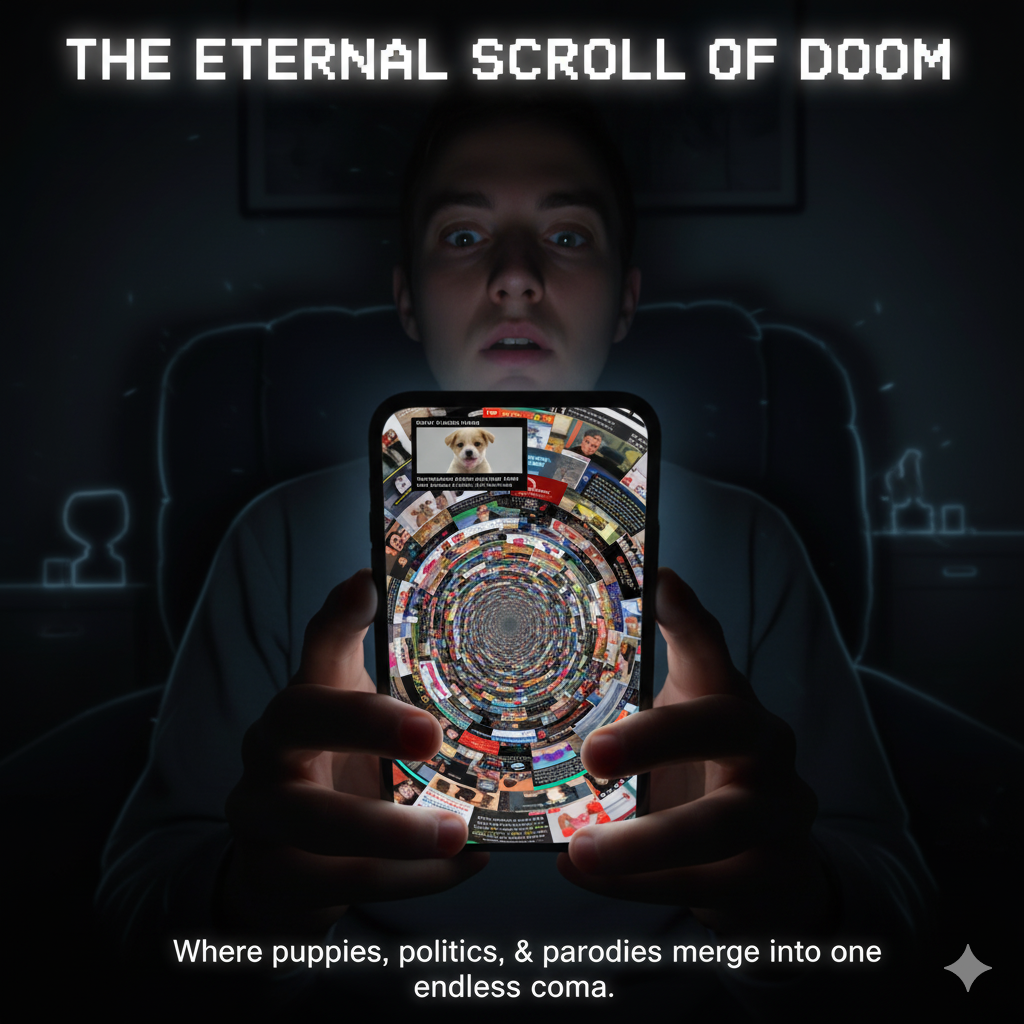
10. The Eternal Scroll of Doom
Where puppies, politics, and parodies merge into one endless coma.
It begins with one innocent swipe. Just one. You tell yourself, I’ll check a few reels before bed, just to relax. The first one is harmless, a fluffy puppy tripping over its own ears. Adorable. The next is a cat that looks like it pays rent. Cute. The next is a stranger dancing in their kitchen with the confidence of Beyoncé and the rhythm of a malfunctioning washing machine. Hilarious. Before you know it, you are three hours deep into the abyss, your thumb moving like a hypnotized metronome, your eyes glazed, your brain humming at the frequency of boiled cabbage. You are not entertained. You are not informed. You are not even alive in the traditional sense. You are in the coma of the scroll.
The scroll has no end. That is its genius and its cruelty. There is no final page, no satisfying “You’ve reached the bottom.” The scroll is eternal, infinite, as bottomless as human stupidity. If Dante were alive today, he would not write about nine circles of hell. He would write about one endless vertical reel feed, where souls swipe forever, watching the same man eat twenty-five cheeseburgers in different lighting.
The feed is not even consistent. It is chaos disguised as entertainment. One second you are watching puppies fall into bathtubs, the next you are learning how to “maximize your investments in real estate.” Then comes a skincare influencer rubbing 47 serums on her face while promising eternal youth. Swipe again, and suddenly you are at a political rally in a country you cannot locate on a map. Swipe again, and it is back to cats. The scroll is not entertainment, it is roulette.
What makes it worse is the moral whiplash. One reel tells you to hustle harder, wake up at 4 a.m., grind until you die. The very next tells you to slow down, meditate, log off, and touch grass. You do neither. You just keep scrolling, torn between becoming a millionaire entrepreneur or a monk in the Himalayas. Then comes a video reminding you that screen addiction is destroying your brain, which you watch on a screen, nodding like a guilty monk. Swipe.
The celebrities are unavoidable. Every day, one of them is coming out of a gym, looking suspiciously glamorous for someone supposedly sweaty. Another is making a reel to a trending song, half-heartedly moving their arms while staring at their phones. It is less choreography, more hostage video. Yet the reel goes viral, because millions of us watch it while lying on our sofas, eating chips, and convincing ourselves we too might one day become famous for raising one eyebrow in rhythm.
Then there are the songs. Some obscure tune becomes viral, and suddenly every reel is the same ten seconds of audio. First it is a dance, then it is a parody, then it is a dog wearing sunglasses to the same beat. By the hundredth time, you want to find the songwriter and either crown them or strangle them. The song burrows into your skull, and days later you are humming it in meetings, while brushing your teeth, even in your sleep. Reels do not just capture attention, they colonize your nervous system.
And the life lessons. My God, the life lessons. There is always one man in a car telling you how to succeed in business. Another pacing in front of a whiteboard like an underpaid prophet. Someone else shouting into a microphone about discipline, focus, mindset. Swipe again, and now it is about relationships. “If he wanted to, he would.” “Know your worth.” “Detox your energy.” It is endless therapy, except instead of healing you, it just makes you feel like you are failing in every category of existence.
The worst is the contradiction. One reel says eat six eggs a day, the next says avoid eggs completely. One guru says save your money, another says spend to manifest abundance. One influencer says cut off toxic friends, another says you are the toxic one. You do not know whether to go vegan, carnivore, or breatharian. You give up and eat a cookie while scrolling further.
Political reels are their own circle of hell. Every debate show, every shouting match, every scandal is compressed into thirty seconds of noise. Angry men in suits wagging fingers. Women with microphones chasing people down corridors. Protesters chanting slogans you cannot understand. The algorithm serves it like candy, and you watch because your thumb is on autopilot. After a dozen such reels, you hate everyone equally. Democracy collapses one swipe at a time.
And just when you think you are about to close the app, the feed hits you with a raccoon riding a bicycle. This is the algorithm’s secret weapon. It knows your willpower is weakest when faced with animals doing human things. A dog skateboarding, a parrot singing Adele, a hamster eating a burrito. You laugh, you forget your guilt, and the thumb keeps swiping. You are trapped again.
The scroll is engineered to destroy bedtime. You check the time. 11:15. You promise yourself fifteen minutes. Suddenly it is 2:47, and you are watching a man from Finland carve spoons out of ice. You do not care about spoons. You do not care about Finland. Yet you cannot stop. The scroll has stolen three hours of your life, and in return, you have acquired exactly zero new skills, except the ability to hate yourself while humming a trending song.
The worst part is the trance. While scrolling, you are neither awake nor asleep. You are in limbo. Eyes half-closed, brain half-dead, thumb fully active. If aliens arrived at that moment, they would not conquer us. They would simply wait. They would know we would scroll ourselves into extinction.
You try to stop. You tell yourself, Last one. But the scroll has no end. You swipe, waiting for closure, but there is none. There is only the next reel. And the next. And the next. You have to physically wrestle your phone away from your face, like Odysseus tying himself to the mast. You throw it on the table, only to pick it up again within five minutes. Addiction is not a strong enough word. This is possession.
And here is the irony. You will wake tomorrow, exhausted, furious, blaming the scroll. You will swear never again. By evening, you will be back. Because the scroll does not need to be good. It only needs to be endless. It thrives on your boredom, your anxiety, your loneliness, your thumb.
The eternal scroll is not content. It is a mirror. It reflects your hunger for distraction, your fear of silence, your addiction to novelty. It gives you everything and nothing, laughter and despair, puppies and politics, skincare and sermons, all in one endless vertical abyss. It does not make you happier, wiser, or kinder. It makes you a thumb with a pulse.
And you know this. You know you are wasting your life. But you also know there might be a cat in a costume on the next swipe. So you scroll. Because humans may seek truth, beauty, and meaning, but at 2 a.m., we mostly seek raccoons on bicycles.
Closed the app. Closed my dignity. Eyes burning, brain fried, thumb still twitching like it’s searching for the next reel. Tomorrow I will pretend to be strong, to live better, to read Tolstoy or meditate. Tomorrow I will swear never again. But the scroll waits. It always waits. And like every tragic hero armed with Wi-Fi, I will return.
Closing Note
If you laughed, sighed, or rolled your eyes anywhere in these pages, then this little diary has done its job. Chaos is eternal, coffee is temporary, but sarcasm is forever. Thank you for reading Echoes Between Coffee and Chaos, may your Mondays be short, your Wi Fi stable, and your coffee endlessly loyal.

Abha Bhardwaj Sharma is a Professor of English Literature with over 25 years of teaching experience. She is the founder of Miracle English Language and Literature Institute and the author of more than 50 books on literature, language, and self-development. Through The Literary Scholar, she shares insightful, witty, and deeply reflective explorations of world literature.
Share this post / Spread the witty word / Let the echo wander / Bookmark the brilliance