
A Forest, A Banished Duke, A Lovesick Poet, And Enough Disguises To Confuse The Gods
Welcome to As You Like It, Shakespeare’s backyard picnic of chaos where everyone escapes into the Forest of Arden, believing trees can fix emotional damage. This is the play where love happens with reckless speed, disguises multiply like rabbits, and fools deliver more wisdom than the nobles who think they are in charge.
The play begins in an unhappy court packed with jealous brothers, political tension, and enough family drama to fuel ten seasons of entertainment. Orlando suffers under his brother Oliver, Rosalind suffers under her usurping uncle, and everyone generally suffers because Shakespeare enjoys placing intelligent people in the company of idiots.
Then Arden appears. The forest becomes Shakespeare’s healing machine, his freedom zone, his comedy laboratory. In Arden, all the seriousness of court life gets tossed into a bonfire of romance, mischief, poetry, and philosophical nonsense.
Orlando transforms into a love struck poet who writes verse so terrible that even the trees look embarrassed. Rosalind, disguised as a boy named Ganymede, becomes the puppet master of Arden, coaching Orlando on love while testing him, teasing him, and slowly losing her own calm. Celia watches with the patience of a woman who has seen her best friend abandon dignity in the name of romance.
Touchstone, the fool, wanders through the forest insulting everyone with the accuracy of a sniper. And Jaques, the professional melancholic, walks around delivering his famous “All the world’s a stage” speech like a man who has been disappointed by humanity for centuries.
This is Shakespeare having fun. No murders. No ghosts. No political bloodshed. Just identity games, gender play, romantic confusion, and a finale where Shakespeare marries off half the cast in one afternoon because why waste time.
Beneath the comedy lies a sharp study of freedom, self discovery, love, loyalty, and the human habit of running into forests when life gets too much. Arden becomes the place where characters shed their wounds, find their voices, and figure out who they actually are when society stops watching.
And when the dust settles, Shakespeare restores order, forgives everyone, crowns love the winner, and hands the final bow to the fool. A perfect insult to seriousness.
ABS Believes
ABS believes As You Like It is Shakespeare’s warmest escape plan, his invitation to step into a world where identity is flexible, hearts are chaotic, and trees mind their own business. ABS believes Rosalind is the brightest romantic brain Shakespeare ever created, Orlando is a pure soul with questionable poetry skills, and the Forest of Arden is the ultimate personality reset button that should be prescribed to half the world.
ACT ONE
Where Brothers Misbehave, Dukes Misrule, And The Forest Begins Whispering From Afar
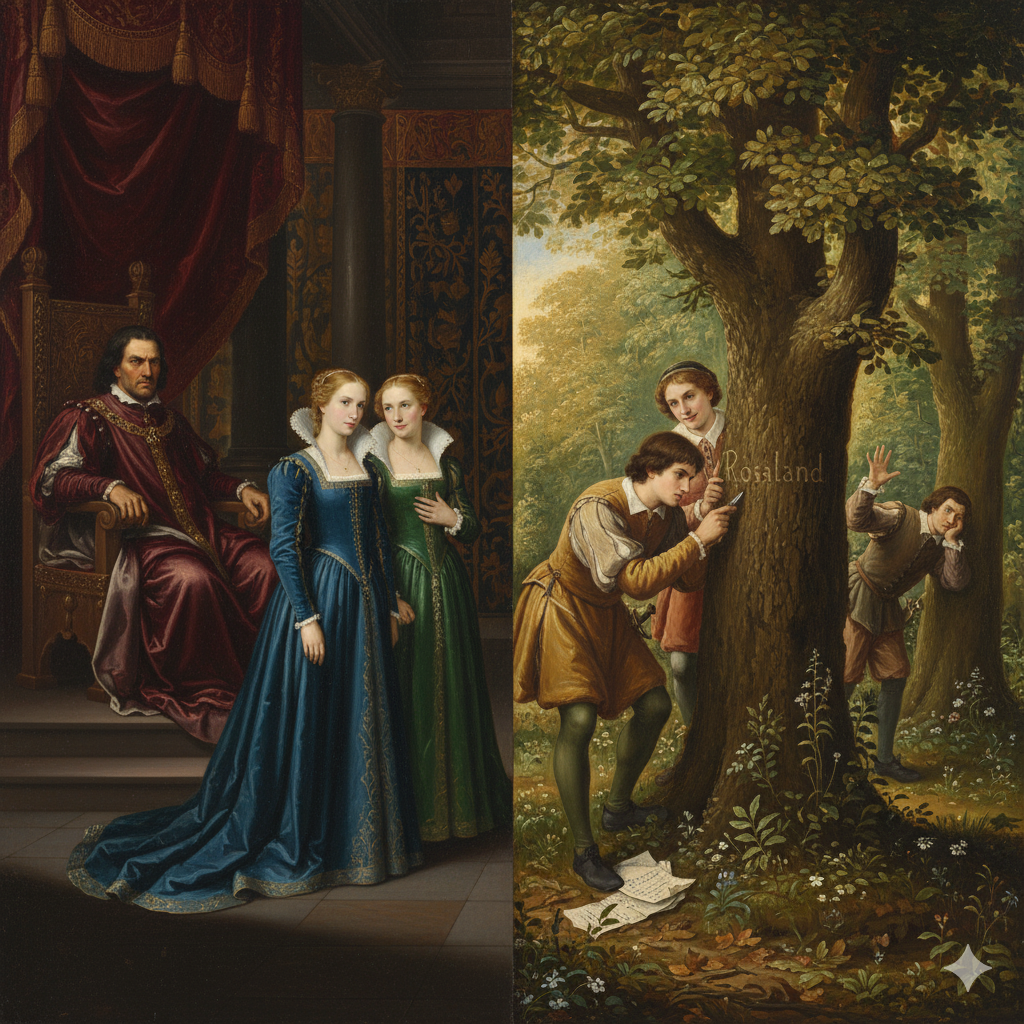
Act One opens not with joy but with familial incompetence. Orlando, our hero with biceps and burdened emotions, tells us that his older brother Oliver has treated him worse than a borrowed horse. According to inheritance law, Oliver should educate Orlando, train him, and treat him like a gentleman. Instead, Oliver gives him nothing but chores and bruises. Orlando wants justice. Oliver wants Orlando gone. Shakespeare wants the audience to enjoy the chaos.
Orlando confronts Oliver in the most polite way a furious man can manage. Oliver responds with calculated insults, the kind that indicate a lifelong habit of superiority without substance. It escalates quickly. Orlando grabs him. Oliver panics. Servants intervene. Shakespeare chuckles.
“The courtesy of nations allows you my better.”
ABS translation,
Legally you outrank me, but I am two seconds away from shaking that out of you.
Meanwhile, Duke Frederick has stolen the duchy from his older brother, Duke Senior, because Shakespeare loves a villain who works through paperwork instead of murder. Rosalind, Duke Senior’s daughter, remains in Frederick’s court only because Celia, his own daughter, refuses to part from her. Their friendship is so strong it embarrasses most modern friendships that fall apart over forgotten birthday wishes.
Rosalind enters sad but still glowing with Shakespearean intelligence. Celia tries to cheer her up with loyalty so intense it deserves an award. Together, they decide to distract themselves by watching a wrestling match, because nothing says emotional healing like watching a man get thrown across the floor.
Then Orlando enters for the wrestling competition. Rosalind sees him and immediately develops symptoms of Shakespearean love, which include heart palpitations, poetic dizziness, and the inability to remain rational. Celia warns him about the champion wrestler, Charles, who has broken bones like a hobby.
Orlando responds with heroic stubbornness. Rosalind gives him a chain as a blessing. Orlando melts into a puddle of hormonal determination. Cue the match.
“If you do in your own person abide the danger of this fight, your mistress shall be better benefited by your being knocked down.”
ABS translation,
You will probably die, but at least she will remember you.
Orlando fights Charles. To everyone’s shock, he wins. Rosalind beams. Celia claps. Duke Frederick becomes upset because he has the emotional flexibility of a stone. When he learns Orlando is the son of Sir Rowland de Boys, he instantly dislikes him because Sir Rowland had been loyal to Duke Senior. Shakespeare loves pettiness, and Frederick delivers it generously.
Rosalind, glowing with victory energy, praises Orlando. Orlando, glowing with love energy, cannot speak. Their mutual staring creates enough electricity to light Arden.
Then comes Frederick’s mood swing. He suddenly decides Rosalind is too popular and must leave the court. Why. Because she is the daughter of the man he exiled. Logic is optional in Frederick’s kingdom. Celia refuses to let Rosalind go alone, declaring their bond stronger than inheritance or tyranny.
“Thou and I are one.”
ABS translation,
If my father throws you out, I am packing my bags first.
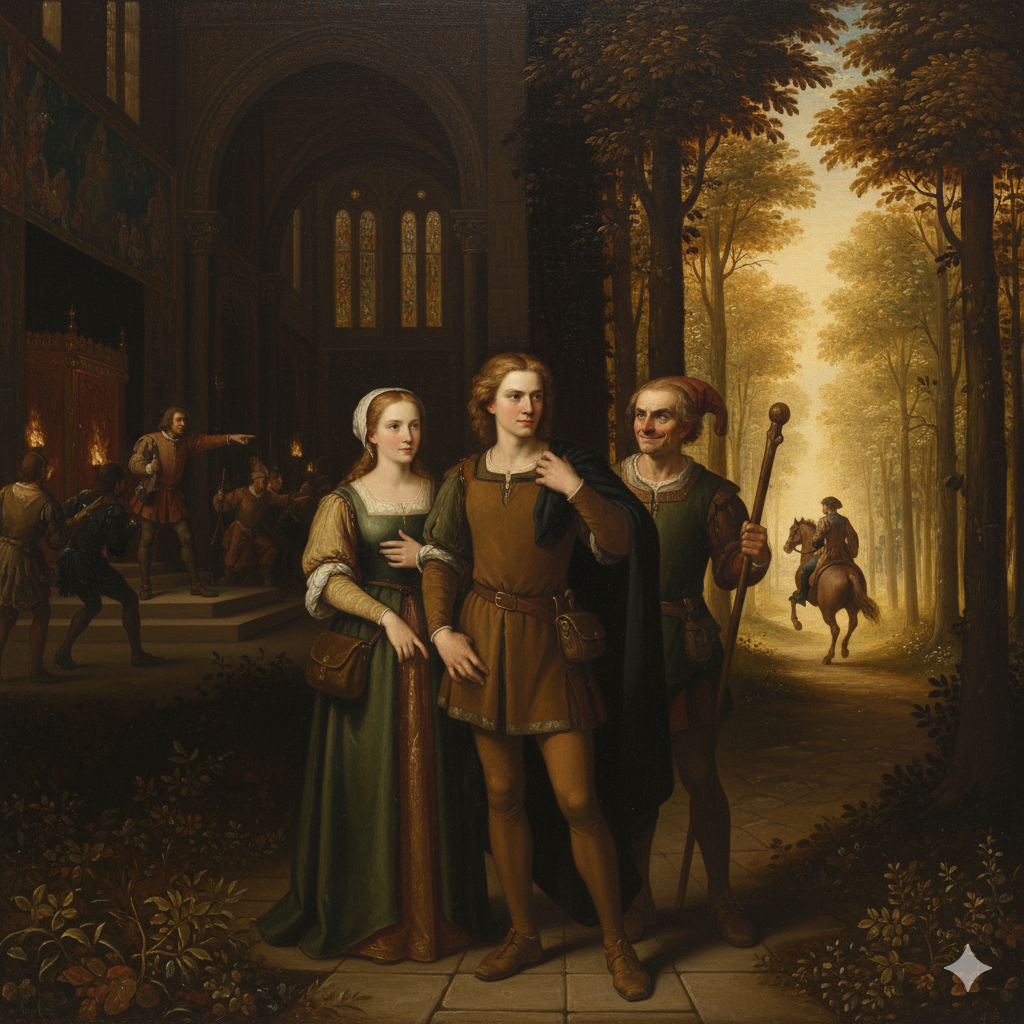
This is where the play reveals its heartbeat. Rosalind decides to flee to the Forest of Arden. Celia insists on going with her. Rosalind chooses a disguise, a brilliant one. She will dress as a young man named Ganymede so they can travel safely. Celia will dress as a peasant girl named Aliena, because the forest respects nobody unless you look poor.
Touchstone, the court fool with razor edged humor, joins them because every Shakespearean escape plan needs a sarcastic witness.
Meanwhile, Oliver plots against Orlando. Frederick orders Orlando’s arrest. Orlando escapes into the forest like a man who has finally realized family is hazardous to health. Arden becomes the destination for all the exhausted, the wounded, the witty, and the romantically confused.
Act One ends with two sisters disguised, one fool following, one hero fleeing, one villain fuming, and the Forest of Arden widening its arms like a charismatic therapist ready to fix everyone’s emotional mess.
ABS leans back, smirks, and says,
Act One is Shakespeare whispering, get ready, the forest is about to steal the show.
ACT TWO
Where Exiles Find Peace, Villains Lose Sleep, And Arden Turns Into Shakespeare’s Counselling Center
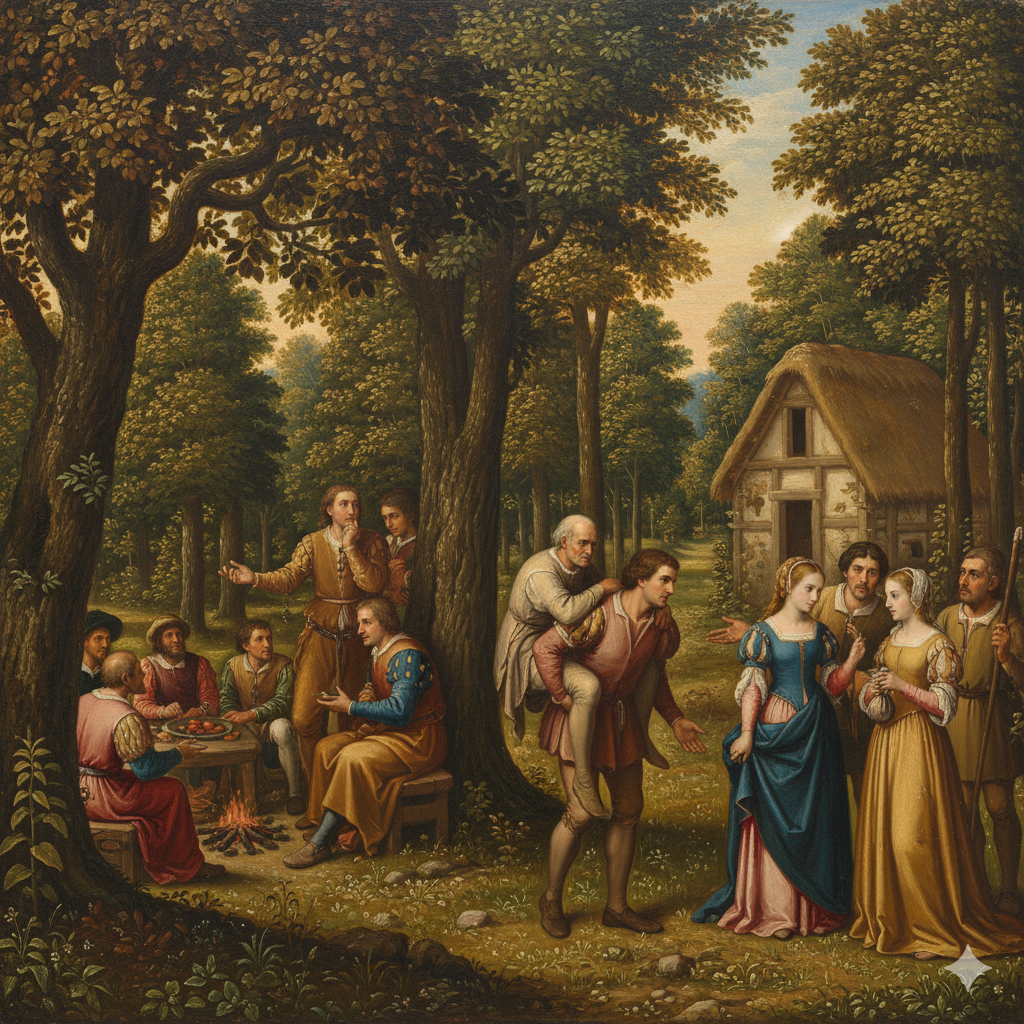
Act Two opens in the Forest of Arden, which behaves like a spiritual detox retreat long before people paid money for those things. Duke Senior, Rosalind’s banished father, sits under a tree delivering the kind of optimistic speech only a man who has accepted exile too gracefully can deliver. Surrounded by loyal followers, the Duke celebrates the forest as a place of freedom, friendship, and philosophical nonsense.
He praises the forest for its honesty, its fresh air, its simplicity, and its lack of treachery. Which is hilarious because half the cast is marching toward Arden bringing their treachery with them.
“Are not these woods more free from peril than the envious court.”
ABS translation,
Sure the forest is cold and full of wild animals, but at least no one here wants my throne.
Then we meet Jaques, Shakespeare’s champion of melancholy. The man complains beautifully. The man suffers loudly. The man criticises everything with poetic precision. He is the Renaissance version of a pessimistic blogger. When he hears about a wounded deer being hunted, he begins mourning it so dramatically that even the hunters look confused.
It is here that Shakespeare introduces the mood of Arden, a place where every personality type gets a microphone.
Meanwhile, back in the villain’s corner, Duke Frederick discovers that Celia has run away with Rosalind. He reacts with royal outrage because tyrants always behave like people who have never been told no. He accuses Orlando, who is already fleeing for his life, of assisting them. Frederick commands Oliver to find Orlando. Oliver, of course, resents being ordered around, but he hates his brother even more, so he accepts.
While Frederick fumes, Arden continues its pastoral therapy.
Orlando enters the forest with his loyal servant Adam. Adam, the sweetest old soul in the play, has followed Orlando out of pure devotion. The poor man is exhausted, starving, near collapse. Orlando carries him like a hero in a tragic romance and sets off to find help. It is the one moment in the play where Orlando behaves with zero poetic foolishness and pure dignity.
Then Shakespeare throws Rosalind, Celia, and Touchstone into the forest. Rosalind in her Ganymede disguise walks with bold confidence. Celia nearly faints from exhaustion. Touchstone complains like a professional. Together they wander, hungry, lost, and thoroughly unprepared for forest life.
Rosalind, in her new masculine role, tries to act tough. Celia tries not to collapse. Touchstone mocks every bird, tree, and pebble with more irritation per minute than most humans can manage.
They soon meet Silvius, the hopeless shepherd, who is drowning in poetic misery over his beloved Phebe. Silvius explains his suffering with such emotional intensity that even Touchstone rolls his eyes.
“O Phebe, Phebe, Phebe.”
ABS translation,
My heartbreak is louder than your survival needs. Deal with it.
Meanwhile, Phebe does not care. She would rather flirt with self importance than reciprocate Silvius’s passion. Shakespeare is warming up the subplot where Rosalind will later roast both of them.
Rosalind and Celia are rescued from hunger by shepherds who offer to sell them a small cottage and some land. Rosalind, still as Ganymede, buys it instantly because her confidence has no pause button.
At the same time, Orlando, in search of food for Adam, stumbles into Duke Senior’s camp. He bursts in with a drawn sword, demanding food like a starving lion. Duke Senior welcomes him with gentle calm, which embarrasses Orlando into immediate politeness. Shakespeare loves humbling his heroes just enough.
Duke Senior feeds Adam and welcomes Orlando with genuine warmth. This is where Arden works its magic. Exiles find comfort. Heroes find companions. Melancholics find a place to complain safely.
Then comes one of the most famous speeches in the entire play, spoken by Jaques with all the dramatic misery that only he can deliver.
“All the world’s a stage, and all the men and women merely players.”
ABS translation,
Human life is a cosmic comedy, and none of you are performing well.
In a forest full of lovers, fools, exiles, tyrants, and cowards, Jaques chooses to describe life as a theatrical tragedy of seven predictable stages. He reduces human existence into one long performance where everyone waits to be replaced by the next clueless actor. He is both brilliant and unbearable.
Act Two closes with everyone settled into Arden like guests at an emotional rehab center. Rosalind has a house. Duke Senior has a peaceful kingdom of trees. Orlando has Adam and dignity. Silvius has heartbreak. Phebe has ego. Jaques has gloom. Touchstone has sarcasm. And Shakespeare smiles because all the important pieces have arrived. The forest is ready.
ABS nods and says,
Act Two is Shakespeare proving you do not need a throne to start a revolution. Sometimes a tree will do.
ACT THREE
Where Love Poems Attack Trees, Disguises Cause Headaches, And The Forest Turns Into A Romantic Circus
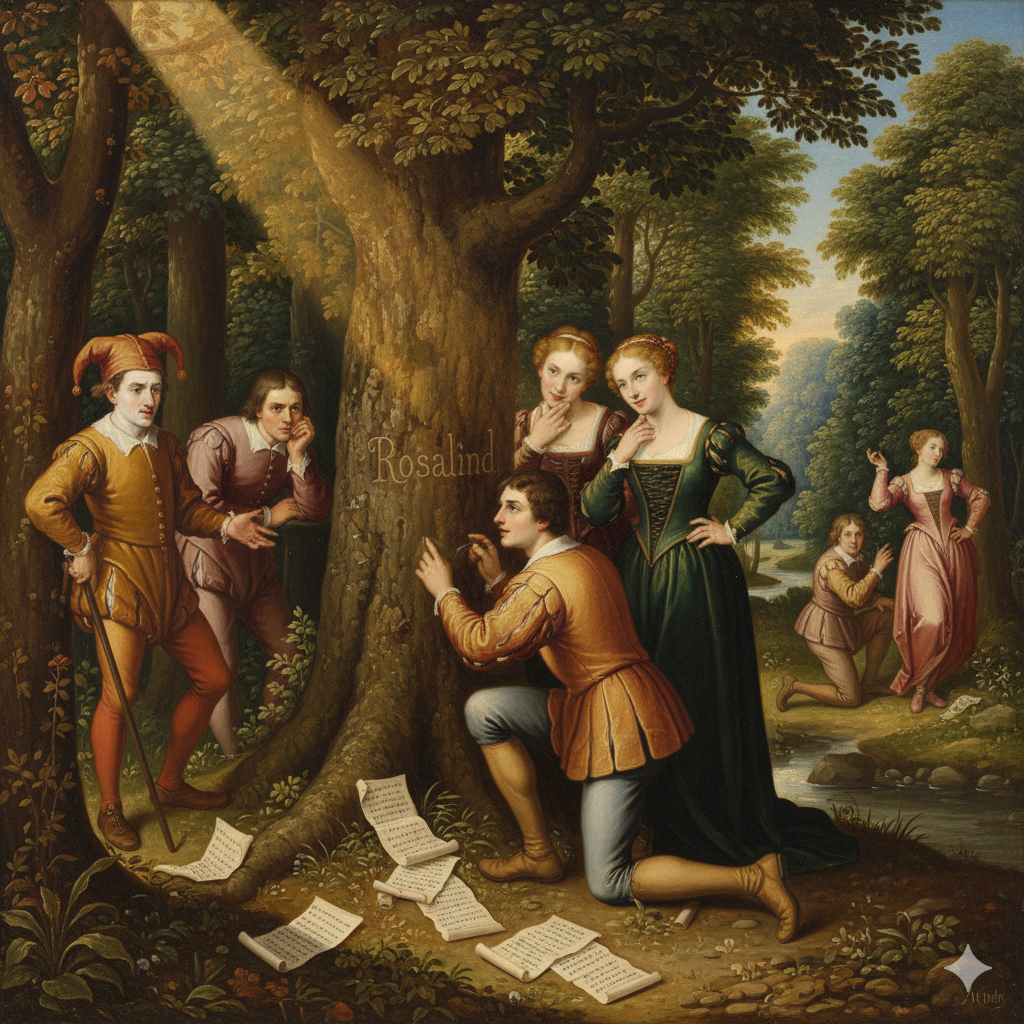
Act Three opens with Orlando behaving like the patron saint of embarrassing lovers. He storms through Arden with the emotional force of a man who has discovered metaphors five minutes ago. What does he do with this newfound power. He vandalises trees with love poetry so terrible it should qualify as forest abuse. Every trunk in Arden is suddenly covered with Rosalind’s name, written with the intensity of a teenager who believes he invented romance.
Rosalind, disguised as Ganymede, discovers these poetic crimes and nearly collapses laughing. She reads Orlando’s poems with a mix of affection, secondhand embarrassment, and questionable patience. Celia stands beside her, witnessing Rosalind slowly transform from a reasonable human being into a full time romantic disaster.
“O Rosalind, these trees shall be my books.”
ABS translation,
I will torture nature until it acknowledges my feelings.
Rosalind’s disguise now becomes her greatest tool. She approaches Orlando as Ganymede and begins conducting fake therapy sessions. Her goal is simple. Test Orlando’s love. Tease him endlessly. Cure him of bad poetry. And enjoy the thrill of controlling the situation while hiding her identity.
Orlando, who has the emotional awareness of golden retriever royalty, believes Ganymede is genuinely trying to help him. Rosalind tells him to pretend that Ganymede is Rosalind and to practice wooing her. Orlando agrees because he is too earnest to question how strange this request is.
Here begins the finest comic manipulation in the entire play.
Rosalind, still disguised, plays both lover and counsellor, giving Orlando ridiculous instructions on how to love better and how to act less hopeless. She mocks him, teaches him, and flirts with him while pretending not to flirt with him. Orlando, meanwhile, smiles through the confusion, trusting every strange lesson.
Celia watches this entire drama like a woman who cannot believe her best friend is emotionally torturing the man she is in love with.
Meanwhile, Touchstone finds romance of his own. He woos Audrey, a simple country girl. Touchstone’s love language is a mix of sarcasm, bad logic, and theatrical desperation. Audrey does not understand half his jokes but seems content that someone with a jester hat is interested in her. Their romance is the chaotic comic relief inside a play already overflowing with chaos.
Jaques enters and mocks Touchstone’s intentions, adding philosophical shade to a situation that already makes no sense. Touchstone fires back with wit so sharp it could peel fruit. Audrey stands in the middle, blinking politely, the only normal person in their triangle of absurdity.
“I am not a slut, though I thank the gods I am foul.”
ABS translation,
I know I am not glamorous, but I am honest, so relax.
Then comes the tragedy of Silvius and Phebe, the forest’s resident melodrama factory. Silvius is still pouring his soul onto the ground every time he speaks of Phebe. Phebe ignores him with the confidence of someone who enjoys breaking hearts as a hobby. Rosalind, disgusted by Phebe’s arrogance, roasts her so savagely that Phebe instantly falls in love with Ganymede instead. Shakespeare loves this kind of emotional whiplash.
Silvius suffers. Phebe simpers. Rosalind panics. Celia laughs. Arden holds all of them without judgment.
The forest fills with layers of parallel love stories.
Orlando loves Rosalind.
Rosalind loves Orlando.
Orlando flirts with Rosalind disguised as Ganymede.
Phebe falls in love with Ganymede.
Silvius loves Phebe.
Audrey loves Touchstone.
Touchstone loves arguments.
Jaques loves misery.
This is Shakespeare constructing a romantic traffic jam with zero signals and zero shame.
But the highlight remains Rosalind, who is enjoying her disguise a little too much. She controls the pace. She controls the misunderstandings. She controls Orlando’s heart while pretending she does not. She becomes the comedic puppeteer of Arden.
Act Three ends with everyone confused, everyone in love, and everyone trapped in one giant emotional knot that only Shakespeare can untangle. Arden is now a full blown comedy carnival, where identity bends, truths hide, and lovers run in circles hoping someone will guide them toward sense.
ABS grins and says,
Act Three is Shakespeare at his playful peak. Everyone is in love and no one knows what they’re doing. Perfect.
ACT FOUR
Where Rosalind Runs The Forest Like A Genius, Orlando Tries His Best, And Every Lover Turns Emotionally Unstable
Act Four begins with Rosalind in her Ganymede disguise taking full command of the forest. If Arden had a king, queen, counsellor, therapist, judge, lawyer, and relationship coach, Rosalind would be all of them at once. She is now the forest’s chief executive of love, and Orlando is her most confused client.
But first, Shakespeare blesses us with the delightful mess of Touchstone and Audrey. Touchstone decides he wants to marry Audrey, but only if he can find a priest careless enough to perform the ceremony. Enter Sir Oliver Martext, a man so incompetent he could not officiate a pillow fight. Touchstone realises the danger and backs out, because even fools have limits.
“I will not be married by you, Sir Oliver.”
ABS translation,
Your priest license is probably printed on bark. I value my survival.
Now Orlando enters, late for his scheduled pretend wooing session with Ganymede. Rosalind, who has elevated emotional manipulation into an art form, scolds him with the elegance of a queen and the fury of a girl in love pretending not to be.
She mocks men who arrive late. She mocks men who swear eternal devotion. She mocks men who die for love in poems but faint at the sight of actual blood. Orlando stands there taking every blow with the patience of a man hopelessly smitten.
Then comes one of the most delicious exchanges in the entire play. Rosalind explains that lovers behave ridiculously because love itself is a kind of madness dressed in poetry. Orlando counters with his own sincerity, claiming he would die for Rosalind.
Rosalind laughs in his face.
“Men have died from time to time, and worms have eaten them, but not for love.”
ABS translation,
Dramatics will not impress me. Worms do their job better than lovers.
Rosalind uses this moment to test Orlando, pretending that she can cure him of love if he undergoes her bizarre behavioural lessons. Orlando nods, desperate to prove himself. Celia watches the entire display with the unimpressed face of someone who knows Rosalind is enjoying this way too much.
Meanwhile, Shakespeare shifts to Silvius and Phebe, the emotional soap opera of the forest. Phebe, still in love with Ganymede and still uninterested in Silvius, receives a scathing lecture from Rosalind. Rosalind tells her she is delusional, vain, rude, ungrateful, and blind to Silvius’s genuine devotion. It is one of the most satisfying roasts in Shakespeare.
Phebe, proving she has the emotional intelligence of a pebble, interprets the insults as flirtation and falls even harder for Ganymede.
Silvius suffers. Phebe fantasises. Rosalind groans. Shakespeare laughs.
The comedic storm continues when Orlando returns to Rosalind with good news. He has been carving fewer poems into the trees. Rosalind pretends she is proud of him, the way one praises a toddler for not biting the furniture. Then Orlando drops a bomb. His brother, Oliver, has arrived in Arden.
Oliver enters transformed. He has gone from villain to repentant gentleman after Orlando saved him from a lioness. Yes, Shakespeare included a lioness. Yes, it makes no sense geographically. Yes, it is perfect.
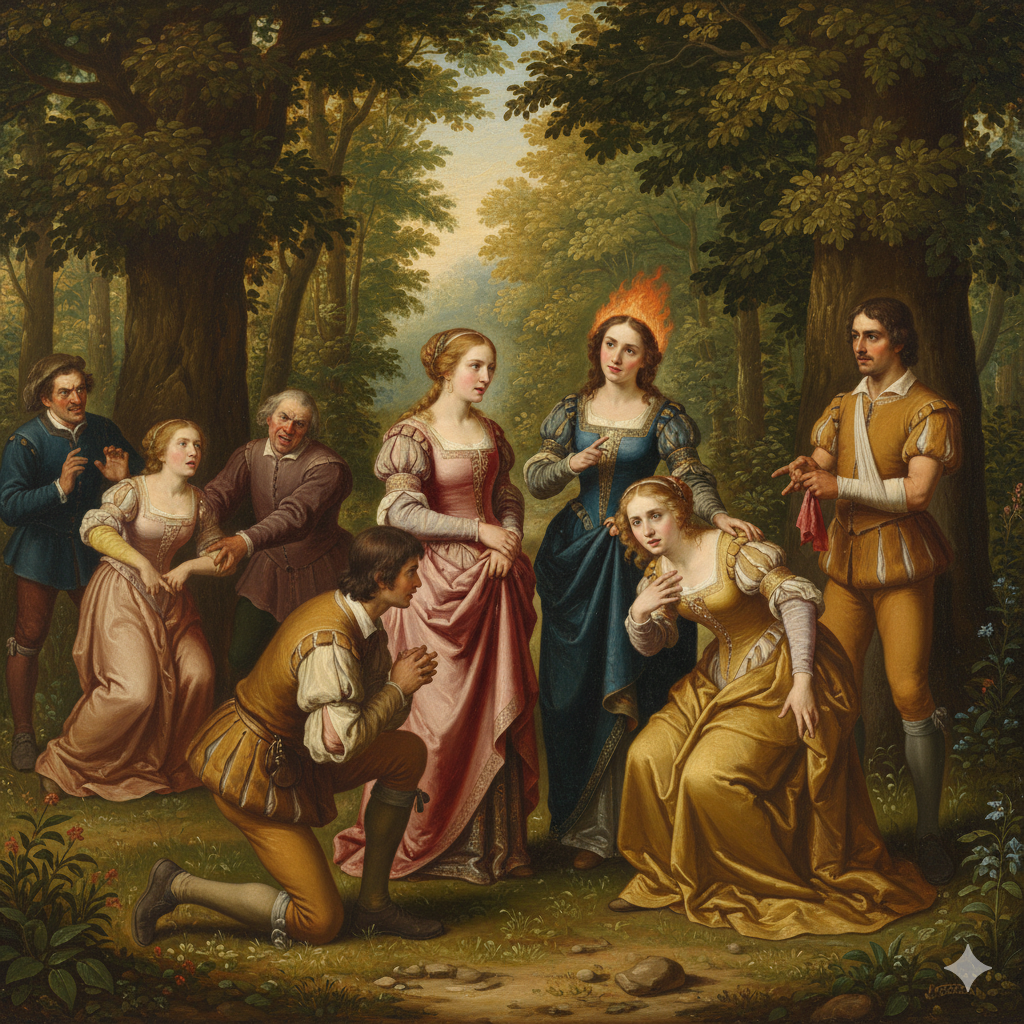
Oliver tells Rosalind and Celia how Orlando fought off the beast and saved his life. Rosalind almost faints. Her disguise cracks. Celia tries to catch her. Orlando sends his bloody handkerchief to Rosalind as proof of his injury, and Rosalind panics like a woman whose heart has just set itself on fire.
“I should have been a woman by right.”
ABS translation,
This disguise is ruining my ability to pretend I am not in love.
Oliver and Celia instantly fall for each other, because Shakespeare believes love can strike with the accuracy of lightning and the logic of drunken bees. Their romance moves so fast it leaves skid marks on Arden’s soil.
Act Four ends with Rosalind promising to solve everyone’s problems the next day. She will fix Phebe. She will fix Silvius. She will fix Orlando. She will fix Oliver. She will fix the entire romantic chaos like a divine administrator of love.
ABS stretches and says,
Act Four is Rosalind operating the universe while everyone else tries not to faint.
ACT FIVE
Where Four Weddings, One Forgiveness, And A Fool’s Exit Tie Every Knot In Arden
Act Five begins exactly as Shakespeare intends: with chaos that wants resolution. Everyone is in love, everyone is confused, and everyone is waiting for Rosalind in her Ganymede disguise to fix their emotional disasters like a one woman repair service.
We begin with Touchstone and Audrey, who still intend to get married, although their romance has the structural stability of wet parchment. Touchstone debates marriage the way a philosopher debates fate, except with more insults and less clarity. He tells Audrey he will marry her, but only if the wedding is done with someone more competent than Sir Oliver Martext. Audrey agrees, mostly because she likes Touchstone’s passion even when his logic is made of dust.
Then we transition to Silvius, Phebe, and their eternal melodrama. Silvius is still begging Phebe to love him. Phebe is still pretending she does not care. And everything is still a mess. Shakespeare has kept this triangle alive purely for Rosalind to enter and solve in the most satisfying way possible.
Celia and Oliver stroll in next, glowing like a freshly baked love story. They fell in love in Act Four with suspiciously supernatural speed, and now Oliver announces that he will give up his property to Orlando and live as a shepherd in Arden. Celia quietly beams, proving she always had excellent boyfriend judgement, unlike Rosalind who chose a man who vandalises trees.
Orlando receives the news with humility, and then confesses that he cannot marry Rosalind because Rosalind is nowhere to be found. Rosalind, still disguised as Ganymede, hears this and almost sighs loud enough to shake the forest.
Now the stage is perfectly set:
Orlando wants Rosalind.
Phebe wants Ganymede.
Silvius wants Phebe.
Oliver wants Celia.
Audrey wants Touchstone.
Touchstone wants an audience.
And Jaques wants everyone to stop being dramatic.
“Good shepherd, tell this youth what ’tis to love.”
ABS translation,
Explain love to this boy who writes poems on trees like a vandal.
Finally, Rosalind steps forward as Ganymede and launches her master plan. She tells Orlando that she can magically bring Rosalind to him, but only if he promises to marry her on sight. Orlando agrees instantly. She tells Phebe that she will get Ganymede only if Ganymede does not want a woman. Phebe agrees because she is delusional. Rosalind then tells Silvius he will either get his love or contentment. Silvius nods because he has the emotional resilience of a sponge.
Rosalind exits to prepare the grand reveal.
Then comes one of Shakespeare’s funniest and most brilliant transformations. Rosalind returns fully herself, no disguise, no gender games, no forest persona. She stands before Orlando as the woman he has been carving into trees for days.
Orlando almost forgets how to breathe.
Phebe realises she has been in love with the wrong gender the entire time.
Silvius finally sees a sliver of hope.
Celia claps like a proud sister.
Jaques mutters something profound and irritating.
Touchstone rolls his eyes dramatically.
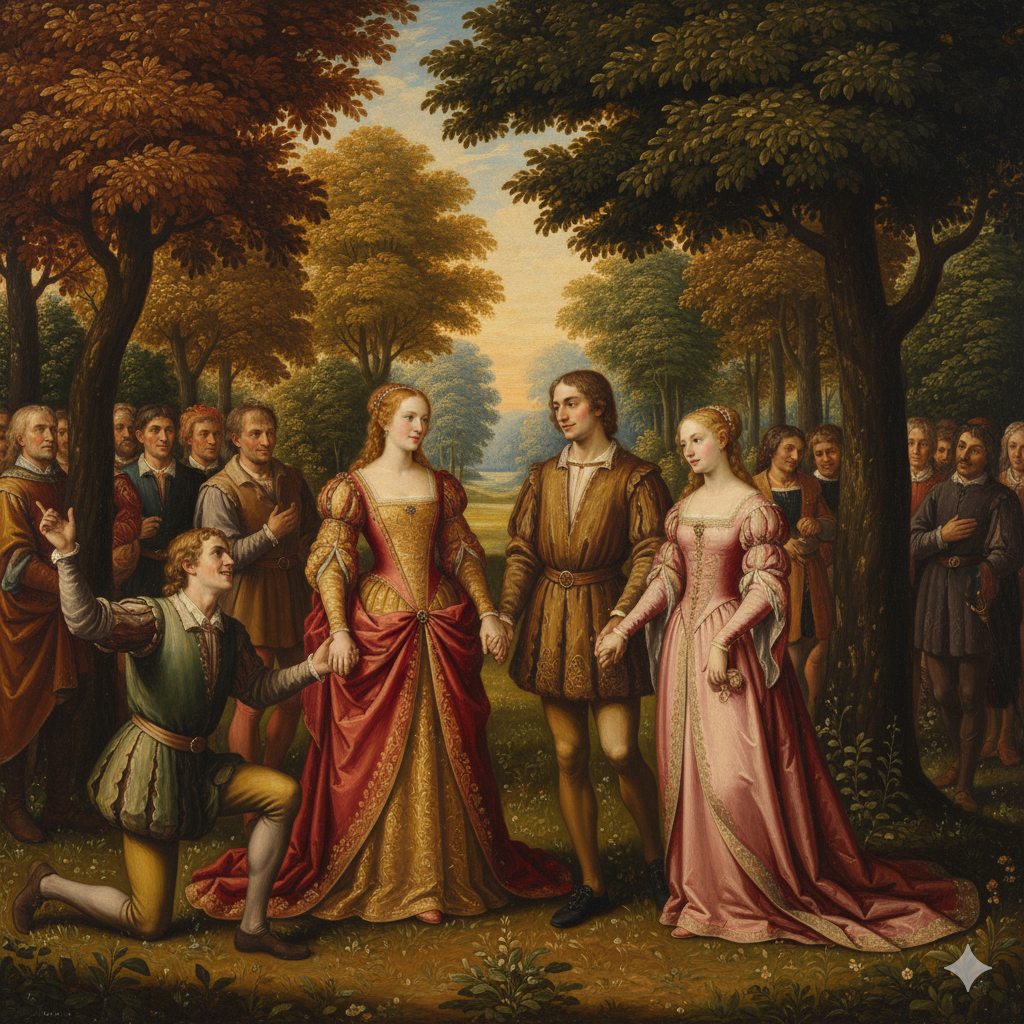
Rosalind declares who marries whom, and Shakespeare ties up the knots with the elegance of a stage magician.
“To you I give myself, for I am yours.”
ABS translation,
You love me, I love you, stop asking questions.
We get not one wedding.
Not two weddings.
Not three weddings.
But four weddings.
Orlando and Rosalind.
Celia and Oliver.
Phebe and Silvius (because her condition backfired).
Touchstone and Audrey (with questionable officiation quality).
Then Shakespeare adds a cherry on top: the news that Duke Frederick, on his way to attack Arden, suddenly met a holy man in the forest, changed his life, gave up everything, and restored Duke Senior to power. This is Shakespeare’s way of saying, we are finishing this play today, no more villains.
Everything resolves smoothly. Arden becomes a land of forgiveness, transformation, and joyful noise.
And then comes the exit speech.
Not from Rosalind.
Not from Orlando.
Not from Duke Senior.
But from Jaques, the melancholic philosopher, who refuses to join the celebrations. He slips away to live quietly with Duke Frederick, proving that some people love misery enough to treat happiness like an allergy.
Finally, Rosalind steps forward for the epilogue, breaking the fourth wall, teasing the audience, and reminding them that stories end but wit does not.
ABS closes Act Five with a grin and says,
The forest healed them all, even if half of them did not deserve it.
A Forest That Fixes Everything Except People Who Do Not Want To Be Fixed
As You Like It ends the way only Shakespeare can manage. He drags half the cast into the forest, forces them through identity crises, love confusions, emotional meltdowns, and philosophical detours, and then ties every knot with a smile as if the entire journey was just a pleasant afternoon stroll. Arden becomes a space where logic politely steps aside and the heart takes over, often with disastrous but entertaining results.
The play is a celebration of freedom, reinvention, and the absurdity of human behaviour. People run away from court, only to rediscover themselves in a forest that functions like a spiritual reboot button. Rosalind becomes the architect of everyone’s fate. Orlando becomes the world’s most earnest romantic. Touchstone becomes a walking satire of society. Jaques becomes the forest’s moodiest raincloud. And the shepherds become collateral victims of too many monologues.
But beneath the jokes, the disguises, and the pastoral glow lies Shakespeare’s quiet truth.
When you remove social expectations, when you peel away titles and rules, when you put people among trees instead of thrones, they reveal who they really are.
Some love fiercely.
Some break easily.
Some heal slowly.
Some complain endlessly.
Some rise.
Some run.
Some transform.
And a few, like Jaques, choose to remain untouched, staring at the world with permanent scepticism.
That is what makes As You Like It endure.
It is not just a comedy.
It is a study of choice, freedom, and the magnificent confusion that is the human heart.
The forest changes everyone, but only because it gives them permission to be themselves.
Identity loosens. Love sharpens. Wisdom wanders. Fools triumph. Tyrants retreat.
And in the end, harmony returns not because the world is perfect, but because people finally stop pretending.
Shakespeare closes the play with an epilogue from Rosalind, the sharpest mind he ever wrote, reminding the audience that stories are only as serious as we choose to make them.
And that laughter, in the right hands, can solve just as many problems as logic.

Abha Bhardwaj Sharma is a Professor of English Literature with over 25 years of teaching experience. She is the founder of Miracle English Language and Literature Institute and the author of more than 50 books on literature, language, and self-development. Through The Literary Scholar, she shares insightful, witty, and deeply reflective explorations of world literature.
Share this post / Spread the witty word / Let the echo wander / Bookmark the brilliance