
When imagination outran science and fiction quietly became fact
ABS Believes
Literature does not predict the future. It merely notices what the world is trying to ignore.Writers do not become prophets. Readers simply arrive late.
The future has always been an overconfident creature. It walks around as if it invented everything, conveniently forgetting that several writers sketched it out long before any engineer found a blueprint. Technology often congratulates itself, unaware that someone with a fountain pen and a stubborn imagination described the same idea a century earlier. You would think the world might show a little gratitude. Instead, it behaves as if these predictions were coincidences. They were not.
The greatest irony is that none of these writers were trying to predict anything. They were not sitting in candlelit rooms whispering, Let me guess the twenty first century. They were simply observing human nature, which, unfortunately for all of us, is far easier to forecast than weather or stock markets. Human behaviour repeats itself with such enthusiasm that fiction becomes prophecy without asking for permission.
Writers do not foresee technology. They foresee people. Technology simply follows.
“The future is not unpredictable. It is just repetitive in higher resolution.”
Look closely at these so called predictions and you will notice something delicious. Every writer who accidentally got it right was simply paying attention. The world changes its gadgets but rarely changes its habits. Fear, curiosity, loneliness, convenience, distraction, power and connection. These forces stay loyal across centuries. So when a writer exaggerates these tendencies on the page, the future dutifully rises to imitate the imagination.
The uncanny accuracy of fiction is not magic. It is human pattern recognition wearing a creative hat.
“A writer exaggerates a problem. The future adopts it as a lifestyle.”
Of course, society refuses to acknowledge this. It prefers the myth that innovation springs from nowhere, that progress is purely scientific, that literature is a charming extracurricular activity rather than a laboratory of human possibility. This is why we find ourselves stunned when a story written in 1909 describes the internet with unsettling precision, or when a novelist mutters a line that becomes a blueprint for tomorrow’s devices. We call them accidental prophets. They call themselves people who wrote before breakfast.
The problem is not that writers predicted the future. The problem is that we keep pretending they did not.
Fiction sketches the map. Reality, lacking creativity, follows it.
“When imagination leaps, the future eventually scrambles after it.”
And this brings us to the heart of this scroll. Not the obvious prophets. Not the writers who intentionally crafted dystopias with flashing neon signs saying Look, this could happen. No. The fascinating ones are those who were simply telling a story, and in the casual act of storytelling, outlined our present with embarrassing accuracy.
Writers who described networked societies before screens flickered.
Writers who invented earbuds before tech companies announced them dramatically on stage.
Writers who envisioned submarines, satellites, surveillance culture, genetic anxieties, and global interconnectedness while the rest of the world was still arguing about telegraph wires and gas lamps.
They did not mean to predict anything. That is what makes them extraordinary.
Accidental prophecy is the most honest kind. It exposes how transparent the future actually is.
“Imagination is never wrong. It is simply early.”
So this scroll is not a tribute to fortune telling. It is a celebration of writers who understood the world so deeply that the world eventually copied them. They wrote fiction. Reality took notes.
Now let us meet the ones who predicted our present while merely trying to write a good story.
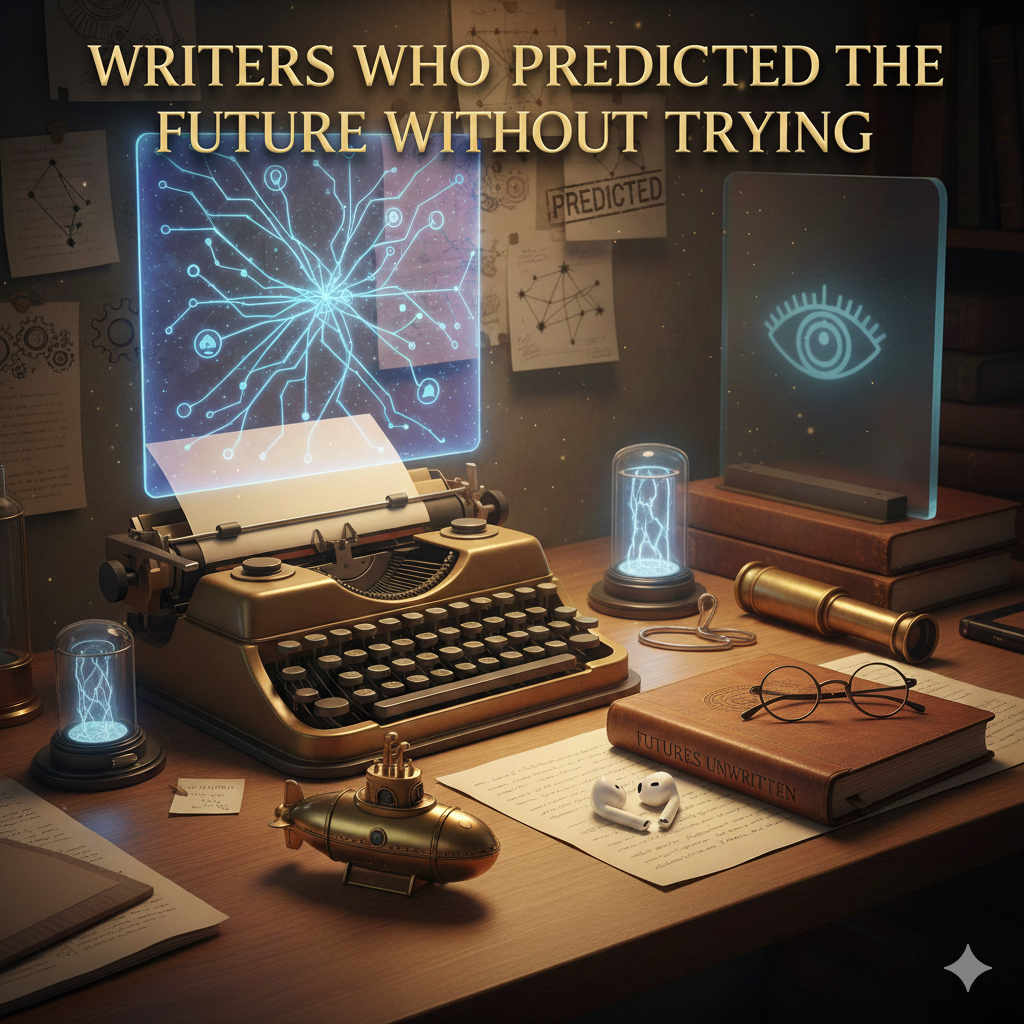
E. M. Forster and The Machine Stops
A Man Who Described the Internet Before the Internet Knew It Existed
Long before people were scrolling endlessly, refreshing screens, attending video calls in pajamas or losing their will to live during buffering pauses, E. M. Forster quietly wrote a story in 1909 that described the entire digital world with unsettling accuracy. The Machine Stops was meant to be fiction. Instead, it became a manual for modern society. The man basically predicted FaceTime, social media, algorithmic dependence and indoor life addiction while electric sockets were still being judged for their moral character.
The story takes place in a future where humans live underground in isolated rooms. They communicate only through screens. They avoid physical contact. They attend virtual lectures. They worship a giant system of instant connectivity. They rely on a vast network that controls everything. If this is not the internet, then the internet owes Forster a public apology.
Forster did not predict machines. He predicted people relying on machines to avoid each other.
“He wrote about video calls before telephones had learned to behave consistently.”
Everything in the story feels alarmingly familiar. People are constantly sharing ideas they have not actually experienced. They prefer secondhand knowledge over real life. They sit comfortably at home, pressing buttons to access information instead of moving their bodies. They believe the machine knows best. They are offended by anyone who wants to step outside. Forster basically described the average twenty first century workday before the twenty first century considered existing.
What makes this even more delightful is the fact that Forster was not a science fiction writer. He was not a futurist. He was not a prophet. He simply had the ability to look at humanity and say, Give them a convenience and they will build a shrine. He did not need to predict technology. He only needed to understand human laziness.
He recognised the oldest truth in history. If you offer comfort, people will sacrifice curiosity.
“The Machine Stops reads like a warning label on modern society.”
The brilliance lies in how he framed the problem. Forster did not write about machines taking over. He wrote about humans surrendering voluntarily. People in the story believe the machine is infallible. They quote its instruction manual like scripture. They lose the desire to think independently. They fear real experience because it is messy and unpredictable. And because the machine keeps them alive, they assume that it can never fail.
This blind trust feels uncomfortably familiar. Replace the underground rooms with air conditioned apartments. Replace the machine with the internet. Replace the lecture system with video platforms. Replace button pressing with tapping screens. Congratulations. You have just recreated the present.
The future did not surpass Forster. It merely updated his vocabulary.
“We have not become more advanced. We have become more predictable.”
The most striking part of the story is the moment when the main character wants to see the surface of the earth. His desire for direct experience is treated as heresy. This is the sign of a writer who understood something fundamental. Convenience creates complacency. Complacency becomes doctrine. Doctrine becomes fear. And fear becomes obedience.
Forster captured the psychology of digital dependency long before screens flickered. He understood that humans will trade reality for comfort without complaint. He knew that technology shapes culture not through force but through seduction. And he knew that people will worship anything that makes life feel easier.
Forster did not predict a machine controlled world. He predicted a world that willingly controlled itself for the sake of convenience.
“The Machine did not stop. We simply renamed it the internet.”
The story ends with the collapse of the system, not because of rebellion but because of overuse and blind trust. When everything depends on a machine that nobody understands, failure becomes inevitable. This is not a prophecy. It is a reminder that every system collapses when people stop asking questions.
Modern readers approach the story with an uncomfortable mixture of admiration and existential dread. We laugh at the ancient description of technology and then realise we are the punchline.
Forster wrote a warning disguised as fiction. The fact that we now treat it as a description of daily life is a testament to how closely imagination traced the outlines of reality.
He did not predict our world.
Our world fulfilled his story.
2
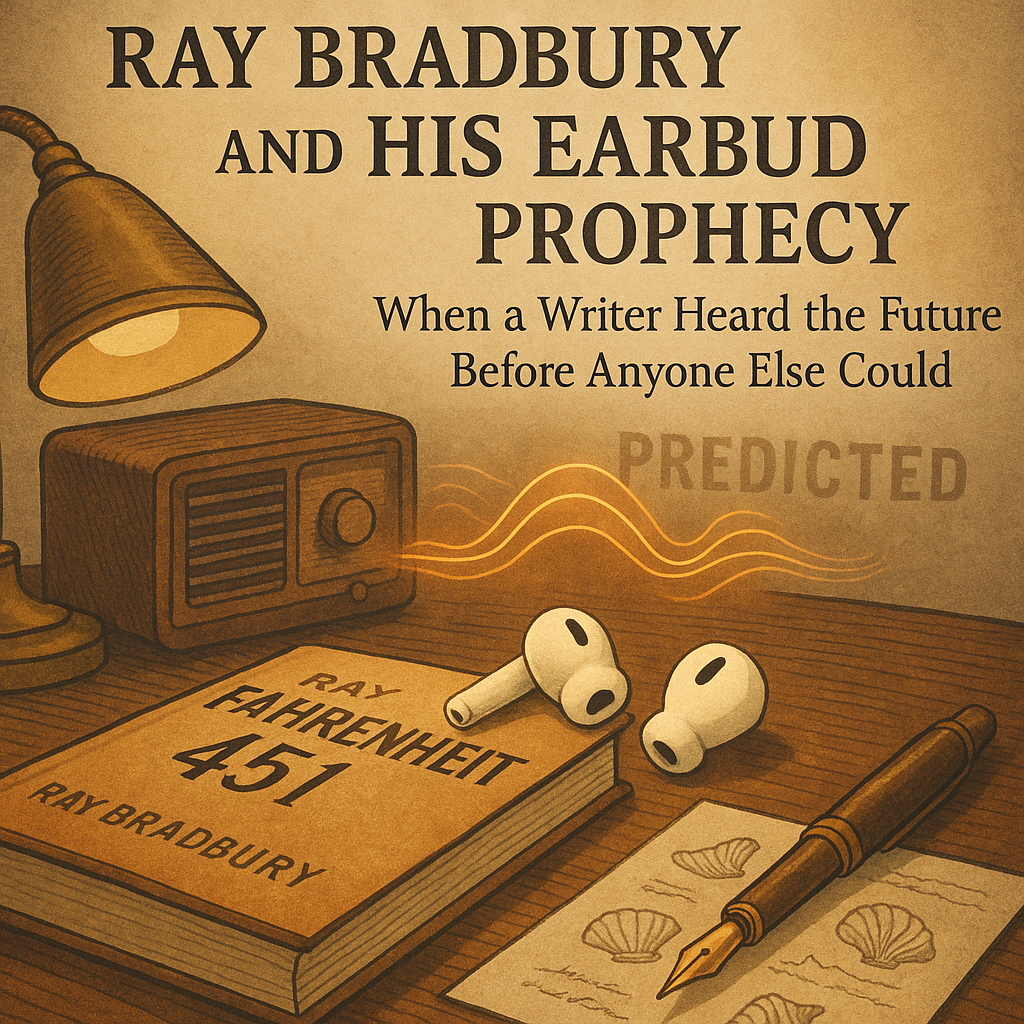
Ray Bradbury and His Earbud Prophecy
When a Writer Heard the Future Before Anyone Else Could**
Long before people started walking around with tiny white gadgets sticking out of their ears, isolating themselves from humanity one playlist at a time, Ray Bradbury casually invented the entire concept in Fahrenheit 451. He called them seashell radios. We call them earbuds. Tech companies call them revolutionary. Bradbury probably called them Tuesday.
In the book, characters walk around with little audio devices that deliver constant streams of sound directly into their ears. They use them to avoid conversation, drown out silence and escape from the exhausting burden of thinking. If modern society ever needed a mirror, Bradbury graciously provided one decades before anyone asked.
Bradbury did not predict technology. He predicted our desire to shut each other out.
“He described earbuds before music stopped being a shared experience.”
Let us appreciate the level of accuracy. Seashell radios are wireless. They are compact. They are inserted directly into the ear. They allow personalised content. They isolate the listener from the world. And they create a private little bubble where nobody else exists. This was written in 1953, when the height of technological excitement was a new model of vacuum cleaner.
Bradbury must have been exhausted from watching humanity flirt endlessly with distraction. His society is filled with people addicted to noise. They cannot tolerate quiet. They cannot handle thought. They drown their discomfort in constant sound because silence would reveal too much. Reading this today feels like listening to someone explain the psychology of modern airports, public transport and every gym in existence.
The book was not about devices. It was about dependency disguised as convenience.
“Bradbury saw that humans would choose distraction over depth every single time.”
He understood something profound. If you give people private entertainment, they will abandon public conversation. If you offer endless noise, they will forget the value of silence. If you provide a constant stream of stimulation, they will never choose stillness voluntarily. The seashell radios are not futuristic inventions. They are emotional crutches built to keep people comfortably numb.
And here is the delicious irony. When Fahrenheit 451 was published, the idea of miniature audio devices seemed ridiculous. Today, it is considered essential. People panic when their earbuds run out of charge, as if they are losing a vital organ. Bradbury predicted the emotional dependence that would arise long before the technology existed.
He did not imagine earbuds. He understood humans too well.
“Noise became a lifestyle. Bradbury merely wrote the instruction manual.”
In his world, seashell radios also function as a subtle form of control. They keep citizens occupied. They keep them distracted. They keep them obedient. People stop asking questions because their minds are full of prepackaged sound. The device does not silence them by force. It silences them through excess.
Sound familiar.
This is the genius of Bradbury. He did not forecast gadgets. He forecast behaviour. He knew that humans crave distraction so eagerly that they will wear it in their ears without question. He knew that entertainment can become a chain disguised as a treat. And he knew that the easiest way to control a population is to keep them constantly entertained.
Bradbury’s prophecy is not eerie because it came true. It is eerie because it came true effortlessly.
“He handed the future a metaphor. The future built hardware.”
The most astonishing part is how normal this technology feels now. Earbuds are fashionable. Convenient. Trendy. Necessary. Nobody thinks twice about walking down a street locked inside their own musical universe. Bradbury’s characters behaved the same way. They could not hear each other. They could not see each other. They could barely notice when their society collapsed around them because they were too busy listening to curated noise.
Modern life did not outgrow Bradbury. Modern life simply fulfilled him.
We treat earbuds as a symbol of progress. Bradbury treated them as a symptom. A symptom of isolation. A symptom of distraction. A symptom of a world in which silence has become an enemy.
He did not predict our technology.
We perfected his warning.
3.
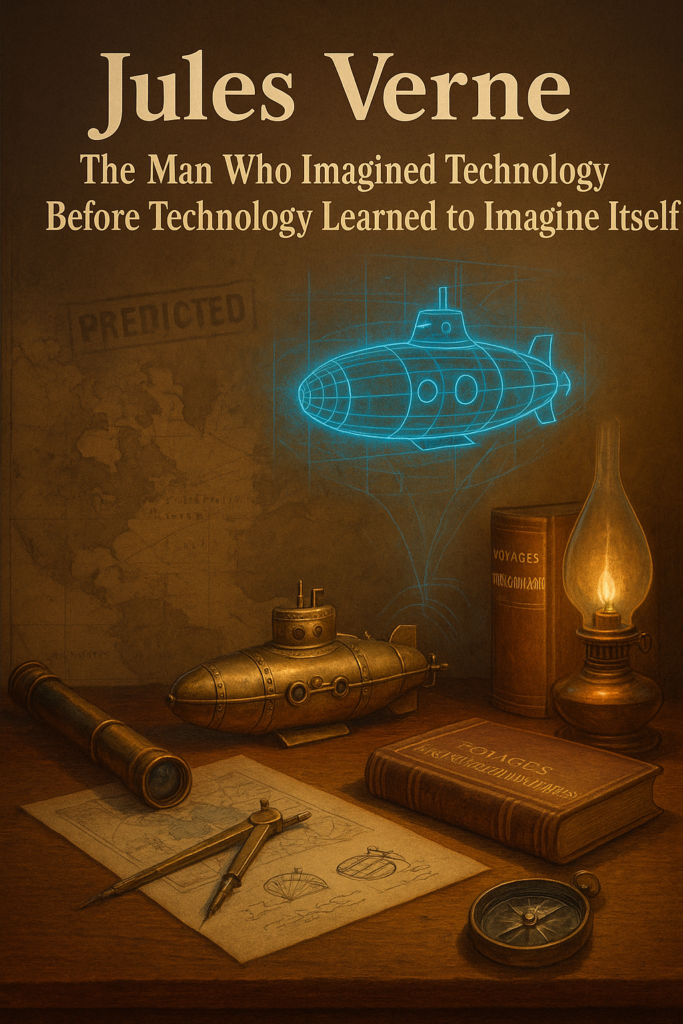
Jules Verne
The Man Who Imagined Technology Before Technology Learned to Imagine Itself**
There are writers who speculate about the future, and then there is Jules Verne, a man who casually described submarines, space travel and deep sea exploration at a time when most people were still impressed by improved street lighting. Verne was not trying to predict anything. He was simply writing adventure stories with the audacity of someone who believed imagination should not wait for engineers to catch up.
In Twenty Thousand Leagues Under the Sea, he introduced the Nautilus, a submarine with features that would not exist for decades. A self powered vessel. Electric energy. Sleek engineering. Navigation systems far beyond the technology of his century. Verne did not give us a submarine. He gave us a blueprint disguised as fiction. By the time the real world built one, he was already several plots ahead.
Verne did not predict invention. He predicted human curiosity refusing to stay shallow.
“He described the deep sea with more accuracy than people who had never seen it.”
Verne’s imagination was not whimsical. It was methodical. He researched ocean currents, pressure depths, geology and early mechanical experiments, then stitched them into stories with an ease that would make modern researchers blush. The result was fiction that looked like prophecy because he understood that the limits of science were temporary, but the limits of imagination were nonexistent.
In From the Earth to the Moon, Verne took a group of men to space using a giant cannon powered by mathematics and stubborn optimism. The details were astonishingly close to actual space travel. Launch site location. Capsule design. Splashdown landing. Trajectory. The story reads like NASA fanfiction written ninety years too early.
He did not guess the future. He calculated it.
“The man wrote space travel while his century was still learning to spell gravity.”
The most amusing part is how seriously Verne took his own ideas. He believed that if something could be imagined, it could eventually be engineered. This is the opposite of how many people think today, where the default reaction to innovation is mild panic and twenty seven committee meetings. Verne believed in possibility. Engineers arrived later and confirmed he had been right.
What makes his predictions feel almost uncomfortable today is their practicality. They are not random fantasies. They are thoughtful, structured, scientifically grounded explorations of what humanity could achieve if it refused to settle for the familiar.
Verne was not predicting machines. He was predicting ambition.
“He trusted imagination more than he trusted limitations.”
Consider his descriptions of the deep ocean. At the time, no one knew what lay beneath the surface. Scientists had theories. Sailors had stories. But Verne created an entire underwater world with a confidence that suggested he had taken a private tour. Today, we read his work with the strange feeling that he somehow understood ecosystems he was never supposed to have seen.
And then there is the technology. Electric power. Diving suits. Modular vessels. Global travel systems. Verne treated each as if they were inevitable. Not dramatic. Not outrageous. Simply forthcoming. The real world eventually agreed.
This is the signature of a visionary. Not accuracy. Not prediction. But inevitability. Verne wrote as if the future had already sent him a letter. All he had to do was translate it into fiction.
The future did not surprise Verne. Verne surprised the future.
“His imagination was not ahead of its time. His time was behind his imagination.”
What separates Verne from other accidental prophets is not the number of things he got right. It is the confidence with which he wrote them. There is no hesitation. No timid speculation. He does not ask whether humanity will build submarines or explore space. He writes as if they already have, and readers simply need to catch up.
Modern readers feel an odd mixture of admiration and embarrassment. Admiration because he was right. Embarrassment because it took everyone else so long to notice.
Verne did not set out to predict anything. He set out to explore everything. And the world, slowly and reluctantly, built the machines to follow him.
He did not foresee the future.
He invited it.
4.
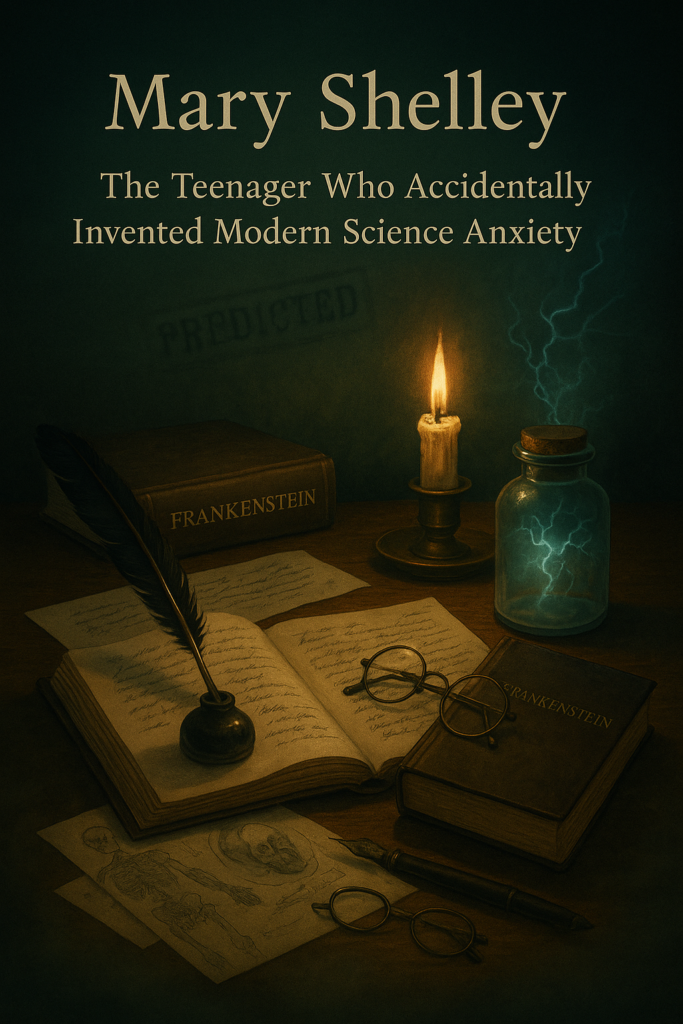
Mary Shelley
The Teenager Who Accidentally Invented Modern Science Anxiety**
Before science fiction existed, before laboratories became ethical battlegrounds and before humanity started arguing about what counts as life, Mary Shelley was nineteen years old and casually writing Frankenstein. She was not trying to predict anything. She was not attempting prophecy. She was simply bored during a gloomy holiday and decided to terrify an entire century. Instead, she terrified the next three.
Her novel introduced the world to the idea of creating life from non life, a concept so far ahead of her time that scientists needed almost two hundred years to catch up. Organ transplantation. Artificial organs. Genetic engineering. Biomedical ethics. Cloning. Even the fear of technology outpacing morality. Shelley did not predict these developments. She exposed the psychological blueprint behind them.
Shelley did not imagine a monster. She imagined a world terrified of its own inventions.
“Frankenstein is not about creation. It is about consequences.”
The brilliance of Shelley’s prediction is that she never once tries to sound scientific. She does not overwhelm readers with jargon. She does not pretend to have advanced knowledge. Instead, she focuses on the human response. The fear. The guilt. The runaway consequences of ambition without responsibility. She understood something that modern debates still struggle to articulate. The danger is not the experiment. The danger is the experimenter.
Shelley created the template for every scientific dilemma that followed. Scientists who push boundaries without considering repercussions. Societies that fear the unknown. Creations that are more innocent than the people who built them. These patterns did not emerge in the twenty first century. They were born in a teenager’s imagination during a humid Swiss summer.
She predicted the emotional architecture of scientific progress.
“Science keeps evolving. Human fear does not.”
The most astonishing part of Shelley’s work is how modern it feels. The creature is not evil. He is abandoned. He is lonely. He is rejected by the society that should have embraced him. If you replace the creature with any modern scientific development, the reaction remains identical. New inventions are met with fascination, followed by discomfort, followed by panic, followed by moral debates delivered very loudly by people who do not understand the invention at all.
Shelley was not predicting cloning or lab breakthroughs. She was examining the psychology of creation. And that psychology remains unchanged. Human beings do not fear monsters. They fear responsibility. They fear accountability. They fear the moment when their inventions stop asking for permission.
Shelley understood that innovation is never dangerous until it meets insecurity.
“The real monster in Frankenstein is fear wearing a lab coat.”
Her vision has aged disturbingly well. As technology grows more complex, our conversations become more primitive. People argue about what should or should not be created without understanding what is already here. Shelley foresaw this beautifully. In Frankenstein, the creature seeks companionship. Understanding. Recognition. Instead, society offers cruelty, avoidance and a collective refusal to take responsibility.
Modern debates about artificial intelligence, genetic editing and bioengineering echo the same pattern. We create. We panic. We distance ourselves. We blame the creation. Shelley warned us that this cycle is a self inflicted trap.
Her story survives because it exposes a truth we still refuse to learn.
“We fear the future not because of what we build, but because of who we become while building it.”
What makes Shelley extraordinary is not her prediction. It is her clarity. She saw the human heart more accurately than any scientist of her time. She recognised that curiosity is unstoppable, creativity is unpredictable and fear is universal. She understood that the moment humanity gains the power to shape life, it also gains the responsibility to confront its own insecurities.
Shelley did not write a prophecy. She wrote a warning. A warning wrapped in fiction so elegant that the future had no choice but to fulfil it.
She did not predict our scientific anxieties.
She diagnosed them.
5.
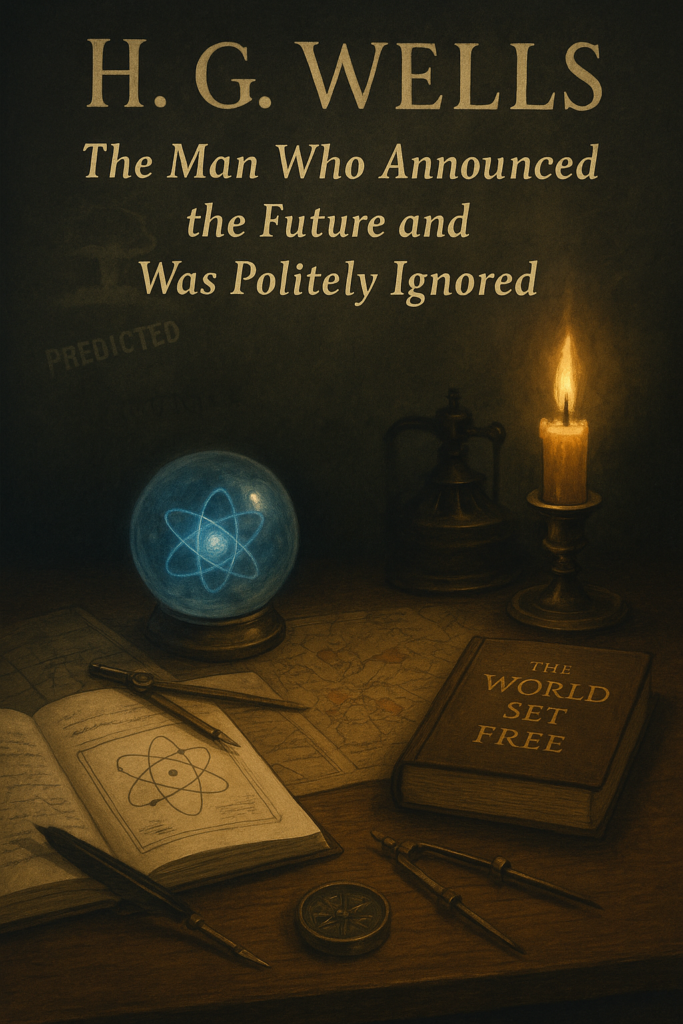
H. G. Wells
The Man Who Announced the Future and Was Politely Ignored**
Long before anyone knew how destructive human brilliance could become, H. G. Wells was busy writing stories that read like classified reports accidentally mailed to the public. He was not trying to predict anything. He was simply fascinated with consequences. Unfortunately for the world, his consequences turned out to be uncomfortably accurate.
In The World Set Free, published in 1914, Wells described powerful bombs created through atomic energy. He wrote about weapons that could devastate entire cities. He imagined governments losing control over their own inventions. He explored global conflict driven by science that outpaced morality. The man essentially warned everyone about nuclear weapons before nuclear weapons existed.
And how did the world respond
With the enthusiasm of a toddler ignoring vegetables.
Wells did not predict destruction. He predicted humanity’s talent for using knowledge irresponsibly.
“He imagined atomic warfare while scientists were still arguing about atoms.”
The most unsettling thing about Wells is not that he predicted technology. It is that he predicted behaviour. He understood the pattern of human ambition. Curiosity becomes experimentation. Experimentation becomes discovery. Discovery becomes weaponry. Weaponry becomes regret. Wells captured this cycle with such clarity that modern readers feel as if he had access to classified documents from the future.
In his stories, invention is never the problem. The problem is always the person holding the invention. Wells had an almost brutal understanding of how power distorts judgment. He knew that the moment humans unlock a frightening new possibility, someone will insist on trying it, if only to see what happens. This is not prophecy. This is psychology.
He saw the scientific ego long before science became powerful enough to indulge it.
“Wells did not warn about bombs. He warned about decision makers.”
What makes Wells even more astonishing is the breadth of his accidental foresight. Air warfare. Tanks. Lasers. Genetic engineering. Global communications. Satellites. He wrote about all of these with the tone of a man describing afternoon weather. Casual. Precise. Completely unbothered by how unrealistic it sounded at the time.
He understood something obvious that people kept trying to deny. Once an idea exists in the human mind, refusing to invent it becomes nearly impossible. Curiosity does not disappear. It waits. It evolves. It becomes restless. And eventually, it becomes reality.
For Wells, imagination was not speculation. It was inevitability taking notes.
“He wrote the future the way others wrote grocery lists. Calmly and without drama.”
The irony is that Wells himself did not expect to be taken seriously. He wrote fiction, not prophecy. He placed grand scientific possibilities in adventure stories because he thought imagination deserved freedom. Instead, scientists and politicians found themselves living inside his metaphors.
When the first atomic bomb was developed, many researchers quietly admitted that Wells had described something similar thirty years earlier. Not in scientific detail. Not in mathematical precision. But in essence. In psychological truth. In the disturbing recognition that humanity was rushing toward a discovery it was not emotionally prepared to handle.
He predicted the emotional immaturity of technological progress.
“Humanity keeps inventing things it is not ready for. Wells simply noticed first.”
What makes Wells timeless is not accuracy. It is courage. He pointed at the future and said, This is where we are heading, even if none of you want to hear it. He challenged complacency. He questioned blind optimism. He warned that knowledge without wisdom becomes a weapon.
And the future responded by proving him right.
Wells did not predict our world.
He exposed it.
6.
Mark Twain
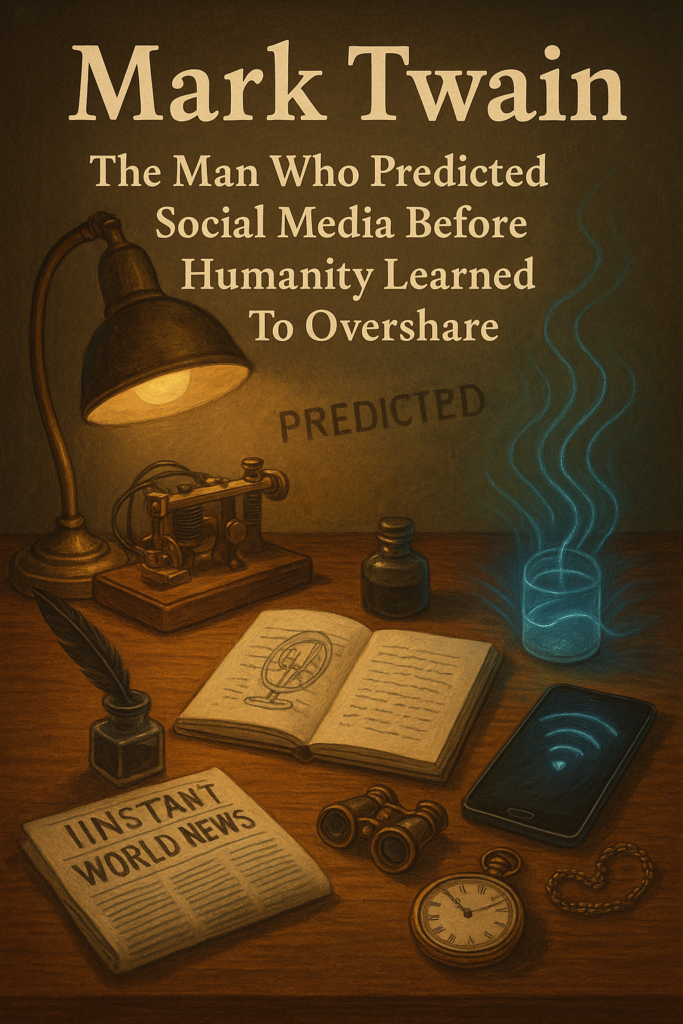
The Man Who Predicted Social Media Before Humanity Learned To Overshare**
Mark Twain is usually remembered for riverboats, sarcasm and a moustache that could intimidate entire governments. What people often forget is that he also predicted the core idea of the modern internet: instant global communication. He imagined a world where information travels instantly, where people react before thinking and where news spreads faster than logic. In other words, he perfectly described social media without ever meeting a smartphone.
In 1898, Twain wrote about the telelectroscope, a device that would let people see and talk to each other across the world. He imagined global conversation, live transmission, real time communication and a society tied together by invisible networks. He basically described video calls, online platforms, global feeds and the chaos that happens when everyone talks at once.
He believed humanity would use this gift wisely.
Humanity read that line, laughed politely and carried on scrolling.
Twain did not predict technology. He predicted noise disguised as information.
“He imagined global connection. We turned it into global interruption.”
The most entertaining part of Twain’s prophecy is not the device. It is the behaviour. He described people becoming obsessed with instant updates. He imagined news traveling so quickly that people had no time to process anything. He even hinted at the performative nature of public communication. Twain predicted the attention economy while his peers were still impressed by telegraph wires.
Twain’s fictional world is filled with people reacting to everything at lightning speed. No reflection. No pause. No depth. Just instant reactions tossed into the public space. This should feel familiar to anyone who has ever opened a comments section and immediately regretted it.
He recognised the oldest digital problem long before digital existed. People love reacting more than they love understanding.
“Twain saw the future of conversation. It was loud.”
In fact, Twain’s imagined communication device created something very similar to modern feeds. Information was constant. Opinions were immediate. Events in one part of the world became spectacles for people elsewhere. It is the same cycle we live in today. A global stage where everything is shared, judged, reposted and forgotten in twenty four hours.
Cue Twain nodding quietly from the nineteenth century.
Twain also understood the emotional and intellectual shortcuts people take when they are given fast information. When communication speeds up, thinking slows down. When reactions become instant, wisdom becomes optional. Twain’s telelectroscope did not create knowledge. It created distraction. He saw that long before distraction became the default setting of society.
Twain predicted the collapse of attention with the precision of a man who knew people too well.
“He did not describe devices. He described human impatience.”
The brilliance of Twain’s accidental prophecy lies in his humour. He did not present the future as terrifying. He presented it as ridiculous. He suspected humanity would be overwhelmed by its own inventions, not because the inventions were powerful, but because people would misuse them with enthusiasm.
Reading Twain today is like reading a commentary on modern digital life delivered by a man who never touched a screen. His observations remain alarmingly current. He understood that global communication would shrink the world, flatten distances and enlarge drama. He recognised that the ability to connect does not guarantee the ability to communicate.
Twain did not predict the internet. He predicted the behaviour that would break it.
“Give people a global voice and they will shout.”
What makes Twain’s prediction even more impressive is how casually he wrote it. There is no scientific arrogance. No claim to foresight. He simply connected the dots of human nature. Curiosity. Vanity. Urgency. A love for gossip disguised as news. Once these traits are given unlimited reach, society becomes noisier than ever.
Twain’s future is not dystopian. It is chaotic, funny and painfully honest. It is a world where people are flooded with information and starved for meaning. It is the world we refresh every morning.
He did not set out to predict social media.
He simply understood that people talk faster than they think.
Twain did not foresee the digital age.
He described it long before it was born.
7.
Philip K Dick
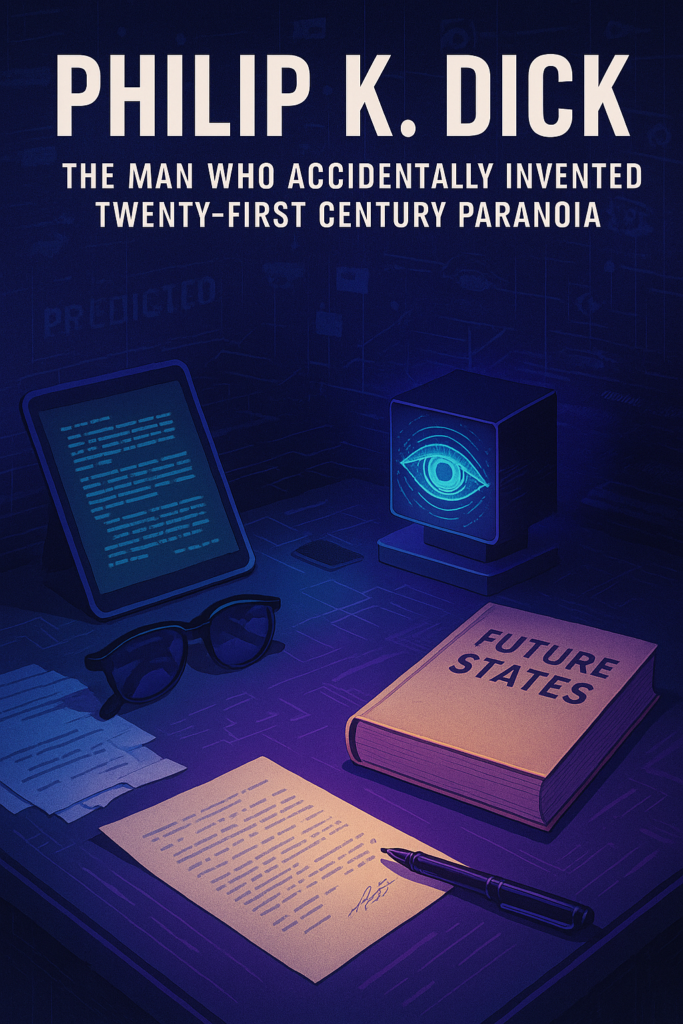
The Man Who Accidentally Invented Twenty First Century Paranoia**
If there is one writer who deserves royalties from the twenty first century, it is Philip K Dick. Not because his stories were adapted into films. Not because he shaped modern science fiction. But because he predicted a world where surveillance, tracking, digital identity and psychological instability all blend into one disorienting experience. Dick did not imagine the future. He exposed the mental state humanity would eventually grow into.
His novels are filled with digital monitoring, identity distortion and governments or corporations quietly observing citizens. He described retinal scans, predictive policing, memory manipulation and databases tracking personal behaviour long before these concepts entered public vocabulary. We call these things innovative. Dick would have called them Tuesday afternoon.
Dick did not predict surveillance. He predicted how comfortable people would become while being watched.
“He wrote about data paranoia before data existed.”
One of Dick’s most striking insights is his understanding of how technology changes self perception. In his worlds, people are constantly questioning whether what they see is real. Whether their memories can be trusted. Whether their identities are stable. Whether their choices are free. This is not science fiction anymore. This is everyday digital life.
Today, people check their screens to verify what is happening. They let algorithms tell them what to buy, what to read, what to fear. Dick saw this dependence coming long before anyone imagined tiny glowing rectangles becoming extensions of the human hand.
He recognised that technology does not control people. People hand over control willingly.
“Dick did not fear machines. He feared human passivity.”
In A Scanner Darkly, Dick portrayed a society where constant monitoring becomes normal. Identities blur. Privacy dissolves. The system knows more about people than they know about themselves. Modern readers approach the novel with an uncomfortable sense of recognition. What Dick described as dystopia has quietly become daily routine.
Cameras on every corner. Tracking in every app. Devices listening politely in the background. People sharing their lives online without thinking twice. Dick understood that the real danger of surveillance is not intrusion. It is convenience.
When technology becomes helpful, people stop noticing when it becomes invasive.
“He warned that erasing privacy would not require force. Only comfort.”
Another recurring theme in Dick’s work is the fragility of identity. Characters discover that their memories have been altered. That their perceptions are manipulated. That their realities are constructed. Replace memory alteration with recommendation algorithms and reality distortion with filtered content and you have the modern internet experience. Dick predicted the psychological consequences of digital life before digital life existed.
He also understood the emotional exhaustion of living in a world where truth becomes negotiable. His characters are constantly trying to make sense of contradictory information. They are overwhelmed by stimuli. They are uncertain about what is real. This is not an exaggeration of modern society. It is a diagnosis.
Dick saw that the future would not collapse from lack of information but from the excess of it.
“Confusion became the new normal. Dick just wrote it first.”
What sets Dick apart from other future predicting authors is the nature of his vision. He did not imagine grand machines taking over. He imagined subtle erosion. Emotional instability. The quiet shift from certainty to doubt. Technology that feels helpful until you realise you cannot function without it. This is prophetic not because it came true but because it became unavoidable.
The world today looks less like a technological triumph and more like a Philip K Dick short story. People wonder if their phones are listening. They question what is real. They debate digital ethics. They worry about invisible systems collecting invisible data. Dick did not create this anxiety. He articulated it before it began.
He did not predict the future. He predicted the feeling of living in it.
“Dick’s world was not ahead of ours. Ours finally caught up.”
His stories endure because they are not about science. They are about vulnerability. They are about the human mind under technological pressure. They are about the discomfort of being observed and the confusion of trusting one’s own senses. These anxieties define modern society as precisely as Dick described them.
Philip K Dick was not a prophet.
He was an observer with terrifying clarity.
He did not foresee our world.
He recognised it long before it arrived.
Conclusion
The future likes to pretend it arrives on its own. New inventions appear, new tools emerge, new systems rise, and everyone behaves as if these ideas materialised magically in laboratories and boardrooms. But a quiet truth runs beneath every breakthrough. Writers were there first.
Long before scientists built machines, authors imagined them. Long before governments panicked about surveillance, writers described its psychology. Long before the internet formed its tangled web, fiction mapped the emotional terrain it would eventually dominate. These so called predictions are not predictions at all. They are recognitions.
Writers do not invent the future. They hear it whispering and write it down.
“Imagination is not ahead of its time. Time is simply slow.”
What unites Forster, Bradbury, Verne, Shelley, Wells, Twain and Dick is not foresight. It is clarity. They understood human nature with uncomfortable precision. They saw that curiosity outruns caution. That convenience outshines wisdom. That distraction wins over silence. That invention depends less on technology and more on desire. That people will always chase progress until progress begins chasing them.
The machines, devices and systems they described were secondary. The behaviour was primary. And that behaviour has remained loyal across centuries. People do not change. Tools simply adapt to their habits.
The accuracy of these writers is not a miracle. It is a mirror.
“The future is predictable because people are predictable.”
If their stories feel prophetic today, it is because humanity keeps repeating the same patterns with better gadgets. Isolation wrapped in connectivity. Noise disguised as information. Fear dressed as progress. Curiosity paired with recklessness. Every era upgrades its technology, but none has successfully upgraded its impulse control.
These writers were not trying to warn us. Most of them were just trying to write something interesting. The warnings appear only in hindsight, when readers realise that the world followed the exact emotional blueprint these authors sketched with effortless intuition.
The lesson is simple.
If you want to understand the future, do not stare at machines.
Stare at stories.
Machines change.
Stories remain accurate.
The future is not built in laboratories. It is rehearsed in literature.
“Fiction is the rehearsal. Reality is the performance.”
So this scroll ends with a quiet invitation. Read the past. Pay attention to the writers who understood people
ABS Folds the Scroll
With the final line settled and the echoes of accidental prophecy still humming through the pages, the scroll is folded slowly and deliberately. ABS closes it with the quiet satisfaction of someone who has seen the future misbehave and the past warn us politely.
The scattered predictions, the eerie accuracies and the authors who whispered tomorrow into yesterday are gathered together under one crease. The scroll becomes a reminder that imagination has always done the heavy lifting while science arrives fashionably late.
ABS sets the folded scroll aside with the calm certainty of a scholar who knows that literature keeps winning arguments long after everyone stops listening.
Until the next scroll opens, let the stories stay bold and the readers stay awake.


Abha Bhardwaj Sharma is a Professor of English Literature with over 30 years of teaching experience. She is the founder of Miracle English Language and Literature Institute and the author of more than 50 books on literature, language, and self-development. Through The Literary Scholar, she shares insightful, witty, and deeply reflective explorations of world literature.
Share this post / Spread the witty word / Let the echo wander / Bookmark the brilliance