
Transformation – Sri Aurobindo
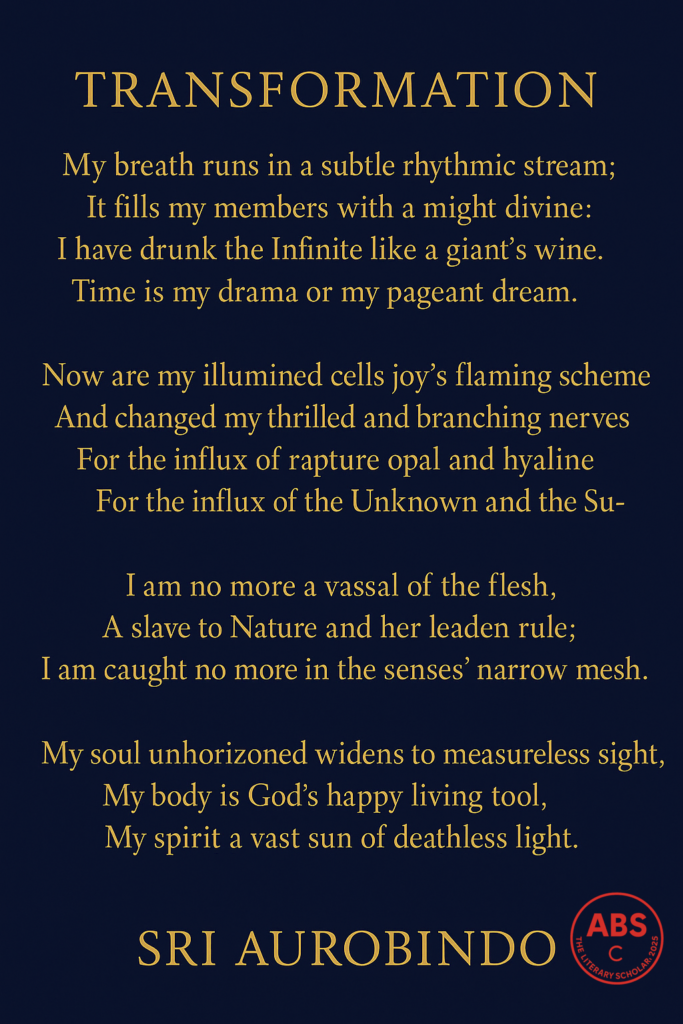
My breath runs in a subtle rhythmic stream;
It fills my members with a might divine:
I have drunk the Infinite like a giant’s wine.
Time is my drama or my pageant dream.
Now are my illumined cells joy’s flaming scheme
And changed my thrilled and branching nerves to fine
Channels of rapture opal and hyaline
For the influx of the Unknown and the Supreme.
I am no more a vassal of the flesh,
A slave to Nature and her leaden rule;
I am caught no more in the senses’ narrow mesh.
My soul unhorizoned widens to measureless sight,
My body is God’s happy living tool,
My spirit a vast sun of deathless light.
— Sri Aurobindo
Author’s Introduction: Sri Aurobindo
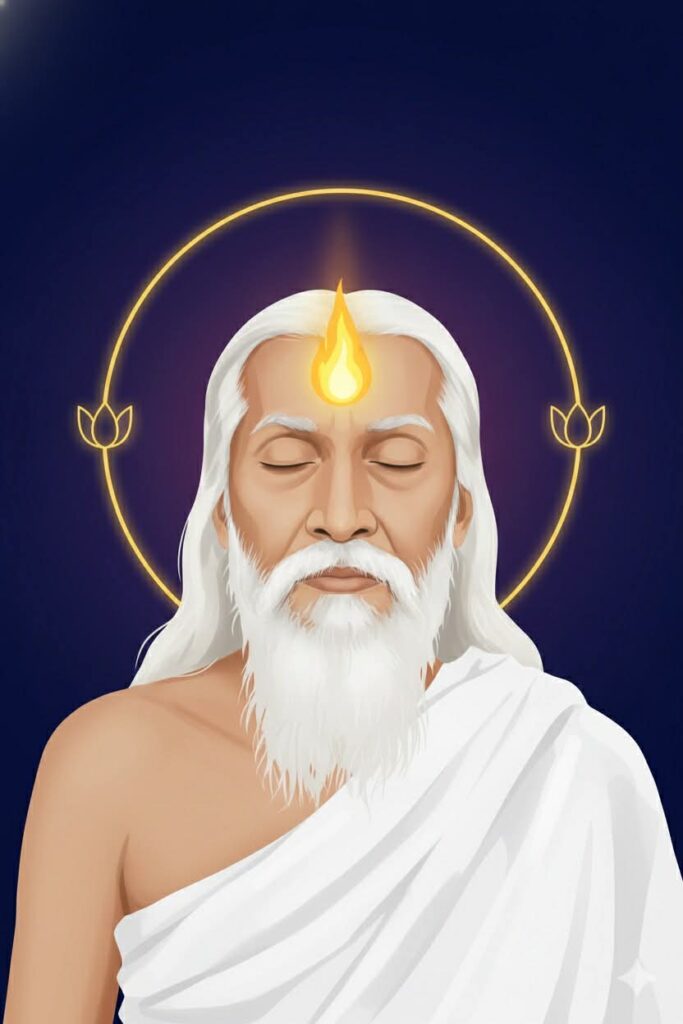
Sri Aurobindo was one of the most remarkable figures in modern Indian literary and intellectual history. He was a philosopher, poet, nationalist, yogi, and spiritual teacher who brought together the strengths of Eastern spirituality and Western education. Born in Kolkata in 1872 and educated in England at Saint Pauls School and Kings College, Cambridge, he developed an early mastery of the English language along with a deep understanding of European literature and thought.
After returning to India, Aurobindo entered the freedom movement and soon became a leading voice in the struggle for national awakening. His political writings show clarity, courage, and insight. A profound inner experience later led him to withdraw from active politics. He moved to Pondicherry, where he devoted the rest of his life to spiritual practice and literary creation.
Sri Aurobindo’s contribution to literature is outstanding. He wrote with complete command over classical forms and with a rare depth of spiritual experience. His epic poem Savitri is one of the longest and most ambitious works in English literature. It blends myth, philosophy, and spiritual revelation into a unified vision. His shorter poems, including his sonnets, reveal his ability to express complex inner states through concise and disciplined language. Poems like “Transformation” show how he brings mystical insight into a precise poetic structure.
As a thinker, Aurobindo developed the philosophy of Integral Yoga, which teaches the transformation of the entire human being. He believed that human life can rise to a higher consciousness and that the body, mind, and spirit can be reshaped by the divine presence. This idea of spiritual evolution appears throughout his poetry and prose. His imagery is luminous, his symbols are deeply suggestive, and his language carries the weight of philosophical reflection.
Sri Aurobindo remains a central figure in Indian writing in English. His work creates a bridge between the spiritual heritage of India and the literary traditions of Europe. He continues to be studied for the originality of his ideas, the richness of his poetic language, and the lasting influence of his spiritual vision.
Detailed Summary of Sri Aurobindo’s “Transformation”
Sri Aurobindo’s Transformation describes the profound inner change that occurs when divine consciousness enters and reshapes the human being. The poem begins with the speaker sensing a refined, rhythmic breath flowing through him, signalling a state of deep spiritual awareness. This breath is not merely physical; it carries a divine potency that fills every part of his body with extraordinary strength. The speaker feels as though he has absorbed the Infinite itself, an overwhelming and exalting spiritual experience that alters his perception of reality. Time, which ordinarily governs human existence, now appears as something insubstantial—either a personal drama or a decorative spectacle—indicating a shift into a higher plane of consciousness.
The transformation then moves inward to the cellular and nervous levels of the body. The speaker’s “illumined cells” become reorganised into a pattern of joy, and his nerves, once ordinary channels of sensation, are refined into delicate, translucent pathways for spiritual ecstasy. These “opal and hyaline” channels allow the divine force, described as the “Unknown and the Supreme,” to flow through him unhindered. The body itself is no longer a barrier to spiritual experience; it becomes transparent and responsive to higher energies.
With this influx of divine consciousness, the speaker’s relation to the physical world changes completely. He is no longer a “vassal of the flesh” nor a slave to Nature’s mechanical laws. The senses, which previously confined perception to limited material reality, no longer entangle him. His soul expands beyond any boundary (“unhorizoned”), gaining access to “measureless sight,” a state of limitless spiritual vision.
This transformation culminates in a redefinition of the speaker’s identity. His body becomes “God’s happy living tool,” indicating joy, purpose, and divine alignment. The spirit, once confined within human limitations, becomes a “vast sun of deathless light”—a symbol of immortality, illumination, and complete spiritual awakening. The poem ends on this image of radiant, boundless consciousness, representing the fulfilment of the transformative process.
.
1. Theme
Theme explained:
The poem describes the moment when a human being undergoes spiritual evolution. Sri Aurobindo shows that transformation is not only mental or emotional but also physical, cellular, and spiritual. The human being becomes a vessel of divine force.
Examples from the poem:
• “My breath runs in a subtle rhythmic stream”
This shows the beginning of inner change. Breath becomes controlled, refined, and spiritually charged.
• “It fills my members with a might divine”
The divine force does not remain abstract. It enters the limbs and strengthens the body.
• “My soul unhorizoned widens to measureless sight”
This line reveals expansion of consciousness. The soul breaks free from boundaries.
• “My body is God’s happy living tool”
The theme of divinisation is clear. The body becomes an instrument of higher truth.
• “My spirit a vast sun of deathless light”
The transformation reaches its peak in spiritual illumination.
2. Type of Poem
Explanation:
“Transformation” is a sonnet. It has fourteen lines and follows the general movement of a Petrarchan sonnet. The poem naturally divides into:
Octave (first eight lines)
Sestet (last six lines)
It may not strictly follow Petrarchan rhyme patterns, but the structure and thematic shift clearly reflect that form.
Example:
The first eight lines describe the inflow of divine energy.
The last six express the results of that inflow.
3. Structure: Octave and Sestet
A. The Octave (Lines 1–8): The Process of Transmutation
Explanation:
The octave focuses on the physical and inner transformation as divine force enters the speaker’s being.
Examples:
• “My breath runs in a subtle rhythmic stream”
Breath becomes spiritually refined.
• “I have drunk the Infinite like a giant’s wine”
A dramatic metaphor for receiving vast spiritual experience.
• “Now are my illumined cells joy’s flaming scheme”
Cells are described as radiant and filled with joy.
• “Channels of rapture opal and hyaline”
Nerves are turned into transparent channels for spiritual ecstasy.
These lines describe the process of transformation.
B. The Sestet (Lines 9–14): The Result of Transformation
Explanation:
The sestet presents the liberated state of the speaker after the transformation is complete.
Examples:
• “I am no more a vassal of the flesh”
He is no longer controlled by physical desires.
• “I am caught no more in the senses’ narrow mesh”
The senses no longer limit his perception.
• “My soul unhorizoned widens to measureless sight”
The soul gains infinite vision.
• “My spirit a vast sun of deathless light”
The final image symbolises enlightenment and immortality.
These lines show the state of spiritual freedom.
4. Poetic Devices
1. Imagery
Explanation:
Aurobindo uses vivid images to convey mystical experience.
Examples:
• “Joy’s flaming scheme”
Visual image of cells burning with divine joy.
• “Opal and hyaline”
Opal suggests colour.
Hyaline suggests transparent purity.
Both describe nerves glowing with inner light.
• “Sun of deathless light”
Powerful image for immortal spirit.
2. Metaphor
Explanation:
He uses metaphors to make abstract spiritual states concrete.
Examples:
• “I have drunk the Infinite like a giant’s wine”
Spiritual experience compared to drinking a powerful wine.
• “My body is God’s happy living tool”
Body as a divine instrument.
• “My spirit a vast sun”
Spirit compared to a radiant sun.
3. Symbolism
Explanation:
Certain words symbolise spiritual concepts.
Examples:
• Light
Represents consciousness, purity, illumination.
Appears in “illumined,” “flaming,” “sun,” “deathless light.”
• Wine
Symbol of ecstatic spiritual experience.
• Mesh
Symbol of sensory limitations trapping the mind.
• Opal and hyaline
Symbols of clarity and transformation.
4. Personification
Explanation:
Nonhuman elements behave like human agents.
Example:
• “Time is my drama or my pageant dream”
Time becomes something created or shaped by the speaker.
5. Alliteration
Explanation:
Repeated consonants add musical flow and emphasis.
Examples:
• “Subtle rhythmic stream”
Repeated “s” sound reduces tension and creates softness.
• “Flaming scheme”
Repeated “f” emphasises the intensity of transformation.
• “Sun of deathless light”
Repeated “s” creates a smooth musical ending.
6. Enjambment
Explanation:
Ideas continue beyond line breaks, creating fluid movement.
Example:**
Lines 5 to 7 flow without pause to mirror the smooth movement of divine energy.
5. Literary Devices
1. Contrast
Explanation:
The poem contrasts the state before and after transformation.
Examples:
• “Vassal of the flesh” vs. “sun of deathless light”
From bondage to illumination.
• “Senses’ narrow mesh” vs. “measureless sight”
From limited perception to infinite perception.
2. Spiritual Elevation
Explanation:
The poem shows gradual ascent.
Example:**
It moves from
breath → cells → nerves → senses → soul → spirit
This sequence mirrors spiritual growth.
3. Evolutionary Imagery
Explanation:
Aurobindo sees human beings as evolving toward divine consciousness.
Example:**
• “For the influx of the Unknown and the Supreme”
Shows a higher force entering the human frame.
6. Musical Devices
1. Rhythm
Explanation:
The steady rhythm mirrors meditative calm.
Example:**
Lines flow smoothly without abrupt breaks, matching the quiet movement of breath.
2. Long Vowels
Explanation:
Long vowel sounds slow the pace and deepen the tone.
Examples:**
“Infinite,” “hyaline,” “measureless,” “deathless.”
3. Internal Echoes
Explanation:
Soft consonant sounds create harmony.
Examples:**
Repeated s, m, and l throughout the poem calm the ear and enhance the spiritual mood.
4. Cadence
Explanation:
The poem rises from calmness to radiance.
Example:**
It begins with subtle breath and ends with
“A vast sun of deathless light.”
This is a clear crescendo of spiritual intensity.
7. Moral / Conclusion
Explanation:
Aurobindo teaches that transformation is possible for every human being. It is an inward, conscious process directed by divine force.
Examples from the poem:**
• “I am no more a vassal of the flesh”
Human limitations can be overcome.
• “My body is God’s happy living tool”
The body has spiritual potential.
• “My spirit a vast sun of deathless light”
The final purpose of human life is spiritual illumination.
Final Message:
Human beings are not fixed or limited. With the presence of divine consciousness, they can rise into a higher, luminous mode of existence.
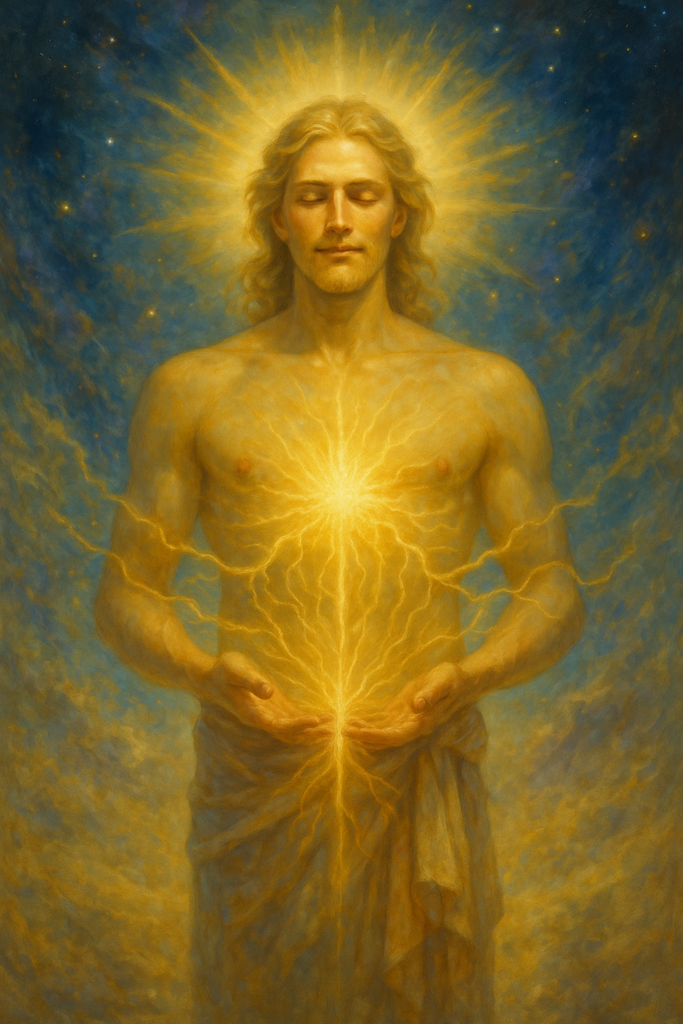
The poem Transformation describes the moment when divine consciousness enters the poet and completely changes his inner and outer being. At first, his breath becomes calm and refined, filling his body with a new spiritual strength. He feels as if he has absorbed infinite power, and time itself seems unreal, like a dream. His cells begin to shine with joy, and his nerves turn into pure, delicate channels for the flow of a higher force. As this transformation deepens, he is no longer controlled by the body or by the senses. He breaks free from the limitations of nature’s ordinary laws. His soul expands beyond all boundaries and gains a vast, measureless vision. His body becomes an instrument of the divine, and his spirit shines like a sun of immortal light. Through this experience, the poet shows how a human being can rise from physical limitation to spiritual freedom and illumination.

Abha Bhardwaj Sharma is a Professor of English Literature with over 30 years of teaching experience. She is the founder of Miracle English Language and Literature Institute and the author of more than 50 books on literature, language, and self-development. Through The Literary Scholar, she shares insightful, witty, and deeply reflective explorations of world literature.
Share this post / Spread the witty word / Let the echo wander / Bookmark the brilliance