
A tour through the world’s most confused moral policing, featuring bears, rabbits, witches and a few very nervous adults.
ABS Believes
Humans fear what they do not understand, especially when it looks cute or carries a moral.
Censorship reveals more about the insecurities of the censor than the danger of the book.
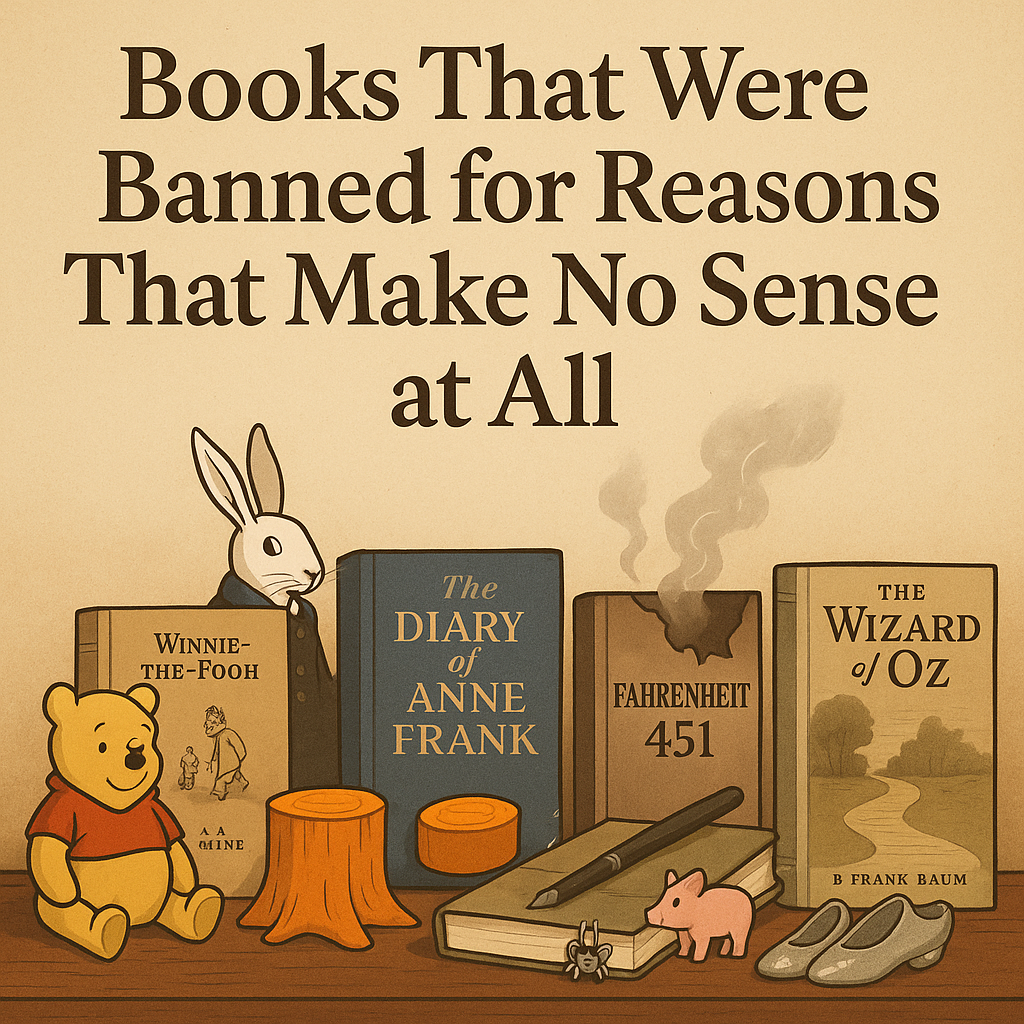
There is a special kind of human who looks at a harmless children’s book, a diary written by a terrified teenager or a story about a friendly spider and thinks to himself, This is dangerous. This must be stopped. These people walk among us. Some even hold official positions. And thanks to them, the history of literature is sprinkled with bans so bizarre that you start wondering whether common sense was the first victim.
Whenever society feels insecure, it doesn’t go to therapy. It goes after books. Nothing scares a fragile moral guardian more than a fictional bear wearing a red shirt or a rabbit who knows how to tell the time. You can almost hear them shouting, Protect the children from imagination. It’s contagious.
The funny part is that none of these bans achieved anything. The books survived. The readers multiplied. The only thing that disappeared was the credibility of the people who thought censorship was a personality trait worth displaying in public. Every ban reads like a confession: I didn’t understand the book, so naturally it must be evil.
As you move through this scroll, you’ll meet a cast of literary criminals. A honey-loving bear. A diary that told the truth. A forest defender who hurt the logging industry’s feelings. A witch with good intentions. A burning book that warned us about burning books. If this sounds absurd, wait till you hear the official explanations. Some of them are so imaginative that the authors should have received royalties.
Welcome to the gallery of banned brilliance. The books were innocent. The reasons were not. Let’s begin.
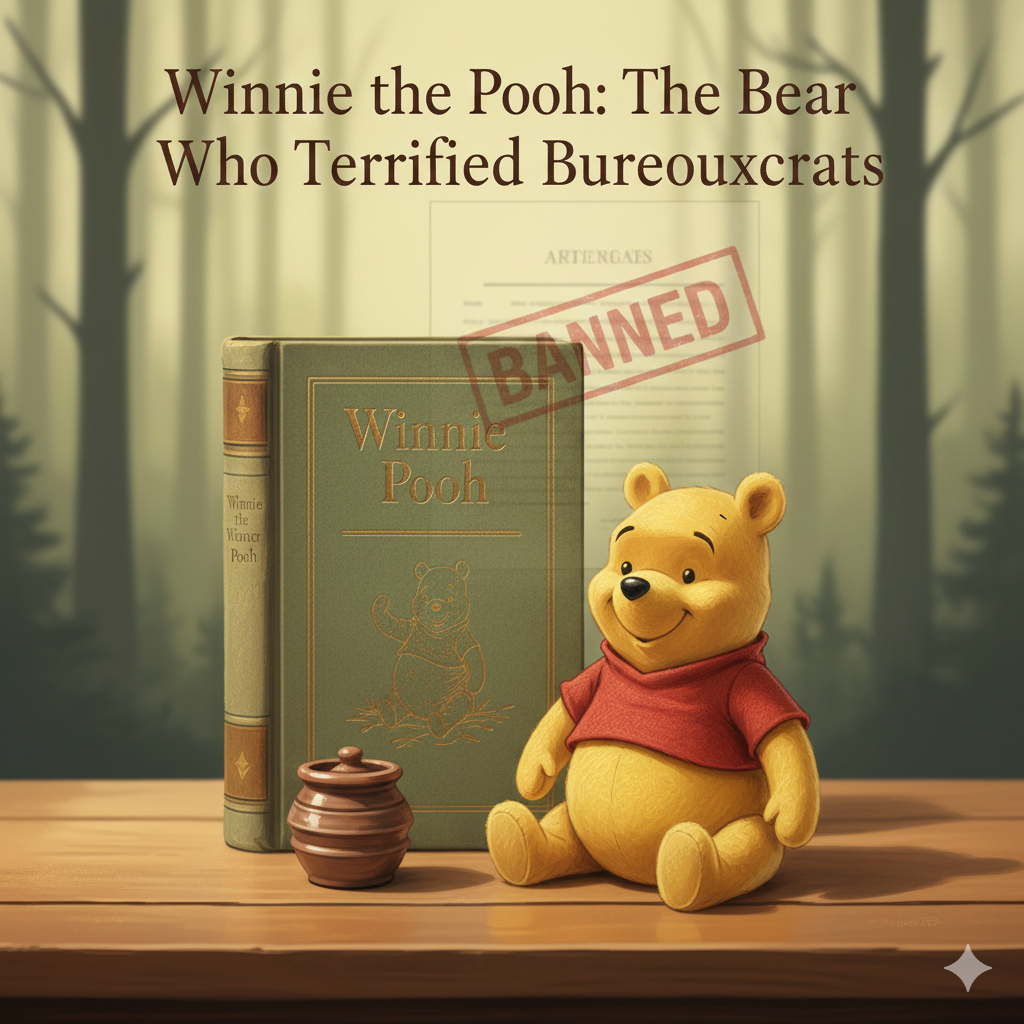
Winnie the Pooh: The Bear Who Terrified Bureaucrats**
If someone told you that a small yellow bear with a soft belly, a mild honey addiction and the emotional intelligence of a kindergartener once got banned because he was considered a threat to human dignity, you’d laugh and ask them to stop making things up. But here we are. Winnie the Pooh, arguably the gentlest creature to waddle out of children’s literature, has been banned more than once, for reasons that range from insecure to imaginative to “please stop embarrassing the species.”
Let’s begin with the most spectacular one. In 1930s China, authorities decided the book was unacceptable because it depicted animals using language. Apparently, the idea of a bear speaking was considered an insult to humans. This tells you everything you need to know about the people who made the ban. Their egos were so delicate that a fictional woodland creature could bruise them. Imagine being so personally threatened by a stuffed bear that your official response is to declare it unfit for public consumption. Forget national security, Pooh might encourage children to befriend rabbits, and then society will collapse.
The logic went something like this: If animals can talk in books, children might start believing animals are equal to humans. And if children begin to see animals as equal, they might begin questioning other hierarchies too. You can almost feel the panic rising. One minute a child reads Pooh chatting with Piglet, and the next thing you know, the government is overthrown. That’s the kind of slippery slope reasoning that belongs in comedy, not in policy.
And if that wasn’t enough absurdity, decades later Pooh was banned again in some parts of Poland because a local council claimed he was “half-naked” and “inappropriate.” Yes. A stuffed bear was sexualized by a group of adults who clearly needed a long vacation and a therapist. The irony is unbearable, pardon the pun. Pooh has been wearing the same tiny red shirt since 1926, and nobody has ever accused him of moral corruption except the people tasked with maintaining community standards. You can almost imagine them holding an emergency meeting: “What will we do about this pants-less menace corrupting our parks?” Meanwhile, actual human problems strolled right past the council unnoticed.
But if you want peak absurdity, here it is: in certain places, Pooh imagery was restricted simply because the bear had become an unofficial political symbol. Yes, the softest, roundest creature in literature was banned for “political resemblance.” Not because of what he said, or what he did, or what he represented in the book. Just because people online started using him as a meme. It’s official: the world has reached a point where even fictional bears are caught in political crossfire.
What makes all this even funnier is that Winnie the Pooh is almost aggressively gentle. There is no violence, no controversy, no rebellion, no dark social commentary hiding beneath the honey pots. The most dangerous thing Pooh has ever done is get stuck in Rabbit’s doorway after overeating. His biggest crime is being so polite that he sometimes apologizes to trees. He goes on small adventures, offers slow but sincere wisdom, hums songs that make no sense, and treats everyone with kindness. In a world constantly on fire, Pooh is the emotional support bear we all deserve.
Which raises an obvious question: how did such a harmless character end up on the censorship list multiple times? Simple. Censorship is never about the content. It’s always about the insecurities of the censor. Pooh didn’t threaten society. He threatened fragile ideas of control, authority and seriousness. He refused to behave like a respectable, obedient literary figure. Instead, he wandered around the Hundred Acre Wood talking to his friends, asking innocent questions like “What day is it?” and delivering lines that accidentally feel like Buddhist philosophy. Maybe that was the real threat. A bear who teaches children to slow down and think kindly is far more dangerous to rigid power structures than we admit.
And that’s the beauty of this ridiculous ban. It exposes the fundamental reality of censorship: the books are rarely the problem. The real danger lies in the imagination of the people banning them. When a governing body looks at a soft yellow bear and sees chaos, corruption or revolution, it tells us nothing about Pooh and everything about them.
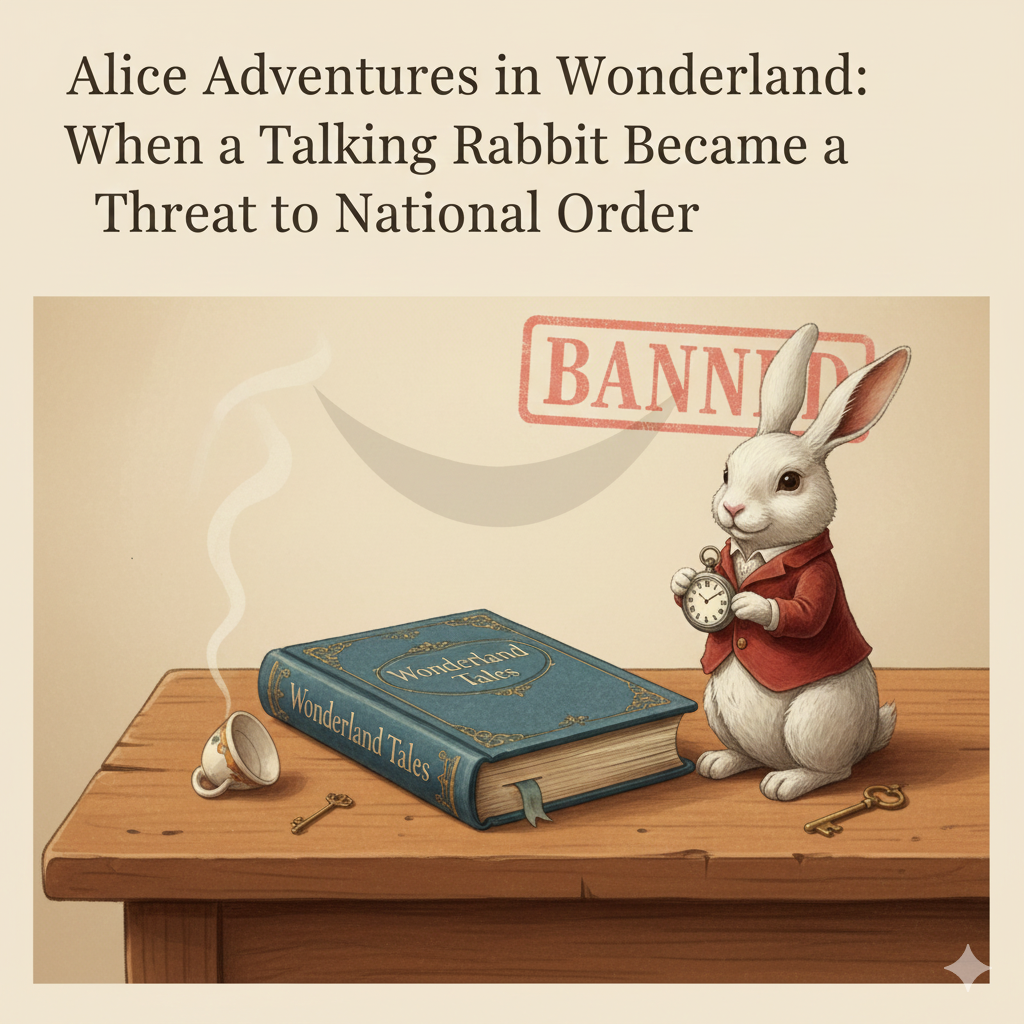
Alice Adventures in Wonderland: When Rabbits Talking Became a National Threat
There are many reasons to worry about the future of civilization. Climate change. Global conflict. Social inequality. But according to the censors of early twentieth century China, the real danger to society was none of these. It was the upsetting possibility that a rabbit might hold a polite conversation with a young girl. This is why Alice Adventures in Wonderland found itself tossed into the forbidden corner. Not because it was chaotic, surreal, or delightfully nonsensical. It was banned because the animals talked.
Let us pause here to admire the logic. A book filled with playful absurdity, philosophical whimsy, and a cat that disappears except for its smile was not banned for confusing children. It was banned because the animals spoke in complete sentences. Somewhere in an office in Hunan province, a very serious official sat upright, read the White Rabbit announcing he was late, and felt personally insulted. You can almost hear his inner voice saying, This book is mocking humanity. Arrest it.
Bold thought. Talking animals were unacceptable because they blurred the line between humans and creatures.
This, apparently, was dangerous. Children might get ideas. They might begin questioning the social order. They might wonder if respect and intelligence are not exclusive to humans. Imagine the horror.
“Nothing frightened the censors more than a rabbit with vocabulary.”
The entire reasoning behind the ban reads like an accidental comedy sketch. The authorities believed that giving animals equal status through speech undermined human superiority. If a rabbit can wear a waistcoat and check his watch, what is the next step. A revolution. A rabbit led uprising. A coup in the carrot fields. This is the dramatic imagination of adults who take themselves far too seriously.
What makes this entire affair even funnier is that Alice Adventures in Wonderland is not even a story about animals acting like humans. It is a story about imagination misbehaving in public. It is a joyful protest against logic. It is mathematical parody wrapped in absurdity. The creatures in Wonderland do not represent threats. They represent curiosity. They represent the freedom to question rules that make no sense. And that is probably the real reason someone somewhere got uncomfortable.
Wonderland encourages children to ask why instead of nodding quietly.
Authoritarian systems do not like that word. Why is a rebel. Why is a spark. Why is a door that opens into a larger world. No wonder a place like Wonderland became suspicious. Any book that teaches children to challenge the Queen of Hearts shouting for heads is a book that quietly trains them to challenge the real queens and kings around them.
“Wonderland teaches children to think. Nothing terrifies authority more than thinking.”
The best part of this entire historical episode is how completely the ban misunderstood the book. Lewis Carroll was a mathematician poking fun at logic. He was not secretly leading a philosophical uprising. He simply believed that nonsense can reveal truth. He believed that absurdity can expose the fragile nature of rigid rules. He believed that a smile without a cat is sometimes more powerful than a cat without a smile. These ideas are hardly a danger to society unless the society in question has something to hide.
And yet, the censors reacted as if the White Rabbit had personally insulted their families. They treated Wonderland like a political threat. They treated the Mad Hatter like a disruptive figure with revolutionary potential. They read the Duchess shouting about morals and thought she was attacking their policies. This is what happens when people in power forget how to laugh. They begin seeing rebellion in teapots and danger in storybooks.
There is another layer to this absurd decision. Children have been talking to imaginary animals since the beginning of time. It is a natural part of childhood. The idea that a book would suddenly corrupt them into believing animals can speak is unintentionally hilarious. Children already believe that. They do not need Carroll for that. They simply need a pet dog with expressive eyebrows.
The ban revealed a truth that censors never intended. They feared imagination because imagination works without permission.
“Once a child enters Wonderland, no authority can control where their mind travels next.”
And that is precisely why the book was banned. Not because of rabbits. Not because of tea parties. Not because of curious little girls falling down metaphorical holes. It was banned because imagination is difficult to supervise. Imagination wanders. Imagination questions. Imagination refuses to obey.
So in this part of our scroll, we salute the courage of the White Rabbit. A creature so terrifying that an entire province decided to protect the public from him. We salute Alice too, for walking boldly into a world where rules unravel and truth laughs at fear.
If a society is frightened by Wonderland, then Wonderland is exactly what that society needs.
Alice Adventures in Wonderland
When a Talking Rabbit Became a Threat to National Order
There is overreacting.
There is overthinking.
And then there is banning Alice Adventures in Wonderland because animals speak in it. That decision deserves a gold medal in creative paranoia. In 1931, officials in Hunan, China, concluded that Lewis Carroll’s whimsical tale posed a moral danger because the animals talked like humans. Yes. Out of every problem facing the nation, they chose the vocabulary of rabbits as their emergency.
The fear was never the book. The fear was losing control of the imagination.
“Talking animals were treated like dangerous ideas.”
The logic was spectacular. If children saw creatures speaking rationally, they might begin to believe that animals are equal to humans. And if children began believing that, who knows what other hierarchies they might question. Heaven forbid a child reads the White Rabbit checking his watch and starts wondering why he is late. Better to ban the entire book before children ask too many questions.
Wonderland does not follow rules. Wonderland mocks rules. Wonderland tosses rules in the air, watches them spin, and laughs as they fall sideways. That alone makes it threatening to any system obsessed with order.
Wonderland trains the mind to ask why instead of nodding politely.
“Once a child enters Wonderland, you cannot predict what they will question next.”
What makes this ban even more amusing is how seriously the censors took themselves. They treated the Cheshire Cat as if he were some philosopher capable of dismantling authority. They viewed the Mad Hatter as a societal danger. They looked at a caterpillar smoking a pipe and asking identity questions and thought, This insect will ruin the youth.
Lewis Carroll would have laughed until his spectacles fogged. He was a mathematician poking fun at logic. He was not leading a rebellion. He was simply enjoying intellectual mischief. Wonderland is his playground of paradoxes. Nothing in it is meant to behave. That was exactly why children loved it. And why authorities did not.
Imagination is impossible to regulate. That is why it frightens every rigid system.
“Authority fears Wonderland because Wonderland listens to no authority.”
Imagine the committee meeting. A stern official lifts the book, adjusts his glasses, reads about a girl falling through a rabbit hole and shouts, Absolutely not. Protect the public from this. Meanwhile, the actual children reading the book are laughing at floating grins and growing taller and shorter like living yo-yos. The real world is fine. Only the adults are panicking.
The whole incident reveals one thing. Those who banned the book were not protecting children from fantasy. They were protecting themselves from the possibility that the next generation might grow up less obedient, less frightened, and less impressed by rules that make no sense.
Wonderland is the enemy only when you have something to hide.
“A society frightened by Wonderland is already standing on shaky ground.”
Today, the ban has evaporated. The book survives. The Rabbit still runs late. The Cat still grins without explanation. And Alice still questions everything she sees. The censors have faded into the footnotes of history. Wonderland remains immortal.
If a talking rabbit can destabilise your entire worldview, perhaps the rabbit is not the problem.
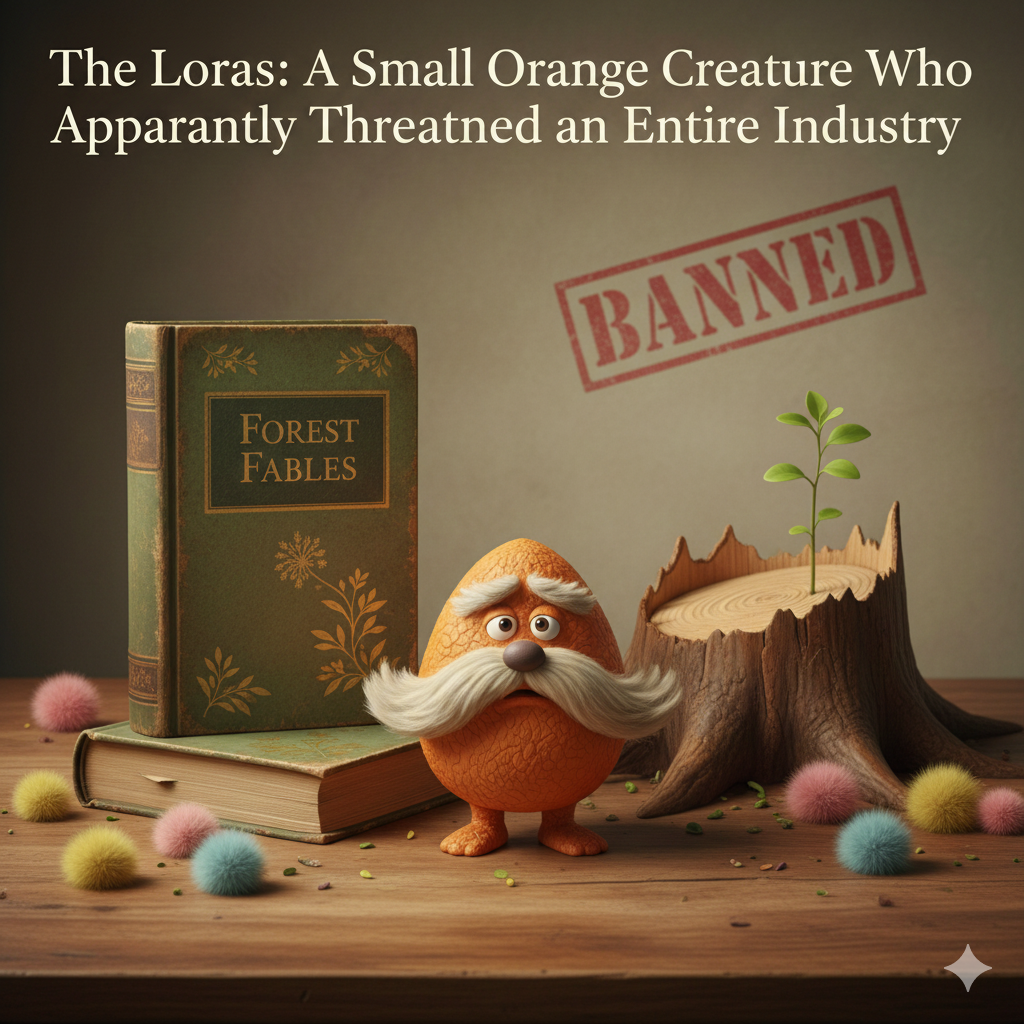
The Lorax
A Small Orange Creature Who Apparently Threatened an Entire Industry
There are books that challenge society.
There are books that expose injustice.
And then there is The Lorax, a small orange creature who speaks for the trees and somehow managed to frighten grown adults whose deepest fear was a child developing common sense. If Alice Adventures in Wonderland was banned because it confused reality, The Lorax was banned because it clarified reality a little too well.
When Dr Seuss published The Lorax in 1971, he probably did not imagine that an environmental fable would one day be treated like an act of economic sabotage. Yet several school districts in the United States, especially in California, declared the book inappropriate for classrooms because children might start questioning the logging industry. Picture that for a moment. A group of fully grown adults looked at a kindly orange figure warning people not to destroy the planet and whispered, This is dangerous.
The problem was never the book. The problem was the questions the book made children capable of asking.
“The crime of The Lorax was not environmentalism. It was honesty.”
The reasoning behind the ban was impressively fragile. If children read the story, they might begin to empathise with forests. They might feel bad for chopped trees. They might develop respect for the environment. They might even dare to wonder why the Truffula trees were vanishing. Apparently that was a threat to civilization. Or at least to quarterly profit margins.
The Lorax merely states the obvious. If you cut down every tree, there will be no trees left. A simple truth, almost embarrassingly simple, yet it rattled certain adults so thoroughly that they treated it like subversive propaganda.
The Lorax did not threaten the economy. He threatened the comfort of people who preferred silence over truth.
“The Lorax spoke for the trees. The censors spoke for their fears.”
This ban is one of the clearest examples of censorship revealing the insecurities of those who impose it. Nobody was worried about the emotional safety of children. They were worried about the intellectual safety of industries. Awareness, not imagination, was the real danger here.
Children are not as naive as adults pretend. They know when something feels wrong. They know destruction when they see it. The Lorax simply gave them vocabulary for their instincts. That alone terrified the people who benefit from a world where children are not encouraged to think.
Responsibility is inconvenient. That is why it was banned.
“If a small orange creature can destabilise your industry, you need a stronger industry.”
Dr Seuss did not give us a political manifesto. He gave us a rhyme. A rhyme with a conscience. The fable is gentle, colourful and poetic. But beneath the softness is a clear warning. Once a resource is gone, it does not return simply because you regret it. The last Truffula seed is placed in your hands. What you do with it reveals who you are.
Naturally, this message was unacceptable in certain circles. Responsibility always becomes the villain when profit wants to play the hero.
The ban failed, as all bans do. Children continued to read the book. Teachers found ways to bring it back. Environmentalists embraced it decades later. And the Lorax himself became a symbol of ecological awareness.
Truth wrapped in rhyme still unsettles those who depend on silence.
“A society that silences a voice speaking for the trees has already silenced its own future.”
Today, The Lorax stands tall as one of the most enduring environmental stories ever written, while its ban remains a case study in how absurd censorship can become when fear and profit sit at the same table. How amusing that a creature with a mustache, standing on a tree stump, was seen as a threat to industry.
If a gentle orange guardian can shake your system, perhaps the guardian is not the problem.
Perhaps your system is.
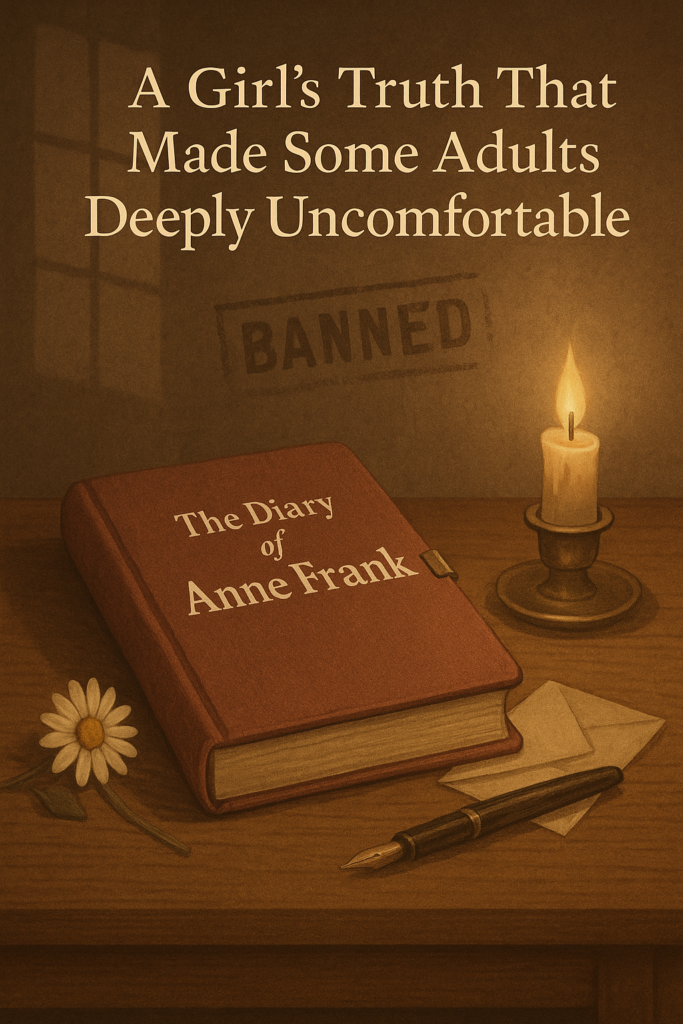
The Diary of Anne Frank
A Girl’s Truth That Made Some Adults Deeply Uncomfortable
Some books are banned because they are outrageous.
Some are banned because they are too bold.
And then there are books banned because they tell the truth with such clarity that adults begin sweating behind their policies. The Diary of Anne Frank is not a scandalous book. It is not provocative. It is the honest voice of a teenage girl trying to understand a world that had lost its humanity. Yet this book has been banned and challenged repeatedly for reasons that range from embarrassing to unbelievable.
Several schools around the world have tried to remove the diary from classrooms because it is considered too depressing for teenagers. This is fascinating. Teenagers who survive exams, social chaos, emotional hurricanes and the internet are apparently too fragile to read the thoughts of a girl who faced real terror with grace. What these bans reveal is not concern for the students. They reveal adults who would rather sanitise history than confront the cruelty humanity is capable of.
The discomfort was never about the book. The discomfort was about the mirror it held up.
“The diary was banned because truth is heavier than fiction.”
Another reason the book was challenged is even stranger. A few people insisted that Anne Frank was too honest about her feelings, especially her thoughts about identity, body and adolescence. Imagine that. A teenage girl being criticised for sounding like a teenage girl. The diary was never meant to be polished. It was not written for publication. It was written because Anne wanted to stay human while the world around her was becoming monstrous.
Some objectors even argued that the diary created too much sympathy for the Holocaust. This is the kind of reasoning that does not deserve analysis. It deserves a long silence followed by a deep sigh. A few groups complained it was politically imbalanced, as if the core problem was not genocide but chapter structure. These reactions reveal an astonishing level of intellectual gymnastics. When people bend this far to avoid the obvious, they usually fall over.
Erasing history does not protect children. It prevents them from understanding the world they will inherit.
“When a diary becomes a threat, it means the truth has already won.”
At its core, the diary is a record of hope under impossible circumstances. Anne Frank documented fear, hunger, confinement and danger with more maturity than many adults who tried to censor her. She wrote about dreams. She wrote about frustration. She wrote about wanting to live fully. Her honesty is the reason the book survived. Her honesty is also the reason some people felt exposed.
The attempts to ban the diary reveal a deeper problem. Certain societies prefer comfortable lies over uncomfortable truth. A history lesson that acknowledges darkness is seen as dangerous. A personal story that refuses to flatten human suffering is labelled disturbing. Yet the only real danger is indifference.
The diary is difficult to read because history was difficult to live.
“The world did not fear Anne’s words. It feared remembering why she wrote them.”
The greatest irony is that the people who banned the diary claimed to be protecting students, but the students themselves often connected deeply with Anne. Her voice feels real. Her worries feel familiar. Her hopes feel universal. Young readers understand far more than adults assume. They recognise courage when they see it. They recognise injustice when it is described without apology.
Even the light moments in the diary are important. They remind readers that Anne was not a symbol. She was a person. She was young, curious, witty and alive. Censorship tries to flatten complexity, but Anne Frank refuses to be flattened. Her humanity cannot be edited out.
Some bans also argued that the diary was too emotionally heavy for the classroom. The truth is simple. The diary is heavy because the history is heavy. Pretending otherwise does not protect anyone. It only encourages ignorance. And ignorance grows easily when difficult stories are removed.
A society that cannot face its past will never shape a better future.
“Banning the diary never erased it. It only revealed the fear of those who tried.”
Today, The Diary of Anne Frank remains one of the most widely read and respected books in the world. It has been studied, adapted, performed and honoured globally. The bans, on the other hand, survive only as footnotes in the long list of human mistakes. The diary is not banned because it is dangerous. It is banned because it is true.
If the words of a teenage girl are enough to unsettle you, the problem is not the girl.
It is the world that allowed her to need a diary in the first place.
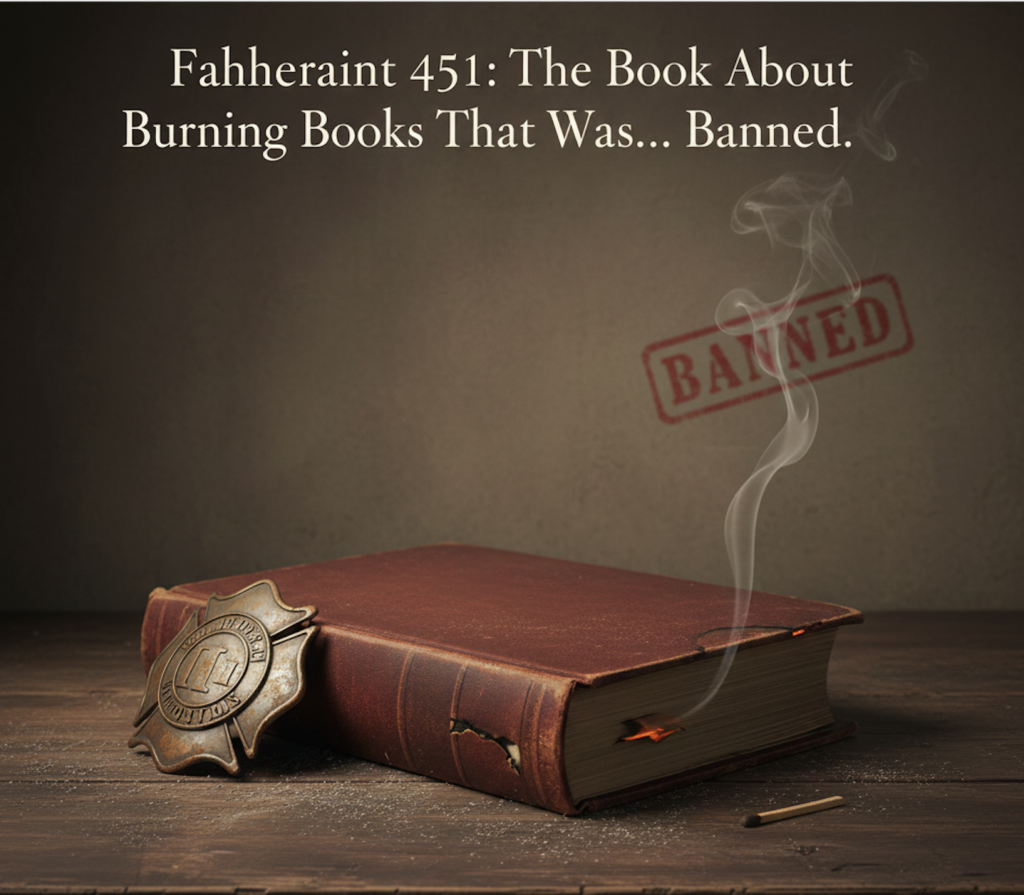
Fahrenheit 451
The Book About Burning Books That Was… Banned
Some stories become ironic by accident.
Some stories become ironic over time.
And then there is Fahrenheit 451, a book about censorship that was itself censored. Ray Bradbury must have looked down from whatever dimension writers occupy and said, I warned you. You did not listen. Now look at the mess you have made.
The logic behind banning Fahrenheit 451 is so spectacular that it should be preserved in a museum of intellectual confusion. The book criticises censorship. It warns against the destruction of literature. It exposes the dangers of anti thinking culture. And several schools decided the best way to handle this book… was to censor it. If irony had a heartbeat, this would be the moment it laughed out loud.
The book was not dangerous. The ideas it exposed were.
“A story about burning books was banned because it talked about burning books.”
One of the most common complaints was that the book contained profanity, as if the real obscenity was a few strong words rather than the society Bradbury was warning us about. Other schools objected to the portrayal of oppressive authority. They felt it encouraged rebellion. Imagine reading a book about the consequences of censorship and saying, This seems a little too critical of censorship. Remove it immediately.
This is the intellectual equivalent of hearing a fire alarm and deciding to ban the alarm instead of addressing the fire.
Many institutions were also uncomfortable with the book’s portrayal of people lost in distraction and entertainment. Bradbury wrote about a population numbed by screens and noise. Some reviewers felt this was too negative. They believed it portrayed society in an unflattering light. Given the current world, the book now feels like a preview rather than a prophecy.
The real reason the book was challenged is simple. It demanded that readers wake up.
“Fahrenheit 451 was not censored for being wrong. It was censored for being accurate.”
The story is not subtle. Firemen do not put out fires. They create them. Books are illegal. Thought is a private crime. Curiosity is dangerous. The entire world becomes quiet because silence is easier to control than thinking. Bradbury was warning us that societies do not lose their freedom dramatically. They lose it gradually and quietly, one convenience at a time.
This honesty made people uncomfortable. A book about censorship cannot be controlled without proving its point. That is exactly what happened. Every ban, every censorship attempt, every edited classroom version made Bradbury’s warning louder.
Censorship hates mirrors. Bradbury built one and handed it to the world.
“If a book about the dangers of censorship threatens you, then you have already crossed the line.”
Even more amusing is the fact that at one point a publisher produced a student safe version of the book, removing sections they considered inappropriate. They censored a book that was about the consequences of censorship. The universe must have clapped sarcastically.
Bradbury himself was furious when he discovered it. He insisted that the original text be restored, pointing out that the edited version betrayed the book’s central purpose. A book that warns against the control of ideas was literally controlled. You cannot invent this level of irony. It writes itself.
The reason this book continues to be banned and challenged is not because children cannot handle it. It is because adults refuse to confront the truth inside it. Fahrenheit 451 demands awareness. It demands responsibility. It demands that readers see the consequences of silence. These demands are uncomfortable for institutions built on obedience.
The book survives because the truth survives. Even fire cannot erase it.
“The more they tried to silence the book, the louder it spoke.”
Today, Fahrenheit 451 is studied worldwide as a warning, a prophecy, a mirror and a reminder that ideas cannot be burned. You can attack pages, but you cannot attack what the pages awaken.
The bans did not diminish the book. They embarrassed the censors. Bradbury wrote a story about a world terrified of thinking. Every attempt to challenge or suppress the book simply confirmed that he understood human insecurity far too well.
If a book about censorship unsettles you, perhaps the problem is not the book.
It is the fear you brought with you.
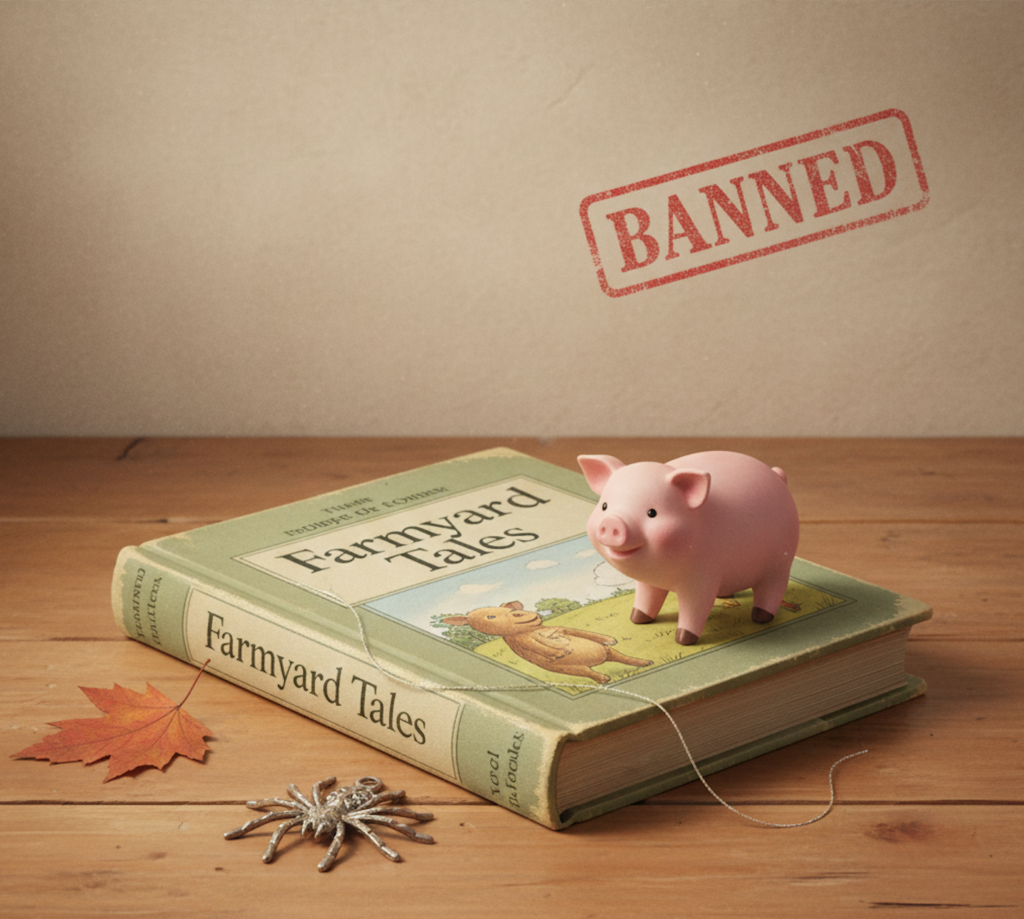
Charlotte’s Web
When a Pig and a Spider Became Philosophical Threats
There are moments in censorship history that make you question whether grown adults should be allowed near decision making rooms. One such moment arrived when Charlotte’s Web, a gentle story about friendship, loyalty and the small miracles of kindness, was declared unacceptable because the animals talked. Apparently, in certain places, a spider with a vocabulary was more frightening than an adult with none.
Yes, the book was challenged and even banned in different regions because some people believed that animals speaking like humans was unnatural, spiritually inappropriate or, strangely enough, disrespectful to human dignity. You have to admire the creativity. A children’s book about compassion was seen as a threat to the moral order. Meanwhile, actual moral failures carried on unbothered.
The book did not confuse children. It confused the adults who feared anything that softened the world.
“A pig and a spider were accused of undermining human dignity.”
Imagine the meeting. A group of officials sits in a circle. Someone opens the book, reads about Wilbur talking to Charlotte, and declares, This goes against nature. Remove it. Another nods thoughtfully, as if contemplating nuclear policy. A third person sighs in relief, convinced they have saved society from the perils of kindness and literacy.
The funniest part is that Charlotte’s Web is one of the most tender stories ever written. It is a quiet, humble celebration of friendship. Charlotte saves Wilbur not for glory, not for reward, not for praise, but simply because she believes in goodness. The book teaches children that even the smallest creature can make a difference. And somehow, this message was interpreted as an attack on the human race.
The fear was never the talking animals. The fear was what the animals were teaching.
“Compassion frightens only those who benefit from cruelty.”
Another wave of objections claimed the book dealt too openly with death. Charlotte’s passing was seen as too upsetting for children. This is charming, considering that the same children were watching cartoons where characters are flattened by falling objects, swallowed by whales and launched into the stratosphere by malfunctioning rockets. But a spider quietly dying after saving her friend? That was apparently too much.
What these censors never understood is simple. Children already know loss. They know fear. They know change. They learn empathy from stories that treat them with respect. Charlotte’s Web offers children a language for grief. It teaches that endings can be bittersweet, that memories matter, that love leaves a mark even when the one who loved you is gone.
Removing truth from a story does not protect children. It only leaves them unprepared.
“Charlotte taught children how to love. The censors taught them how to fear.”
Some bans were based on religious objections. A few groups believed that animals using language violated divine order. This interpretation is impressive in its creativity. Charlotte uses words to save a life. The censors used words to ban a book. Only one of these acts seems to violate anything sacred.
There were also claims that the book encouraged children to see animals as equals. That is an accusation E. B. White would probably have accepted as a compliment. If a child finishes the book believing that animals have feelings, thoughts and dignity, then perhaps the book has succeeded more beautifully than its critics intended.
Any society that fears empathy is already in trouble.
“If a story about kindness threatens your values, rethink your values.”
Through all of this, the most remarkable thing is the dignity with which the book itself stands. It does not shout. It does not rebel. It simply tells the truth with softness. Wilbur wants to live. Charlotte wants to help. Fern wants to understand. There is no villain except ignorance. No hero except kindness. This simplicity is precisely what makes the book dangerous to people who prefer complicated excuses to avoid responsibility.
The bans did not last long. The book’s message was stronger than any restriction. Generations continued to read it, love it, quote it and cry over it. Charlotte became immortal not because she escaped death, but because she lived with purpose. Wilbur grew strong not because he was saved, but because he learned to value goodness.
The book remains a masterclass in gentle truth.
“Charlotte’s Web survived every ban because love always outlives fear.”
Today, the story stands untouched as one of the greatest children’s books ever written. The bans, once again, survive only as footnotes under the category What were they thinking. A pig who wants to live and a spider who wants to help were never the danger.
The danger was the adults who forgot what kindness looks like.
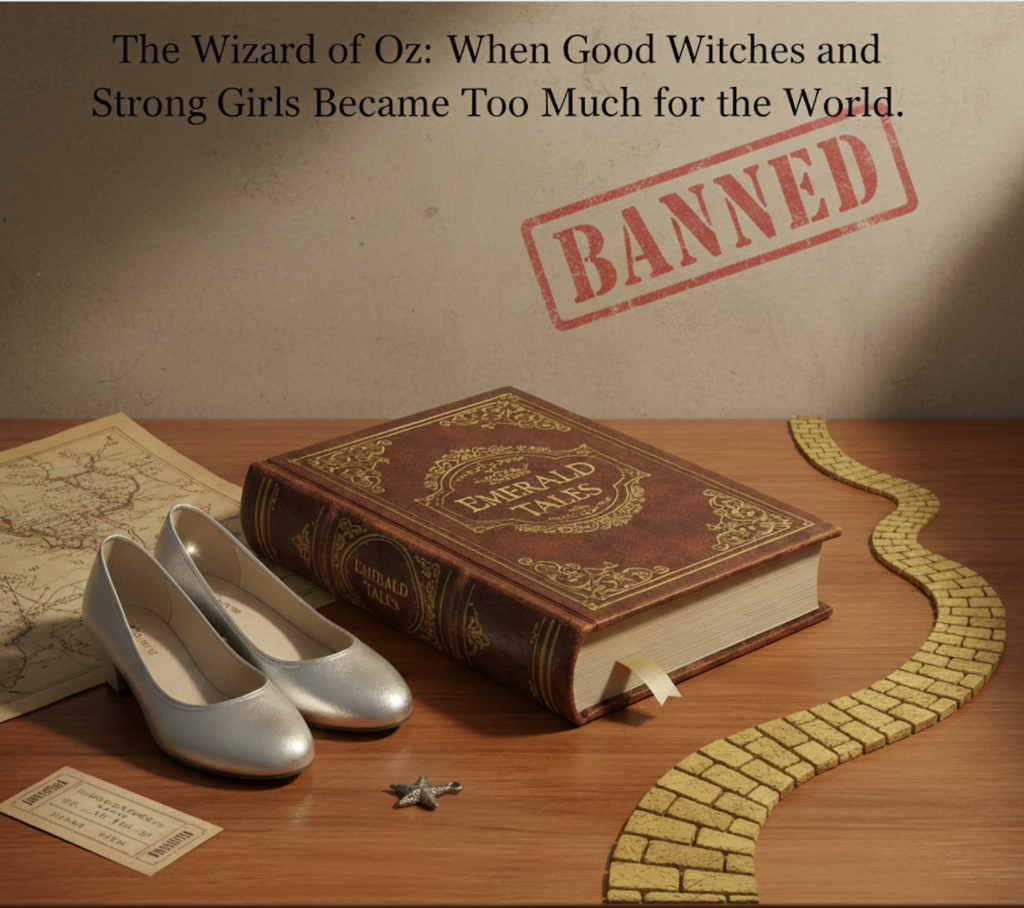
The Wizard of Oz
When Good Witches and Strong Girls Became Too Much for the World**
Some books are banned because they are bold.
Some are banned because they are misunderstood.
And then there is The Wizard of Oz, a book banned because its characters were apparently too nice to each other. Yes. A story about courage, kindness and self discovery was once considered immoral. Welcome to one of the most bizarre chapters in censorship history.
One of the earliest bans came from libraries and schools that believed the book showed women in strong and independent roles, which they considered inappropriate for children. Dorothy, a girl who stands up to danger, makes friends without prejudice and defeats villains without needing permission, was somehow seen as a threat to proper values. Imagine being so fragile that a child with a loyal dog rattles your worldview.
Dorothy was not dangerous. She was simply confident. That was the danger.
“A girl who thinks for herself frightened people who never learned how.”
Another objection came from the fact that The Wizard of Oz portrays witches who are good. According to some groups, magic in literature must be evil, or at least morally complicated. A kind witch was unacceptable. A helpful witch was even worse. People declared it theologically inappropriate. If a witch could be good, then what else might children question. Perhaps the real issue was that moral complexity terrifies people who prefer the world in black and white.
It was not magic that bothered them. It was nuance.
“The idea of a good witch upset those who feared losing control of the narrative.”
The book also faced bans for promoting values like cooperation, compassion and teamwork. Authorities argued that these themes were too soft and unrealistic. This is impressive. A world run by corrupt wizards behind curtains was apparently fine. Kindness, however, was too far. The irony is so loud it echoes.
Some even argued that the story encouraged fantasy too strongly. Children, according to these critics, might lose touch with reality if they followed Dorothy down the yellow brick road. Given that many of these same critics believed in invisible threats hiding in storybooks, the concern about imagination seems a bit misplaced.
The real fear was not fantasy. The real fear was freedom.
“A child who imagines a better world usually grows up wanting one.”
Another interesting ban came from the 1950s and 60s, when some librarians argued that the book lacked literary merit. This tells you everything you need to know about people who confuse complexity with value. Not every masterpiece is complicated. Some stories survive because they speak to the human heart directly. The Wizard of Oz is one of those stories.
Dorothy’s journey is not about escaping reality. It is about understanding it. Her companions are not caricatures. They are reflections of human longing. The Scarecrow wants wisdom. The Tin Man wants feeling. The Lion wants courage. These desires are universal. They continue to resonate long after formal critics stop frowning over booklists.
The idea that this story lacked merit is unintentionally hilarious. A tale that has inspired generations of children, artists, scholars and thinkers was dismissed because it did not fit into someone’s narrow idea of seriousness. As if seriousness is the measure of truth.
Joy is also a form of intelligence.
“If a story stays loved for a century, it needed no permission slip from critics.”
The bans reveal something deeper about the people who imposed them. They feared stories in which power is questioned. The Wizard is revealed to be ordinary. The powerful are exposed as vulnerable. The idea that authorities might not be what they seem unsettled those who depended on unearned respect.
Dorothy pulling back the curtain is one of the most iconic moments in children’s literature. It teaches children that power is not always legitimate. That authority can be challenged. That truth is not always handed politely. This lesson alone was enough to make some people uncomfortable.
The Wizard was not the only one exposed. The censors exposed themselves too.
“If a child pulling back a curtain frightens you, perhaps you fear what stands behind yours.”
Despite the scattered bans, The Wizard of Oz remained unstoppable. Children kept walking the yellow brick road. Adults kept rediscovering the truth behind its charm. The story continues to survive cultural shifts, academic debates, political climates and all the odd accusations thrown its way.
It survived because it is more than fantasy. It is hope. It is courage. It is the reminder that ordinary people can do extraordinary things when they believe in themselves. Dorothy never needed magic. She needed clarity. That is why the book frightened people who profit from confusion.
The most amusing thing about the book’s censorship is how completely it backfired. The bans made the story seem dangerous. Children love dangerous things, especially the gentle kind. Every attempt to silence the book only made readers more curious. The story became larger than its critics. That is the destiny of every tale rooted in truth.
Dorothy, Toto, the Scarecrow, the Tin Man and the Lion walk on because they belong not to institutions but to imagination. And imagination cannot be banned.
The road to Oz remains open because courage always finds its way back home.
“If The Wizard of Oz threatens your worldview, perhaps your worldview needs a better foundation.”
In the end, the critics faded. The bans faded. The story did not.
And somewhere, the yellow brick road goes on shining, refusing to be censored.
Every banned book tells two stories. One is the story inside its pages. The other is the story around its ban. And very often, the second one is far more revealing. We travelled from a gentle bear to a curious girl in Wonderland, from an orange guardian of forests to a girl writing in an attic, from a burning book to a humble pig and spider, and finally down a yellow brick road that apparently threatened entire worldviews. What we discovered along the way is strangely consistent.
Books are rarely banned because they are dangerous. They are banned because someone felt small while reading them.
“Censorship is not about protection. It is about insecurity wearing authority’s costume.”
Look closely at every ban we explored. The common thread is fear. Fear of imagination. Fear of honesty. Fear of empathy. Fear of ideas that refuse to kneel. A talking animal offended someone’s pride. A diary exposed too much truth. A fable questioned greed. A fantasy celebrated courage. A road made of bricks suggested that power is not always what it pretends to be.
The books did nothing wrong. They simply existed. They asked quiet questions. They whispered possibilities. They encouraged children to think, to feel, to wonder, to rebel against the boredom of unquestioned rules. That alone makes any fragile system nervous.
The people banning books were not protecting society. They were protecting themselves from reflection.
“A banned book is a spotlight pointed directly at the fear that banned it.”
What is even more amusing is that every ban failed in the most dramatic fashion. The books grew stronger. The audiences grew wider. The stories became cultural anchors. The censors became footnotes. For all their loud warnings and stamped paperwork, they achieved the opposite of what they intended.
Trying to stop a book is like trying to hold smoke in your hands. The tighter the grip, the faster it escapes.
Censorship has never understood one simple truth. Stories do not obey walls. They move. They travel. They enter classrooms through whisper and memory. They leap across borders. They survive in second hand copies, in digital archives, in the hearts of readers who refuse to forget what mattered. A ban can silence a shelf. It cannot silence a mind.
Every book in this scroll shares something powerful. It offered the world a new way of seeing. A softer way. A sharper way. A freer way. And that was enough to unsettle the rigid. Because once a child imagines something better, they rarely accept something lesser.
A world that fears books is a world that fears its own potential.
“When a society bans a story, it is not the story that is dangerous. It is the society that is fragile.”
And so we end this scroll where every good story ends. With clarity. With defiance. With a reminder that the true measure of a society is not what it bans but what it allows itself to learn. These books survived because truth always finds its readers. And truth, unlike authority, does not require permission to exist.
Let the censors ban what they want. Literature has outlived every one of them.
And it always will.
ABS Folds the Scroll
ABS Folds the Scroll
With the final page complete, the scroll is folded with the calm certainty that banned books have always carried. Figures in power tried to silence bears, rabbits, orange forest spirits, honest girls, smoldering pages, gentle spiders and fearless children. In the end, the only thing silenced was the credibility of those who attempted it.
The scroll is set aside, a reminder that stories remain stronger than the insecurities that try to contain them. Books do not bend. Only the systems that fear them do.
Until the next scroll opens, may the shelves stay bold and the readers stay awake.

Abha Bhardwaj Sharma is a Professor of English Literature with over 30 years of teaching experience. She is the founder of Miracle English Language and Literature Institute and the author of more than 50 books on literature, language, and self-development. Through The Literary Scholar, she shares insightful, witty, and deeply reflective explorations of world literature.
Share this post / Spread the witty word / Let the echo wander / Bookmark the brilliance