
“Where Arrogance, Ambition, Jealousy, and Indecision Share a Table”
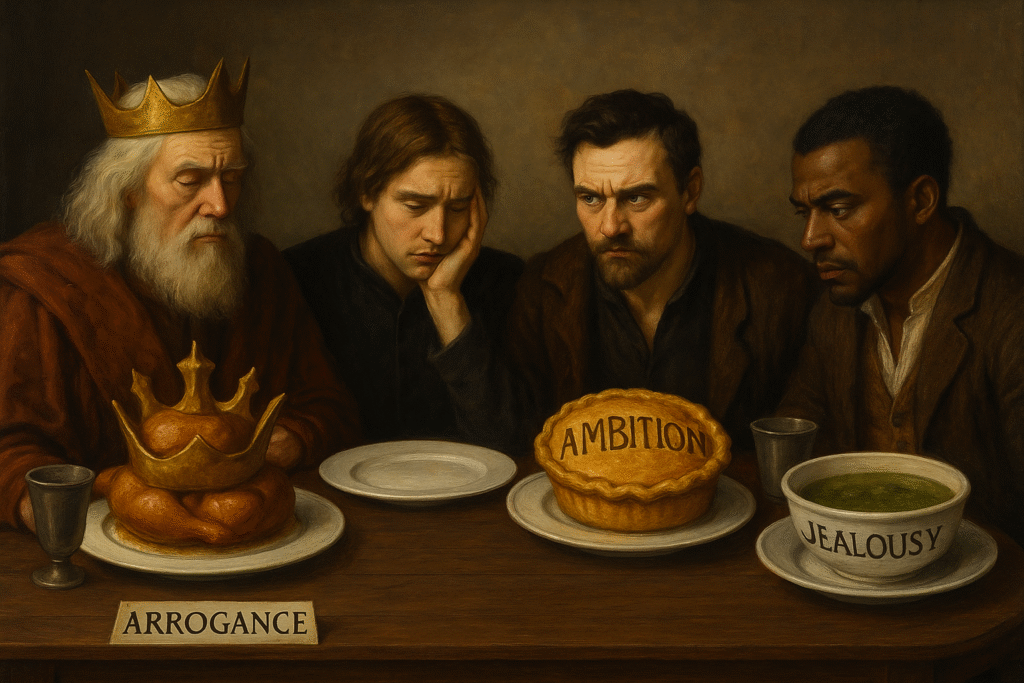
The room is candlelit, the table long, the wine poured. Aristotle, somewhere in the heavens, checks his notes and wonders whether he should have included a chapter on dinner parties in The Poetics. Tonight is no ordinary feast. Tonight, the four great tragic heroes of Shakespeare — Lear, Hamlet, Macbeth, and Othello — gather at the same table. They are joined, of course, by their obligatory sidekicks: Lear’s Fool, Hamlet’s Horatio (and a ghost hovering suspiciously behind), Macbeth’s unfortunate Banquo (already dead but refusing to miss dinner), and Othello’s Iago (who should have been banned at the door but smuggled himself in with a smile).
This is not merely a dinner. This is a tragic symposium. A roast. A masterclass in how fatal flaws can ruin not only kingdoms and marriages but also the main course.
The Guests Arrive
First through the door: King Lear, age eighty going on eighteen, still convinced the universe owes him a throne at every table. He is accompanied by the Fool, who jingles and giggles, his sarcasm sharper than any carving knife. Lear pounds his staff against the floor and bellows:
“Which of you shall we say doth love us most? The one who brings the biggest appetizer?”
The Fool mutters, “Nothing will come of nothing, sire, especially if the caterer is late.”
Next: Hamlet, Prince of Denmark, dragging his feet as if the floor were lined with existential dread. Horatio follows loyally, ready to fact-check his friend’s paranoia. Behind them, the Ghost of Hamlet’s father floats in, trying to look dignified but mostly transparent. Hamlet looks at the table and sighs:
“To eat, or not to eat, that is the question. Whether ’tis nobler in the mind to suffer the slings and arrows of outrageous hors d’oeuvres…”
Horatio whispers, “Just sit down, my lord.”
Then: Macbeth, eyes wild with ambition, already plotting whether the head seat at the table should rightfully be his. Banquo’s ghost hovers behind, sulking. Macbeth rubs his hands together and whispers:
“If chance will have me king… perhaps it will also have me get the biggest steak.”
Banquo coughs from the shadows: “Aye, but your appetite will murder sleep.”
Finally: Othello, tall, proud, suspicious eyes scanning every seat. Iago walks behind him with that oily grin that makes waiters nervous. Othello glares at the wine bottle as if it might be cheating on him with another cup.
The Table is Set
The heroes sit. The Fool sits too, though uninvited, and immediately starts pouring himself wine. Iago sidles up to Lear and whispers, “Your Fool mocks you, my lord. Should I arrange… an accident?” Lear snorts, “Out, viper. I need him more than I need daughters.”
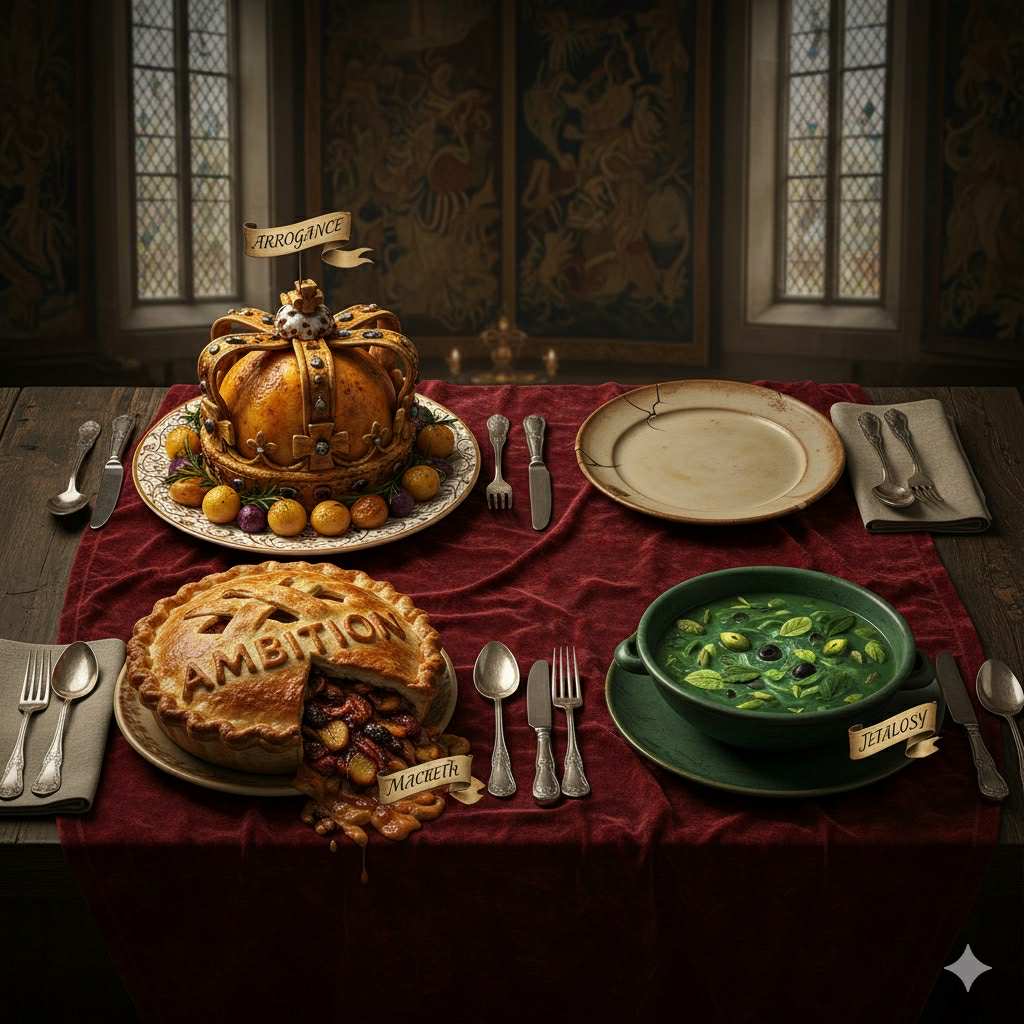
The first course arrives. The waiter trembles as he places the plates. Four men, four flaws:
Lear demands the largest portion because he is still king, crown or no crown.
Hamlet hesitates endlessly, cutting his bread into pieces while muttering about indecision.
Macbeth stares at the platter and mutters: “Is this a dagger which I see before me, its handle toward my hand?” The waiter whispers, “No sir, that’s just the carving knife.”
Othello narrows his eyes at Hamlet’s plate: “Why is his cut thicker than mine?”
Aristotle sighs from Olympus: hamartia, hamartia everywhere.
Conversation Turns Fatal (as Always)
The wine flows, and so do the flaws.
Lear, with booming arrogance, insists on retelling his story:
“I gave my kingdom away because I wanted flattery! Was that so wrong? Kings need compliments too.”
The Fool quips: “Thou shouldst not have been old till thou hadst been wise.”
Hamlet interrupts, dramatically clutching his cup:
“Oh, that this too too solid stew would melt, thaw, and resolve itself into a dew!”
Horatio: “My lord, it’s soup.”
Macbeth raises his glass nervously, sees Banquo’s ghost reflected in the wine, and screams:
“Avaunt! And quit my sight! Let the earth hide thee!”
The waiter drops a tray. Banquo, smug, replies: “This is dinner, old friend, not Dunsinane.”
Othello, meanwhile, notices Iago whispering to Hamlet and explodes:
“What dost thou whisper, villain? Dost thou teach him to seduce my wife?”
Iago feigns innocence, “I am but your loyal servant, my lord. Merely admiring Horatio’s posture.”
Aristotle’s Ghostly Lecture
At this point, one imagines Aristotle himself pulling up a chair, stroking his beard, and muttering in Greek. He takes notes:
Lear = hubris, arrogance, demanding love without deserving it.
Hamlet = indecision, thought without action, a walking seminar in procrastination.
Macbeth = ambition on steroids, sees daggers in appetizers.
Othello = jealousy weaponized, always suspecting betrayal.
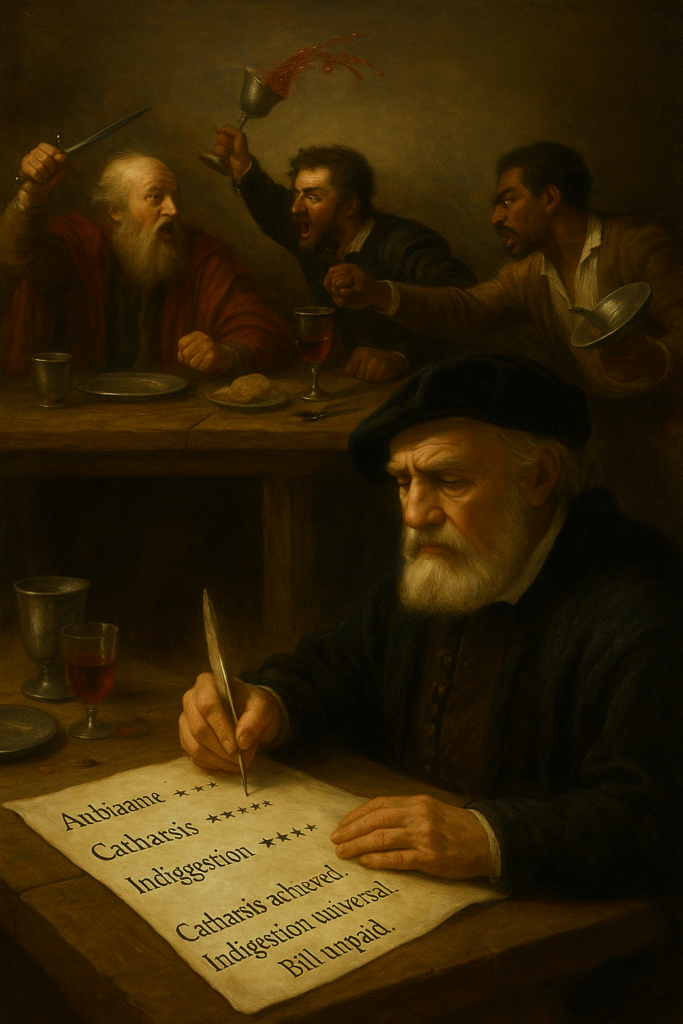
Aristotle scribbles in the margin: Catharsis? Pity and fear? At this table, mostly indigestion.
Dessert is a Disaster
By dessert, the evening collapses.
Lear insists the Fool taste his pudding first, to check for betrayal.
Hamlet refuses dessert until he has proof it exists. “What a piece of custard is man…”
Macbeth devours his tart, then panics: “Was it foretold in the prophecy that cherries would choke me?”
Othello smashes his plate, convinced Desdemona’s slice was bigger.
The Fool leaps onto the table, raises a goblet, and shouts: “Here’s a health to all our tragic flaws — may they never find therapy!”
Banquo’s ghost claps politely. Horatio buries his face in his hands. Iago smiles, calculating how to poison the leftovers.
The Aftermath
The dinner ends, not with digestion, but with destruction. The table lies overturned, the wine spilt, the heroes storming out to repeat their downfalls anew.
Aristotle closes his notebook:
“Tragedy, my friends, is not confined to the stage. Put four flawed men at a dinner table and you get the same result: pity, fear, and food poisoning.”
Closing Roast
And so, ladies and gentlemen, behold the most disastrous dinner party in literary history. If you ever doubted Aristotle, remember this: all tragedy springs from character flaws, and Shakespeare stocked his pantry with the juiciest ones. Lear’s arrogance, Hamlet’s hesitation, Macbeth’s ambition, Othello’s jealousy — together they cannot share a table without sharing their ruin.
Next time, perhaps, invite Rosalind, Beatrice, or Falstaff. At least they’d keep the party merry. But for now, we fold the scroll with laughter and leave Aristotle to pay the bill.

Abha Bhardwaj Sharma is a Professor of English Literature with over 30 years of teaching experience. She is the founder of Miracle English Language and Literature Institute and the author of more than 50 books on literature, language, and self-development. Through The Literary Scholar, she shares insightful, witty, and deeply reflective explorations of world literature.
Share this post / Spread the witty word / Let the echo wander / Bookmark the brilliance