



A literary journey through Brave New World, Island, and the mind of a writer who wondered whether humanity might one day surrender its freedom simply to feel comfortable.
What ABS believes in
ABS believes that literature should entertain the mind while quietly disturbing its furniture.
Huxley makes us laugh at a world that has mistaken convenience for happiness and obedience for peace.
His writing asks an unsettling question: what if the greatest threat to freedom is not suffering, but our willingness to avoid it?
Read him with a smile, certainly, but keep one eyebrow raised.
1. Aldous Huxley: The Intellectual Who Was Afraid We Might Get Exactly What We Want
Aldous Huxley was born into a distinguished English family, surrounded by people who valued science, scholarship, and serious conversation. In such a household, one suspects even the teapot had opinions. Huxley’s early life was marked by tragedy: a serious eye illness left him with severely impaired vision, disrupting his plans and forcing him to reconsider what kind of life he could lead. He later became a novelist, essayist, critic, and one of the most alert observers of modern civilisation. His wide-ranging curiosity made him suspicious of any single explanation for human life. Science could illuminate the world, but it could also become a rather smug authority; religion could offer meaning, but institutions could turn it into a rulebook with a locked cover. Huxley watched the modern age celebrate machines, mass production, efficiency, and progress, then asked what these achievements were doing to the inner life. He was not simply against technology or pleasure. He was interested in what happens when tools become masters and comfort becomes an unquestioned goal. His humour often comes from treating our grandest ambitions as slightly ridiculous household habits. Humanity invents extraordinary systems, he suggests, and then obediently rearranges itself to fit inside them. Huxley’s central unease was not that people might be forced to live badly, but that they might be persuaded to stop asking what a good life means.
2. Brave New World: Everyone Is Happy, So Why Does It Feel Like a Nightmare?
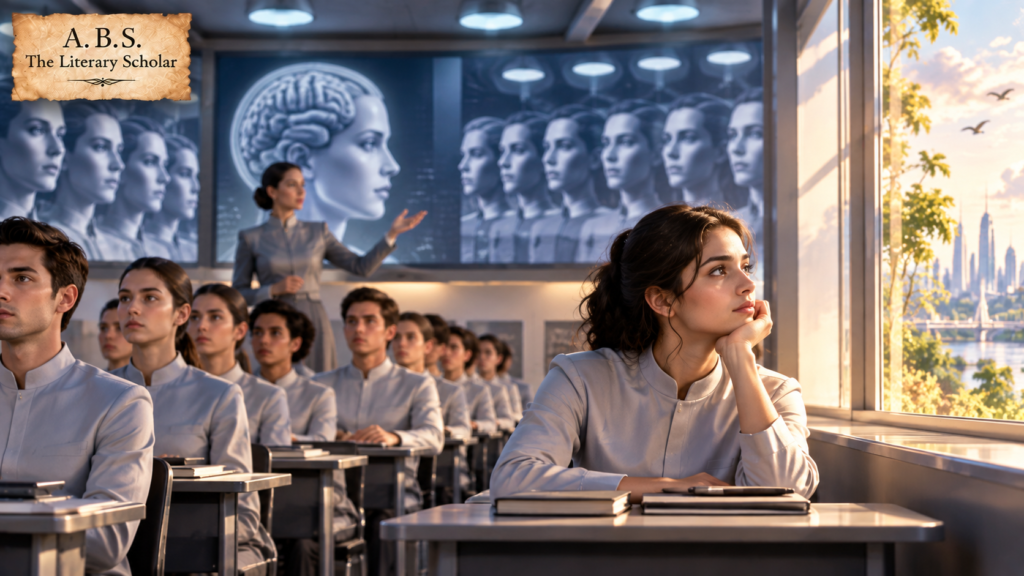
In Brave New World, Huxley imagines a society that has solved many familiar problems by preventing people from becoming fully themselves. Human beings are manufactured, sorted into castes, conditioned from childhood, and kept content through entertainment, consumption, and the convenient drug soma. Nobody needs to endure the awkward business of grief, uncertainty, or difficult thought. Feeling unhappy? Take a holiday from your feelings. Feeling lonely? Buy something. Feeling curious? How very inconvenient. The World State has made stability its highest virtue, and freedom is the price quietly deducted from everyone’s account. Huxley’s genius is to make this nightmare glitter. There are no gloomy tyrants constantly shouting orders; instead, the system offers pleasure, amusement, and ready-made opinions. It does not need to crush every independent thought if it can keep people too distracted to have one. Bernard Marx feels alienated, John the Savage arrives with a different moral vocabulary, and their discomfort exposes the emptiness beneath the polished surface. Yet Huxley does not let us settle into the comforting belief that only fictional citizens could accept such a bargain. The novel’s sharpest joke is that people may defend their own cages if the cushions are soft enough. Brave New World asks whether happiness can remain meaningful when it is manufactured, whether pleasure without choice is freedom, and whether a society can be peaceful while quietly abolishing the conditions that make human dignity possible.
3. The Huxleyan Mind: Conditioning, Desire, and the Fear of Thinking for Ourselves
Huxley was fascinated by the ways people are shaped before they realise they are being shaped. In Brave New World, conditioning begins in childhood, long before anyone can question the slogans planted in the mind. The result is a population that experiences social programming as personal preference. This is the cleverest trick of all: nobody feels controlled if the control feels like “just the way I am.” Huxley understood that human beings are not purely rational creatures who examine evidence, weigh arguments, and then calmly select a worldview. We are also creatures of habit, appetite, fear, belonging, and the desperate wish not to look foolish in front of the group. His satire therefore reaches beyond governments and institutions into the private psychology of conformity. We may laugh at citizens repeating slogans, then catch ourselves repeating a phrase because everyone around us seems to agree. Huxley’s characters often reveal how uncomfortable genuine independence can be. Thinking for oneself sounds heroic until one discovers that it may involve loneliness, uncertainty, and the unpleasant possibility of being wrong. The mind prefers a comfortable answer to an open question; it likes a neat label, a reassuring authority, and a little applause. Huxley’s warning is not that people are stupid, but that intelligence alone cannot protect us from manipulation. A clever person can build a magnificent argument around a desire they have never examined. The most effective chains, he suggests, may be the ones we polish, decorate, and proudly call our personality.
4. Beyond Brave New World: Island, Crome Yellow, and the Search for Another Way to Live
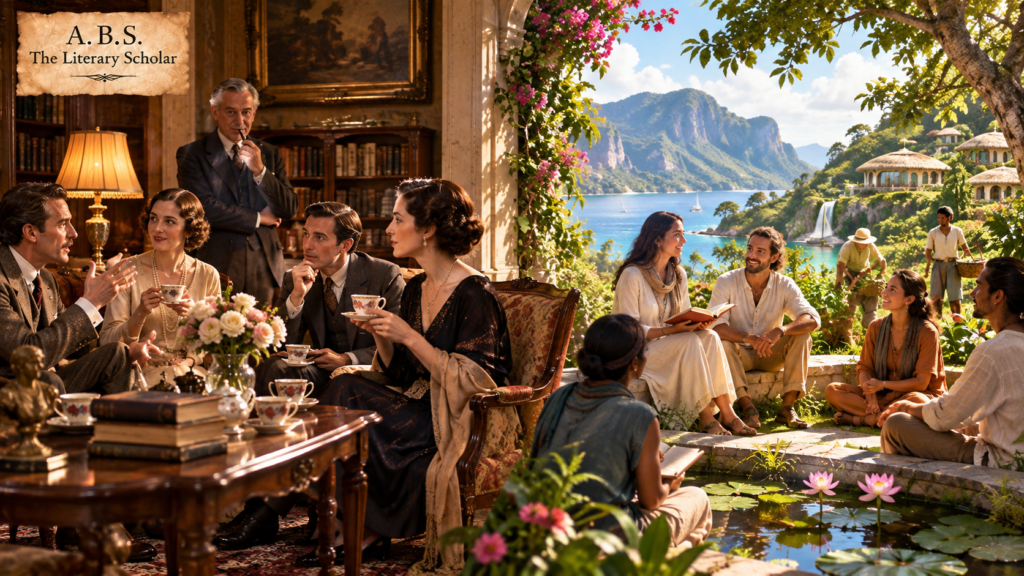
Huxley did not spend his entire career imagining societies that had gone wrong. In Crome Yellow, his early comic novel, he satirises the conversations, pretensions, and intellectual performances of fashionable people gathered at a country house. Everyone has a theory; everyone has a pose; and the room is so full of cleverness that ordinary sincerity can barely find a chair. The comedy is affectionate at times, but Huxley notices how easily intelligence becomes theatre. In Island, his final novel, he explores a contrasting possibility: a community that tries to combine practical knowledge, spiritual awareness, education, and care for human needs. Pala is not presented as a flawless paradise. It faces pressure from outside, and its ideals remain vulnerable to greed, ambition, and political calculation. That vulnerability matters. Huxley is not merely replacing one perfect blueprint with another; he is asking whether people can build a society that encourages attention rather than distraction, responsibility rather than automatic obedience. His nonfiction, including The Doors of Perception, also reflects his interest in consciousness and the limits of ordinary perception. Across these works, he returns to a persistent question: can human beings become more awake to their own lives? His answer is neither a simple yes nor a motivational poster. Awareness requires discipline, humility, and the willingness to see unpleasant truths. Utopia, in Huxley’s hands, is not a place where everyone smiles on cue. It is a difficult experiment in living more consciously.
5. Huxley’s Lasting Question: What Are We Willing to Trade for Comfort?
Huxley’s fiction remains unsettling because its central temptation is so ordinary. Most people do not wake up wishing to surrender their freedom. They want less anxiety, fewer complications, more convenience, and perhaps a day when the printer works without requiring a small religious ceremony. Huxley understood the appeal of relief. His concern was what happens when the desire to feel comfortable becomes more important than the desire to live thoughtfully. In Brave New World, people are not simply deprived of freedom; they are trained to regard freedom as an unnecessary burden. In Island, by contrast, a meaningful life requires attention, education, self-knowledge, and an acceptance that pain cannot always be edited out. These opposing worlds illuminate Huxley’s psychological insight: pleasure is not the same as fulfilment, and the absence of discomfort is not proof that life is going well. His satire works because it refuses to place the problem safely in the future. We recognise the appetite for distraction, the pressure to conform, and the habit of letting someone else decide what deserves our attention. Huxley does not ask us to reject every convenience or distrust every pleasure. He asks us to notice the bargain being offered and read the small print. What part of our independence are we exchanging? What questions have we stopped asking? And if a society promises to keep us happy, who gets to define happiness? These are not merely political questions. They are intimate questions about the shape of a human life.
ABS Folds the Scroll
Aldous Huxley leaves us with a warning wrapped in wit: a cage does not become freedom simply because it is comfortable, and a life does not become meaningful simply because it is pleasant.
Perhaps the real test is not whether we can escape every difficulty, but whether we can remain awake while living through them. ABS folds the scroll, but keeps one question open: Are we choosing the life we want, or have we simply become very comfortable with the life chosen for us?

Abha Bhardwaj Sharma is a Professor of English Literature with over 30 years of teaching experience. She is the founder of Miracle English Language and Literature Institute and the author of more than 50 books on literature, language, and self-development. Through The Literary Scholar, she shares insightful, witty, and deeply reflective explorations of world literature.
Share this post / Spread the witty word / Let the echo wander / Bookmark the brilliance
