
When a Victorian Poet Quietly Exposed the Gap Between What We Claim to Be… and What We Actually Are
ABS BELIEVES
We have mastered the performance of certainty… but forgotten the practice of truth.
Civilization evolves, but human contradiction remains stubbornly unchanged.
And somewhere between poetry and reality, we are still those “ignorant armies.”
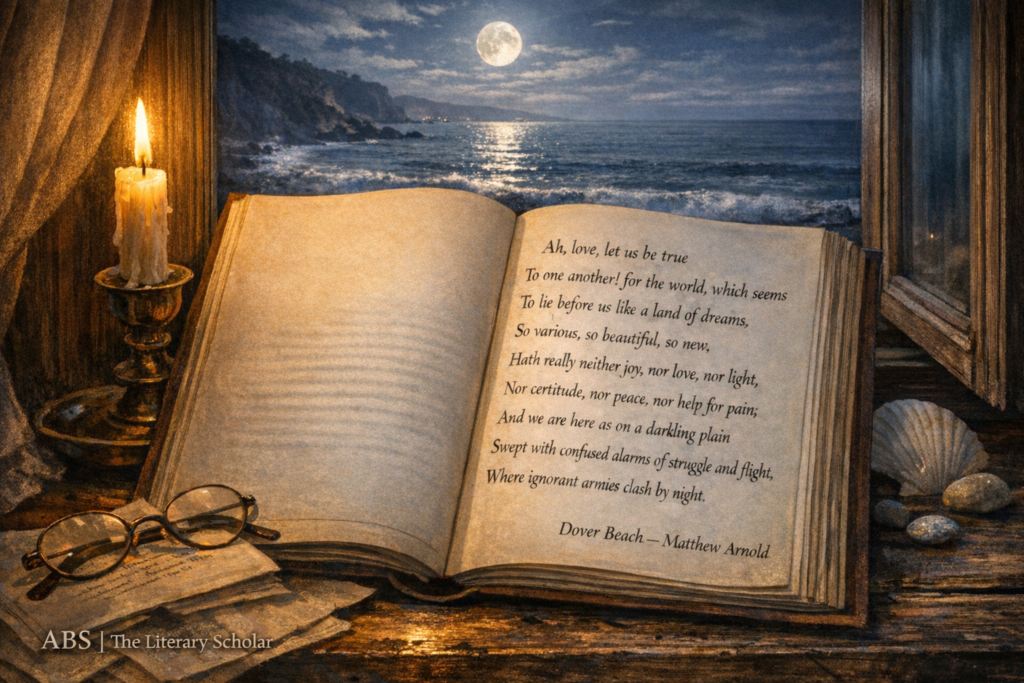
Arnold's Dover Beach analysis
Victorian England was a curious place. On the surface, it was polished—manners impeccable, morals loudly advertised, tea poured with the precision of a military operation. Beneath that polished surface, however, ran a quiet anxiety, a creeping doubt that perhaps all this “progress” was not quite as glorious as it claimed to be. Into this well-dressed discomfort walked Matthew Arnold—poet, critic, school inspector, and, one suspects, a man perpetually raising an eyebrow at society’s self-importance.
Arnold is often introduced as a “Victorian poet,” which is accurate in the same way calling a storm “a bit of weather” is accurate. Yes, he belongs to the Victorian age, but he also quietly dismantles its illusions. While his contemporaries were busy celebrating empire, industry, and moral superiority, Arnold was standing at the edge of a metaphorical shoreline, watching the tide of certainty slip away. And instead of panicking loudly, he did something far more unsettling—he wrote poetry that whispered truths people did not want to hear.
Let us begin with the famous culprit, Dover Beach. That deceptively gentle opening lures you in like a polite conversation at a formal dinner:
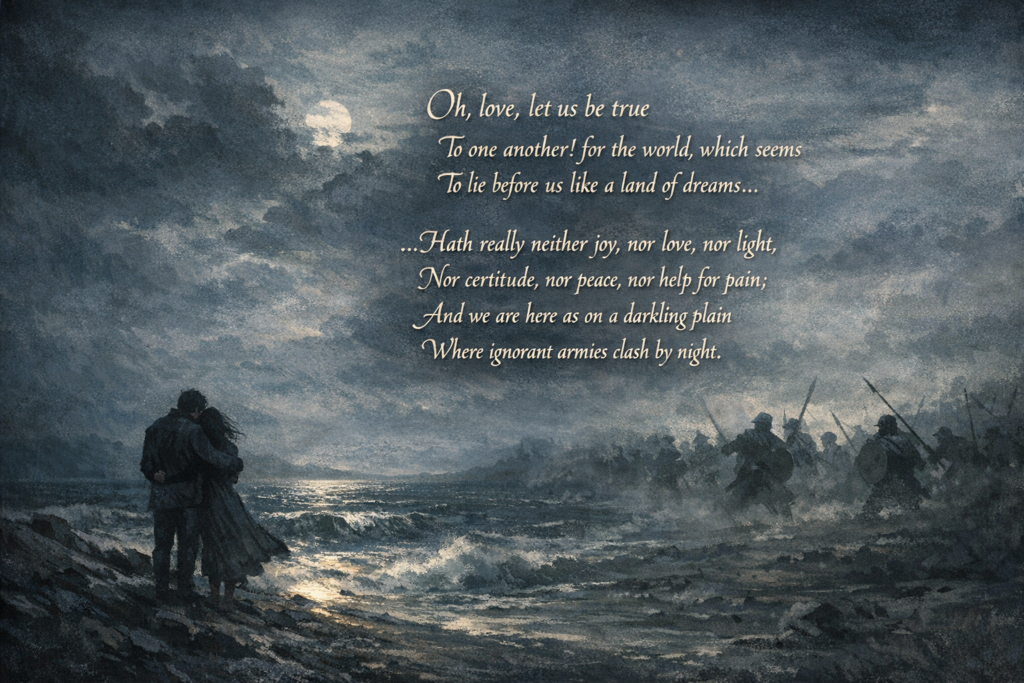
“Oh, love, let us be true
To one another!”
Ah, how tender, how romantic. One almost expects violins. But Arnold, being Arnold, refuses to let you stay comfortable. Within a few lines, the dream dissolves:
“Hath really neither joy, nor love, nor light,
Nor certitude, nor peace, nor help for pain…”
That escalated quickly.
What Arnold is doing here is not merely describing a bleak world. He is exposing a contradiction. Victorian society prided itself on certainty—religious certainty, moral certainty, cultural superiority. Arnold looks at all this and quietly says, “Really? Are you sure?” The poem ends with one of the most devastating images in English literature:
“Where ignorant armies clash by night.”
Notice the brilliance here. Not heroic armies. Not noble warriors. Ignorant armies. Fighting not for truth, not for clarity, but for confusion. Arnold essentially reduces grand narratives of power and conflict into something almost embarrassingly human—misguided, chaotic, and tragically blind.
Now, if this were all Arnold did, we could label him as merely melancholic and move on. But that would be unfair. Because Arnold is not just a poet of despair; he is a poet of diagnosis. He identifies the problem with surgical precision: humanity is excellent at pretending.
Which brings us to Victorianism itself—a grand performance of moral confidence. The Victorians believed in progress, in improvement, in the steady march of civilization. Factories roared, empires expanded, and society congratulated itself with admirable enthusiasm. Arnold, however, was not entirely convinced. He saw that beneath the machinery and manners lay a troubling emptiness—a lack of what he famously called “sweetness and light.”
Yes, Arnold the poet eventually became Arnold the critic, and when he did, he did not hold back. In essays like The Study of Poetry, he argued that poetry should not merely entertain or decorate life—it should criticize life. Not in the petty, finger-pointing way we see today, but in a deep, reflective sense. Poetry, for Arnold, was a moral and intellectual force, a way of confronting reality without the comforting lies we so lovingly construct.
And yet, here is where the irony becomes delicious.
Arnold believed in culture as a civilizing force. He advocated for refinement, for education, for intellectual depth. He genuinely thought that if people engaged with great literature, they might rise above their limitations. It is a beautiful belief. It is also, if we are being honest, slightly optimistic.
Because humanity, as Arnold himself subtly suggests, has a remarkable talent for doing the opposite of what it knows is right.
We preach truth, but practice convenience.
We celebrate morality, but negotiate it when necessary.
We admire depth, but scroll past it.
Arnold would have had a field day today.
Take his idea of culture—a pursuit of perfection through knowledge and beauty. Now place it next to modern reality, where attention spans are measured in seconds and opinions are formed before facts arrive. One can almost hear Arnold sighing across centuries.
And yet, his relevance persists. That is the uncomfortable part.
Consider The Scholar-Gipsy, another of his works, where he imagines a figure who escapes the noise and confusion of modern life in search of something more authentic. It is, in many ways, the opposite of Dover Beach. Where Dover Beach reveals chaos, The Scholar-Gipsy seeks escape from it. But the underlying message remains consistent: modern life, for all its advancements, has lost something essential.
Arnold is not shouting this from rooftops. He is observing it, almost quietly, like someone watching a party that has gone on too long and is no longer enjoyable.
What makes Arnold particularly interesting is that he does not offer easy solutions. He does not say, “Do this, and all will be well.” Instead, he suggests something far more demanding: awareness. To recognize the gap between what we claim and what we are. To see through the performance.
And that is where his sarcasm, subtle as it is, begins to shine.
Because Arnold is not mocking individuals; he is exposing patterns. The pomp of power, the illusion of control, the confidence of institutions—all gently dismantled by a poet who preferred understatement to outrage. He does not ridicule loudly; he reveals quietly. And that, in many ways, is far more effective.
If Pope laughed at society, Arnold studies it with a calm, almost unsettling clarity. If Swift attacked, Arnold observes. And in that observation lies a kind of intellectual irony that lingers long after the poem ends.
So where does that leave us?
Standing, perhaps, on our own version of that “darkling plain.” Surrounded by noise, convinced of our progress, yet not entirely certain of our direction. We have more information than ever before, and yet clarity remains elusive. We have louder voices, but not necessarily deeper understanding.
Arnold saw this coming—not in specifics, but in essence. The forms change, the technology evolves, but the human condition remains stubbornly familiar.
And so his lines endure, not as relics of a bygone age, but as mirrors held up to our own.
“Ah, love, let us be true…”
It sounds simple. It is anything but.
Because truth requires consistency. And consistency is not humanity’s strongest trait.
Arnold knew this. He did not dramatize it excessively. He simply wrote it, placed it before us, and trusted that we would recognize ourselves in it.
Whether we choose to do anything about it—that, of course, is another matter entirely.
ABS FOLDS THE SCROLL GENTLY
But the question remains open.
If the world is still a “darkling plain,” the problem is not the century.
It is the human condition.

Abha Bhardwaj Sharma is a Professor of English Literature with over 30 years of teaching experience. She is the founder of Miracle English Language and Literature Institute and the author of more than 50 books on literature, language, and self-development. Through The Literary Scholar, she shares insightful, witty, and deeply reflective explorations of world literature.
Share this post / Spread the witty word / Let the echo wander / Bookmark the brilliance